
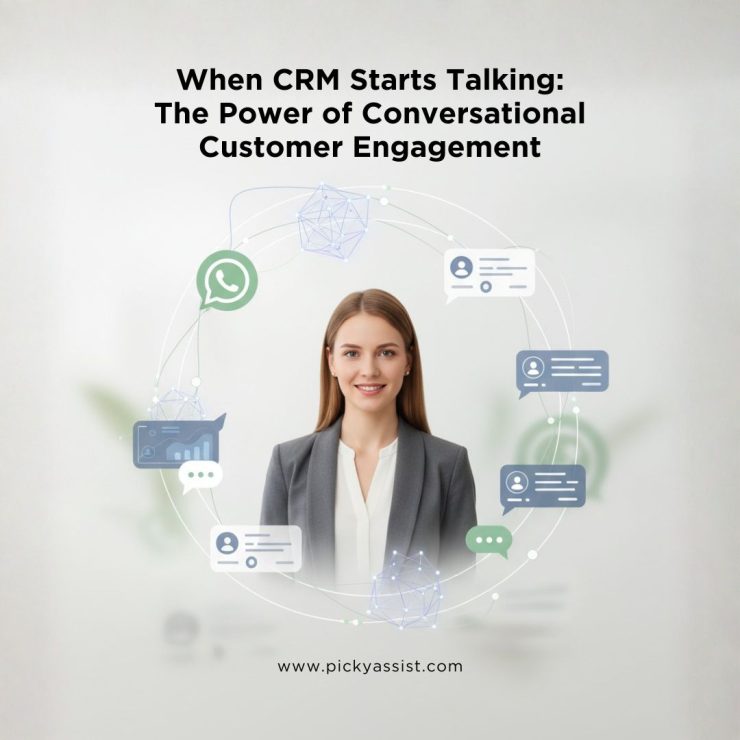
For years, businesses have invested heavily in CRM platforms with the expectation that better data would automatically translate into better customer relationships. In reality, most CRM implementations have become passive databases, updated after interactions occur, reviewed in weekly meetings, and largely invisible to customers themselves. A conversational CRM system addresses this gap by transforming CRM from a silent record-keeping tool into an active participant in customer engagement. Instead of merely storing information, it enables businesses to respond, qualify, and convert customers in real time, where conversations actually happen.
Meanwhile, customer behaviour has changed dramatically. Buyers now expect instant responses, personalised conversations, and seamless continuity across channels like WhatsApp, web chat, and social messaging. This growing mismatch between customer expectations and CRM capabilities is where traditional systems break down.
The Purpose of Traditional CRM and Why It No Longer Fits
Customer Relationship Management software was originally designed to help sales teams organise contacts, track deal stages, and forecast revenue. At the time, communication was slow and linear. Emails, phone calls, and meetings followed predictable patterns, and CRM systems simply needed to document these interactions.
However, modern customer journeys are fragmented and fast. A single prospect might initiate contact on WhatsApp, request pricing on a website chat, and expect follow-up reminders automatically. Traditional CRM software struggles in this environment because it was built to record activity, not to drive it. The result is delayed responses, disconnected touchpoints, and lost context, problems that directly impact revenue.
Why Silence Is the Biggest Weakness of Traditional CRM Systems?
A silent CRM is one that operates entirely behind the scenes. It relies on humans to update data and initiate actions. In a world where customers expect near-instant replies, this silence becomes expensive.
Research consistently shows that responding to a lead within the first five minutes can improve conversion probability by more than 400%. Yet many businesses still respond hours later because their CRM system is not connected to live conversations. When engagement tools and CRM systems operate separately, sales teams lack real-time visibility into customer intent. Opportunities are missed not because teams are unskilled, but because the system itself is slow.
Conversational CRM System as a Response to Real-Time Customer Behaviour
A conversational CRM system is designed around how customers actually communicate today. Instead of treating conversations as external inputs, it places them at the core of the CRM experience.
Every message becomes structured data. Every interaction updates the customer profile automatically. This allows businesses to see not just who the customer is, but what they want right now. The CRM no longer waits for human input, it listens, reacts, and assists in real time.
This shift fundamentally changes sales and support workflows. Teams spend less time logging data and more time acting on high-intent conversations.
The Role of Conversational AI in Modern CRM Architecture
Conversational AI is the engine that enables CRM systems to scale conversations without sacrificing quality. Rather than relying on static rules alone, AI analyses message content, intent signals, and behavioural patterns to determine the most relevant response.
Within a conversational AI CRM, this intelligence allows businesses to automatically qualify leads, route conversations to the right teams, and personalise messaging based on past interactions. Over time, the system improves as it learns from thousands of conversations.
A conversational AI powered CRM does not replace human judgment. Instead, it ensures that human effort is applied only where it adds the most value, complex queries, high-value deals, and relationship-driven conversations.
Why CRM Software Built for Emails Fails on Messaging Channels ?
Most CRM management software was designed when email was the dominant business communication channel. Messaging platforms like WhatsApp operate very differently. Conversations are shorter, faster, and more frequent. Context shifts quickly, and customers expect continuity even if they return after days or weeks.
Traditional CRM systems struggle to handle this conversational flow. Messages remain siloed in inboxes or third-party tools, while CRM records remain outdated. This fragmentation forces sales teams to jump between systems, increasing response times and reducing accuracy.
A conversational-first CRM system solves this by unifying messaging and customer data into a single operational layer.
How Picky Assist Redefines CRM for a Messaging-First World ?
Picky Assist approaches CRM from the opposite direction of traditional platforms. Instead of adapting old CRM logic to messaging, it builds the CRM experience around conversations from the ground up.
Every WhatsApp interaction is automatically captured, categorised, and linked to the customer journey. Sales and support teams can view the entire conversation history, customer intent, and engagement status without leaving the chat interface.
By integrating conversational AI with CRM software principles, Picky Assist allows businesses to automate routine interactions while maintaining a human tone. This results in faster response times, more consistent follow-ups, and higher conversion rates, without increasing headcount.
Measuring the Business Impact of Conversational CRM
The impact of conversational CRM system adoption is measurable across key business metrics. Businesses that move from silent CRM systems to conversational models typically see significant improvements in response speed, lead qualification efficiency, and customer satisfaction.
Faster engagement alone can reduce lead leakage by 20–30%. Automated qualification improves sales productivity by ensuring reps focus on high-intent prospects. Over time, consistent conversational experiences strengthen trust, increasing lifetime value and repeat purchases.
These outcomes are difficult to achieve with traditional Customer Relationship Software that treats conversations as secondary data points.
Conversational CRM System vs Traditional CRM: A Structural Shift
This is not a matter of incremental feature upgrades. The difference between conversational CRM system and traditional CRM software is architectural.
Traditional systems prioritise internal reporting and manual updates. Conversational systems prioritise live engagement and automated intelligence. One is reactive; the other is proactive. As customer expectations continue to rise, this structural difference becomes impossible to ignore.
Who Should Adopt Conversational CRM System Now ?
Businesses that rely heavily on inbound leads, time-sensitive enquiries, or relationship-driven sales benefit most from conversational CRM. This includes SaaS companies, e-commerce brands, education providers, real estate firms, and service-based businesses. For these organisations, speed and context are competitive advantages. A CRM system that cannot engage customers in real time becomes a bottleneck rather than an enabler.
Conclusion
Customer relationships today are built in conversations, not spreadsheets. A conversational CRM system aligns CRM systems with this reality by making engagement real-time, contextual, and intelligent. Silent CRMs that merely store data are no longer sufficient in a messaging-first economy. As platforms like Picky Assist demonstrate, combining conversational AI with CRM functionality allows businesses to respond faster, sell smarter, and build stronger relationships at scale. In the modern marketplace, a CRM that cannot talk is not just outdated, it is a liability.
FAQs on Conversational CRM
What is a conversational CRM?
A conversational CRM system that manages customer relationships through real-time messaging, using automation and AI to engage, qualify, and convert customers during live conversations.
Why do traditional CRM systems fail modern businesses?
Traditional CRM systems are built for data storage and reporting, not real-time engagement. This leads to slow responses, fragmented conversations, and lost opportunities.
How does conversational AI improve CRM performance?
Conversational AI enables intent detection, automated qualification, and personalised responses at scale, making CRM systems faster and more effective.
Can conversational CRM System replace existing CRM software?
In many cases, conversational CRM system can act as the primary engagement layer while syncing essential data with existing Customer Relationship Management software.
Is conversational CRM System only useful for sales teams?
No. It benefits sales, support, and marketing teams by creating a unified view of customer interactions across the entire lifecycle.
Add comment