
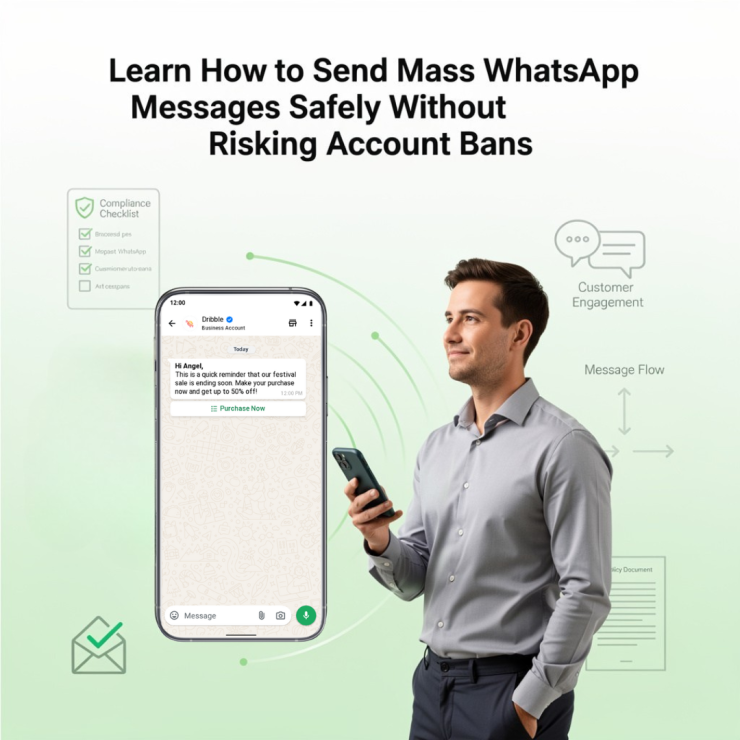
WhatsApp remains one of the most effective channels for reaching customers, with industry-leading open rates and near-instant visibility. But mass volume and urgency within a platform can be risky for our business. When businesses try to scale without the right tools and processes they face account suspension, poor deliverability, and unhappy customers. This blog explains proven, compliant methods to send mass WhatsApp messages while protecting deliverability and staying on the right side of platform and legal rules.
Why does Compliance Matter?
WhatsApp enforces strict policies to prevent spam. Data and marketing regulations (GDPR-like rules in many regions) add legal risk if you message users without consent. Done right, however, permissioned outreach can improve engagement by 40% versus untargeted blasts. That’s why companies moving from ad-hoc messaging to structured bulk WhatsApp marketing see sharply better outcomes: fewer complaints, higher reply rates and stronger brand trust.
1. Use the official WhatsApp Business Platform (API)
The safest, most scalable route is the official API. It provides:
- Template approval for outbound messages outside the 24-hour session.
- Messaging quality metrics and tiered sending limits that increase with healthy engagement.
- Programmatic sending so you can schedule notifications and integrate delivery reports into your CRM.
For organizations seeking an enterprise-grade WhatsApp mass sender, the API is the backbone. Pairing the API with a middleware simplifies template management and analytics so operations teams can focus on relevance instead of manual sends.
2. Work with a Certified Provider (a trusted WhatsApp bulk message sender)
A Certified Business Solution Provider (BSP) like Picky Assist can act as the operational layer on top of the API. They let you:
- Import contact lists from CRM and run campaigns without saving every number to a phone.
- Personalize messages at scale and route replies to agents.
- Throttle campaigns to avoid spike-triggered blocks.
If your team searches for a reliable WhatsApp bulk message sender, choose one that emphasizes opt-in capture, template governance and retry logic. That combination reduces risk and saves hours of manual work.
3. Segment, personalize and avoid one-size-fits-all blasts
Not all lists are equal. Segmenting by behaviour, geography or purchase history reduces unsubscribes and boosts ROI.
- Use tags and CRM attributes to send targeted offers.
- Personalization (even a single field like {Name} or {OrderID}) increases relevance.
- Throttle sends in batches rather than a single massive push.
In practice, a well-run bulk WhatsApp sender that supports dynamic fields and segmentation will outperform generic blasts. This is how teams transform raw bulk WhatsApp message campaigns into targeted experiences that feel personal.
4. Respect conversation windows and use templates wisely
WhatsApp allows free-form replies inside a 24-hour window after a user messages you. Outside that window, you must rely on approved templates. Smart flows mix both:
- Use templates for transactional alerts (booking confirmations, shipping updates).
- Route customer replies to agents or bots for rapid handling.
- Avoid promotional language in templates unless you have explicit consent and necessary approvals.
A good WhatsApp mass sender implementation pairs template-driven notifications with human fallbacks to handle exceptions and complex queries.
5. Build opt-in flows and progressive onboarding
Don’t import purchased lists and blast. Instead:
- Ask for consent at point-of-contact (website, POS, lead form).
- Send a short confirmation message and only add contacts who opt in.
- Run a pilot cohort to test templates and timings.
This progressive approach converts passive contacts into engaged subscribers and is the foundation of smart bulk WhatsApp marketing strategies.
6. Practical ops: send bulk without saving contacts, safely
The native WhatsApp app requires saved numbers for broadcast lists, but BSPs and the WhatsApp APIs together lets you send bulk WhatsApp messages without adding contact to a device. This capability is critical for scale, upload a CSV or sync CRM contacts, and the platform handles distribution, templates and logging. If your operational brief includes “how to send mass WhatsApp messages without manual saves,” prioritize providers that support CSV imports and campaign scheduling.
7. Tools, throttling and handling replies
A robust campaign is more than sending, it’s measuring and responding:
- Use throttling and retries to smooth delivery and stay under spam thresholds.
- Monitor delivery rates, reply rates and opt-out signals.
- Route replies directly into helpdesk or CRM so agents can follow up in the same channel.
Teams often pair a WhatsApp bulk messenger with a CRM to ensure leads created from campaigns are actioned within the required SLA.
Performance expectations and benchmarks
When done right:
- Delivery rates for permissioned campaigns are high; read rates often exceed traditional channels.
- Personalized and segmented campaigns typically show 20–40% higher response than untargeted blasts.
- Campaigns that ignore opt-in or template rules face high block rates and irreversible reputational harm.
If your KPI is conversions, prioritize segmentation and template clarity over sheer list size. A well-managed mass WhatsApp approach yields better business outcomes than a single, massive push.
Best Practices to follow before Sending Mass WhatsApp Messages
You can consider following this checklist before you send mass WhatsApp messages.
- Collect and log explicit opt-ins.
- Use approved templates for outbound messages outside reply windows.
- Segment your contact lists and personalize content.
- Throttle sends and monitors delivery.
- Provide clear opt-out instructions and honor requests immediately.
- Ensure human fallback for complex replies.
If you follow these, you’ll avoid the common pitfalls that turn a promising outreach into a compliance disaster.
What to Look for While Implementing Mass WhatsApp Messaging Tools?
When evaluating solutions, compare these capabilities: template management, CRM sync (to send mass WhatsApp messages without manual contact saves), throttling controls, reply routing, analytics, and data retention for opt-in evidence. Vendors that market as a WhatsApp bulk message sender should provide transparent SLAs and compliance workflows.
Conclusion
Mass messaging on WhatsApp offers exceptional reach, but success depends on structure, consent, and quality. Adopt the official API or certified providers, build opt-in and segmentation-first campaigns, use templates responsibly, and always pair automation with human response capability. By following these methods you can scale outreach, reduce risks and deliver measurable business results while keeping customers satisfied.
FAQs on Sending Mass WhatsApp Messages
1. What is the safest way to send mass WhatsApp messages?
Use the WhatsApp Business Platform via a certified BSP, collect explicit opt-ins, and send template-based notifications outside the 24-hour window. Throttle sends and monitors quality metrics.
2. Can I send bulk WhatsApp messages without adding contact?
Yes. With the official API and a certified provider you can upload lists and execute campaigns without saving numbers on each phone, this is standard for enterprise workflows.
3. Are free bulk WhatsApp senders safe?
Most unofficial tools violate WhatsApp’s policies and risk account suspension. Use official or certified platforms for long-term scale.
4. What is the difference between a bulk WhatsApp sender and a WhatsApp bulk messenger?
The terms are often used interchangeably, but a bulk WhatsApp sender usually emphasizes campaign dispatch, while a WhatsApp bulk messenger may include richer CRM, routing and analytics features.
5. How can small businesses start with bulk WhatsApp marketing safely?
Start with small, permissioned lists, use the WhatsApp Business App for basic broadcasts, and plan a migration to a certified provider as volume grows.
6. What happens if users report your messages as spam?
High complaint rates damage quality scores and lead to temporary or permanent restrictions. Immediately suspend problematic campaigns, investigate the opt-in pathway, and remediate.
7. How do I measure campaign success for mass text WhatsApp campaigns?
Track delivery rate, read rate, reply/engagement, CTR on links, and opt-out rate. Tie replies to CRM records to measure downstream conversions.
Add comment