
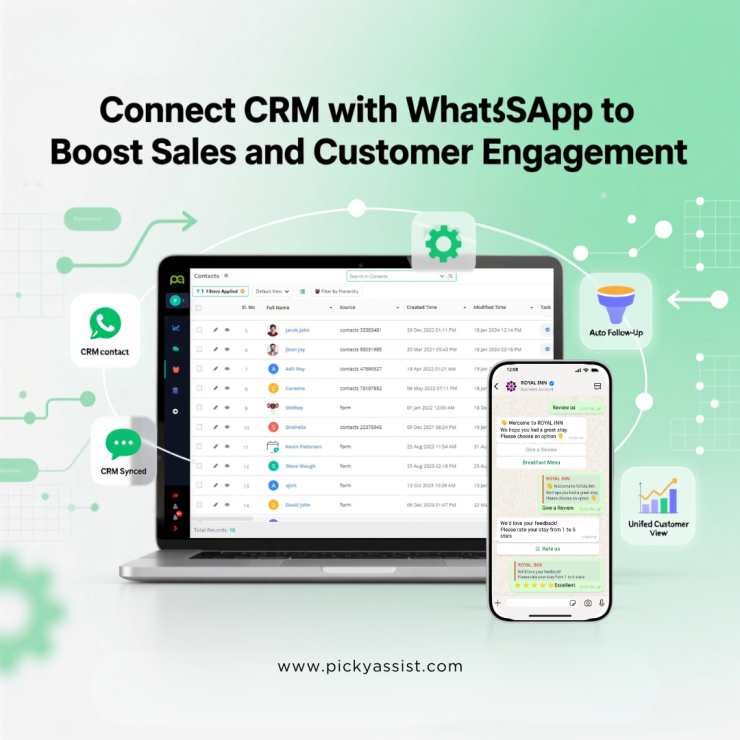
CRM with WhatsApp integration has become a critical growth enabler for businesses in 2026. As customer communication rapidly shifts from emails and calls to instant messaging, WhatsApp now dominates how Indian consumers interact with brands. Businesses that fail to integrate WhatsApp into their CRM risk slower response times, missed leads, and fragmented customer experiences.
Today, CRM is no longer just a database for contacts and deals. It is the operating system that connects conversations, automation, sales, support, and retention into a single unified workflow. When WhatsApp is integrated directly into CRM, businesses gain the ability to engage customers in real time, at scale, and with full context.
This guide explains what CRM with WhatsApp integration is, why it matters, how it works, and how businesses can use it to drive predictable growth.
What is CRM with WhatsApp Integration?
CRM with WhatsApp integration refers to a customer relationship management system that connects WhatsApp conversations directly to customer records, pipelines, and workflows.
Instead of handling WhatsApp chats manually on individual phones, businesses can:
- Capture WhatsApp leads automatically
- Assign conversations to sales or support teams
- Track chat history inside the CRM
- Automate replies, reminders, and follow-ups
- Measure conversion and engagement metrics
This integration transforms WhatsApp from a simple messaging app into a structured business communication channel.
Why WhatsApp Integration in CRM is Essential in 2026
India is a WhatsApp-first market. Customers expect fast, conversational responses not delayed email replies.
Key reasons why there is a high demand:
- WhatsApp has higher open and response rates than email
- Customers prefer chat over calls and forms
- Businesses handle leads across multiple channels
- Manual follow-ups lead to revenue leakage
- Teams need visibility and accountability
A WhatsApp-enabled CRM ensures that every message, follow-up, and interaction is tracked and acted upon systematically.
Problems with Managing WhatsApp Without CRM
Many businesses still manage WhatsApp conversations manually. This approach fails as volume grows.
Common challenges:
- Missed or delayed replies
- No ownership of conversations
- No follow-up reminders
- Customer data scattered across devices
- Zero reporting or performance visibility
CRM eliminates these issues by centralizing communication and automating engagement.
How CRM with WhatsApp Integration Works
A WhatsApp-integrated CRM typically works through the WhatsApp Business API and automation workflows.
Core workflow:
- A customer sends a WhatsApp message or clicks a Click-to-WhatsApp ad
- The message enters a shared CRM inbox
- Lead data is automatically captured
- The chat is assigned to the right team member
- Automated responses or chatbots handle first interaction
- Follow-ups, reminders, and tasks are triggered
- Full chat history is stored against the contact record
This creates a seamless, trackable customer journey.
Key Features of a CRM with WhatsApp
A modern CRM system with WhatsApp integration should offer more than basic messaging.
Essential features include:
- Shared WhatsApp team inbox
- Automated chat assignment
- No-code chatbot and flow builder
- Lead capture and tagging
- WhatsApp broadcast and campaigns
- Payment links and reminders
- Complete chat history and CRM records
- Analytics and performance reporting
The deeper the automation, the higher the scalability.
Benefits of CRM with WhatsApp Integration
1. Faster Lead Response Time
Instant replies improve conversion rates and customer trust.
2. Higher Lead Conversion
Contextual conversations lead to better qualification and closing.
3. Centralized Customer Data
Every interaction is stored in one system, accessible to all teams.
4. Automated Follow-Ups
No lead is forgotten, even at high volume.
5. Improved Customer Experience
Personalized, timely communication builds long-term relationships.
Who Should Use CRM with WhatsApp Integration?
Common use cases:
- D2C and e-commerce brands
- EdTech and coaching institutes
- Real estate and property consultants
- BFSI and insurance companies
- SaaS and service businesses
- Manufacturing and distributor networks
WhatsApp CRM vs Traditional CRM
| Traditional CRM | CRM with WhatsApp Integration |
|---|---|
| Email and call focused | Chat-first communication |
| Manual follow-ups | Automated journeys |
| Slower responses | Real-time engagement |
| Limited visibility | Full conversation history |
| Lower retention | Higher repeat revenue |
How to Choose the Right CRM with WhatsApp Integration
When selecting a CRM with built-in WhatsApp, consider:
- Native WhatsApp Business API support
- Depth of automation and chatbot capabilities
- Shared inbox and team collaboration
- Integration with ads, payments, and tools
- Scalability and pricing
- Data security and compliance
The right CRM should support your customer journey end-to-end.
Future of CRM with WhatsApp Integration
Emerging trends include:
- AI chatbots handling complex queries
- Predictive follow-up recommendations
- WhatsApp-based customer journeys
- Deeper personalization at scale
- Unified sales, marketing, and support dashboards
Final Thoughts
CRM with built-in WhatsApp is no longer a competitive advantage, it is a business necessity. As customer expectations continue to shift toward instant, conversational engagement, companies that unify WhatsApp with CRM will outperform those relying on manual or fragmented systems.
The future belongs to businesses that manage conversations as strategically as they manage data.
FAQs on CRM with WhatsApp Integration
What is CRM with WhatsApp integration?
CRM with built-in WhatsApp is a system that connects WhatsApp conversations directly with customer data, sales pipelines, and automation workflows, enabling centralized and scalable communication.
Why is WhatsApp integration important for CRM?
WhatsApp offers higher engagement than email or calls. Integrating it with CRM ensures faster responses, better tracking, automated follow-ups, and improved customer experience.
Can small businesses use CRM with WhatsApp integration?
Yes. Many CRM platforms offer affordable or free plans, making WhatsApp-integrated CRM accessible for startups and small businesses.
Is WhatsApp Business API required for CRM integration?
Yes. Most CRM systems use the official WhatsApp Business API to enable automation, shared inboxes, and compliance.
How does CRM with built-in WhatsApp improve sales?
It reduces response time, automates follow-ups, improves lead qualification, and maintains full conversation context, leading to higher conversion rates.
Can CRM with built-in WhatsApp support customer service?
Absolutely. Support teams can manage tickets, respond faster, track issues, and maintain conversation history directly inside the CRM.
Is CRM with built-in WhatsApp secure?
Reputable platforms follow WhatsApp API guidelines, data encryption standards, and compliance protocols to ensure secure communication.
Add comment