
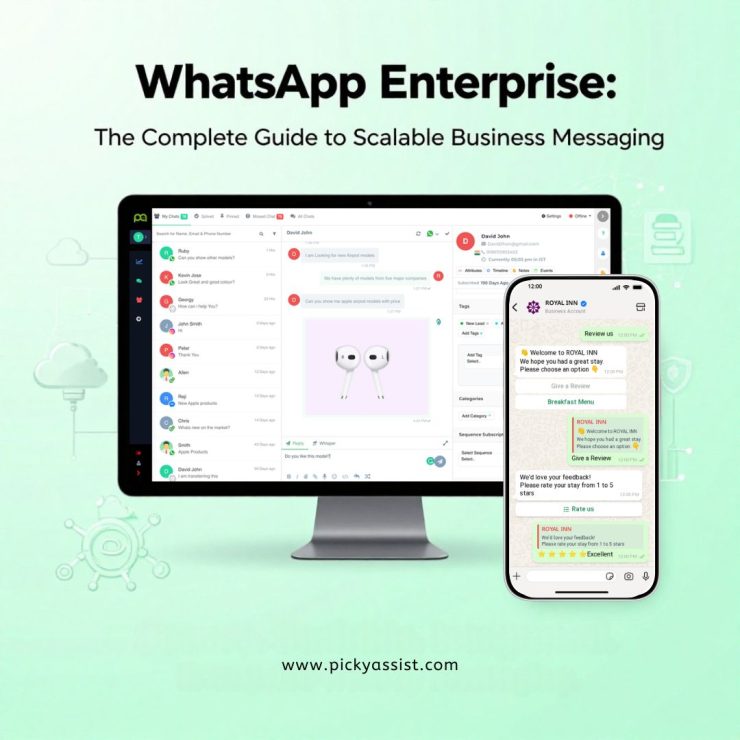
Digital communication has shifted permanently toward instant messaging. Email open rates are declining, phone calls are often ignored, and customers expect real-time responses on familiar platforms. This shift has positioned WhatsApp enterprise as a mission-critical channel for modern organizations.
Enterprises today require more than a simple chat app. They need secure, scalable, automated, and CRM-integrated communication infrastructure. This is where enterprise solutions become central to customer engagement, sales acceleration, and operational efficiency.
This in-depth guide explains what WhatsApp enterprise is, how it works, enterprise use cases, pricing structures, integration capabilities, compliance considerations, and how large organizations can deploy it successfully.
What is WhatsApp Enterprise?
WhatsApp enterprise refers to the enterprise-grade implementation of WhatsApp designed for medium and large businesses that require automation, multi-agent support, system integrations, and API-based messaging at scale.
Unlike the standard WhatsApp Business App, WhatsApp for enterprise businesses operates through the WhatsApp Business Platform (API). This enables:
- Automated workflows
- CRM and ERP integrations
- Multi-user access
- Campaign broadcasting
- Chatbot deployment
- Advanced analytics
WhatsApp Business Enterprise vs WhatsApp Business App
Many organizations confuse the WhatsApp Business App with WhatsApp business capabilities. The differences are substantial.
The Business App is suitable for small businesses that manage limited conversations manually. It supports one primary device and limited automation.
In contrast, WhatsApp business is built for structured workflows, cross-department collaboration, compliance logging, and customer lifecycle management. It connects with CRM systems, helpdesk tools, payment gateways, marketing automation platforms, and AI chatbots.
Enterprises cannot rely on manual chat handling. They need orchestration.
How WhatsApp Enterprise Works?
WhatsApp solutions operate through the official WhatsApp Business Platform (API). Businesses must apply via an authorized Business Solution Provider (BSPs) like Picky Assist.
The architecture typically includes:
- WhatsApp Business API access
- Cloud or on-premise hosting
- Integration layer (CRM, ERP, marketing tools)
- Automation layer (chatbots, workflows)
- Agent dashboard or shared inbox
Messages are categorized into two main types:
- User-initiated conversations (customer starts chat)
- Business-initiated conversations (template-based notifications)
This structure allows enterprises to manage transactional alerts, promotional campaigns, support tickets, and service reminders in a compliant format.
Why WhatsApp for Enterprise Businesses Is Growing Rapidly?
Customer behavior drives this adoption. Over 2 billion users actively use WhatsApp globally. Enterprises are following where customers already are.
- Higher engagement rates compared to email
- Real-time communication
- End-to-end encryption
- Verified business profiles
- Faster sales cycles
- Lower customer acquisition costs
Enterprises in banking, e-commerce, education, healthcare, and logistics increasingly deploy WhatsApp business messaging service models to centralize communication.
Core Features of WhatsApp Enterprise Solutions
1. Multi-Agent Access and Role-Based Controls
Enterprise dashboards allow multiple team members to handle conversations simultaneously. Access can be segmented by department; sales, support, billing, and marketing.
2. CRM and ERP Integration
WhatsApp integrates with Salesforce, HubSpot, Zoho, SAP, and other systems. This ensures customer context, order history, and transaction data are available inside chat workflows.
3. Automation and AI Chatbots
Chatbots handle FAQs, appointment booking, order tracking, and qualification flows. AI-driven systems reduce support workload and improve response times.
4. Broadcast Messaging at Scale
WhatsApp business supports structured broadcast campaigns through pre-approved templates. These include offers, reminders, alerts, and updates.
5. Analytics and Reporting
Enterprises can track delivery rates, read receipts, response times, campaign ROI, and agent productivity.
6. Security and Compliance
End-to-end encryption ensures privacy. Enterprises can configure data hosting, retention policies, and regulatory compliance frameworks.
Use Cases
Customer Support Automation
Companies deploy WhatsApp solutions to automate ticketing systems, enable intelligent routing, and reduce call center dependency.
Sales Funnel Acceleration
Sales teams use WhatsApp business messaging service tools for lead qualification, follow-ups, and automated reminders.
Order Updates and Notifications
E-commerce and logistics companies use WhatsApp business for real-time delivery notifications and transactional alerts.
Appointment and Booking Management
Healthcare and service industries use WhatsApp for businesses to confirm appointments and reduce no-shows.
Financial Alerts and Account Notifications
Banks and fintech companies use WhatsApp for secure account communication and fraud alerts.
Pricing Explained
Costs vary depending on:
- Country of the recipient
- Conversation category (utility, authentication, marketing, service)
- Volume of messages
- Business Solution Provider pricing
In addition to WhatsApp’s base conversation charges, enterprises may pay:
- Platform subscription fees
- Integration costs
- Chatbot development costs
- CRM licensing fees
Pricing structures can scale efficiently when implemented correctly, especially compared to traditional call center expenses.
WhatsApp Business Messaging Service: Deployment Models
There are two primary deployment models:
Cloud API (Meta Hosted)
- Faster setup
- Lower infrastructure overhead
- Ideal for most enterprises
On-Premise API
- More control
- Custom infrastructure
- Used by highly regulated industries
Most modern enterprises prefer the Cloud API for agility and scalability.
How to Implement It Successfully?
A structured approach ensures success.
Step 1: Define Business Objectives
Clarify whether the goal is sales growth, support automation, customer retention, or operational efficiency.
Step 2: Choose a Certified Provider
Select a trusted provider offering scalable WhatsApp solutions with CRM integration capabilities.
Step 3: Map Workflows
Design conversation journeys; onboarding, support, escalation, retention.
Step 4: Deploy Automation
Implement AI chatbots and routing systems to minimize manual effort.
Step 5: Monitor and Optimize
Track engagement metrics, ROI, and performance regularly.
WhatsApp Enterprise vs Traditional Communication Channels
Traditional channels like email and voice calls lack immediacy and engagement.
- Instant visibility
- Higher open rates
- Interactive media support
- Two-way conversational engagement
The shift toward conversational commerce makes WhatsApp for enterprise businesses strategically critical.
Industries Benefiting from WhatsApp Solutions
- Banking and Financial Services
- E-commerce and Retail
- Real Estate
- Healthcare
- Travel and Hospitality
- Education
- Insurance
These sectors rely heavily on high-volume communication and benefit significantly from automation and personalization.
Security and Data Governance
Security is central to enterprise adoption.
- End-to-end encryption
- Verified business accounts
- Two-factor authentication
- Controlled API access
- Data hosting compliance
Enterprises must also align with GDPR, local telecom regulations, and internal IT policies.
Future of WhatsApp Enterprise
- AI-powered conversational agents
- Hyper-personalized marketing automation
- Integrated payment flows
- Omnichannel messaging platforms
- Advanced conversational analytics
Enterprises that adopt early and implement strategically will gain competitive advantage in customer engagement.
WhatsApp enables automation, integration, personalization, and measurable ROI. While WhatsApp enterprise pricing depends on usage and provider structure, the return on investment typically outweighs traditional communication costs.
Organizations leveraging WhatsApp business capabilities see improved response rates, faster sales cycles, and reduced operational overhead.
FAQ on WhatsApp Enterprise
1. What is WhatsApp enterprise?
WhatsApp enterprise refers to the enterprise-grade implementation of the WhatsApp Business Platform API, enabling automation, CRM integration, and scalable messaging for large businesses.
2. How is WhatsApp business enterprise different from the Business App?
The Business App supports small-scale manual messaging. WhatsApp business enterprise supports API integration, automation, and multi-agent workflows.
3. What is WhatsApp enterprise pricing based on?
WhatsApp enterprise pricing is conversation-based and varies by country, message type, and provider fees.
4. Can WhatsApp enterprise integrate with CRM systems?
Yes. WhatsApp enterprise solutions integrate with CRM, ERP, and marketing automation platforms.
5. Is WhatsApp enterprise secure?
Yes. It uses end-to-end encryption and enterprise-level security controls.
Add comment