
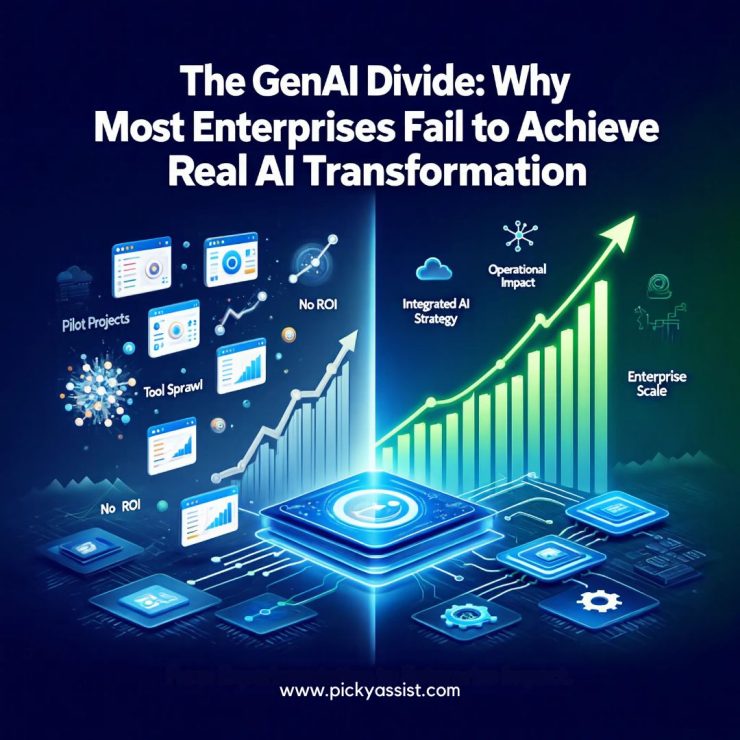
Enterprise enthusiasm for generative AI has never been higher. Boards are allocating budgets, CIOs are launching pilots, and employees are experimenting daily with large language models. Yet a stark pattern has emerged: widespread adoption does not equal measurable business transformation. This growing gap between experimentation and economic impact is what many analysts now describe as the GenAI Divide.
Despite billions invested into AI Next Gen initiatives, only a small minority of organizations are extracting significant profit-and-loss impact. The rest remain stuck in pilot mode, running proofs of concept that improve individual productivity but fail to alter workflows, cost structures, or revenue models. Understanding this divide is critical for organizations navigating the next generation of Artificial Intelligence.
What is the GenAI Divide?
The GenAI Divide refers to the widening gap between companies that are experimenting with generative AI tools and those that are achieving meaningful operational or financial transformation.
On one side of the divide:
- Organizations deploy chat-based tools for drafting, summarizing, and ideation.
- Employees report higher productivity.
- Pilots generate enthusiasm but little structural change.
On the other side:
- AI systems are embedded into core workflows.
- Automation replaces external spend such as BPO contracts.
- Customer conversion, retention, or cost metrics show measurable improvement.
The difference is not model quality alone. It is not regulation, talent shortage, or compute constraints. The defining factor is approach, how organizations integrate and evolve AI systems within operational processes.
High Adoption, Low Transformation: The Illusion of Progress
More than 80% of enterprises have explored tools like ChatGPT or Copilot-style assistants. Nearly 40% report some form of deployment. On paper, that appears impressive.
However, most of these deployments sit at the “individual productivity” layer:
- Drafting emails faster
- Generating meeting summaries
- Producing marketing copy
- Assisting with lightweight analysis
While useful, these applications rarely move enterprise P&L metrics. They enhance output per employee but do not fundamentally change workflows, cost structures, or customer journeys. Meanwhile, custom-built or enterprise-grade AI solutions show a dramatic drop-off:
- Many are evaluated
- Fewer reach pilot stage
- Only a small fraction reach production
This pilot-to-production chasm defines the GenAI Divide. Organizations invest in tools but fail to operationalize them at scale.
Why Most GenAI Pilots Stall?
1. Brittle Workflow Integration
Many AI tools operate as external overlays rather than embedded systems. If a tool does not integrate seamlessly with CRM systems, ERP platforms, or internal dashboards, adoption declines rapidly. Employees revert to manual processes or consumer-grade tools because they are faster and more flexible.
2. Lack of Persistent Learning
A recurring complaint from enterprise users is that most systems do not retain feedback or adapt to context. They require repeated prompting and manual context input. For mission-critical workflows, legal reviews, financial approvals, compliance checks; this limitation is unacceptable. The next generation of Artificial Intelligence must move beyond static outputs toward systems that learn from past interactions.
3. Misalignment with Day-to-Day Operations
Many vendors demonstrate polished demos but fail to understand internal approval chains, data flows, or operational constraints. Without workflow alignment, AI remains peripheral. This learning gap, where systems fail to adapt to organizational context, is the central structural barrier keeping companies on the wrong side of the divide.
Industry Impact: Why Only a Few Sectors Show Real Disruption
Despite media attention, only a small number of sectors show signs of structural transformation.
Technology and Media have experienced:
- AI-native challengers
- Shifts in content production models
- Developer workflow disruption
Other industries, such as healthcare, advanced manufacturing, energy, and financial services; show heavy experimentation but minimal structural change. This suggests that visibility of AI does not equal industry-level disruption. The GenAI Divide is measurable not by press coverage but by shifts in market share, cost structure, and user behavior.
The Shadow AI Economy: Employees Cross the Divide First
An unexpected insight emerges when examining employee behavior. While official enterprise AI initiatives struggle, individual employees often use personal AI subscriptions daily. This “shadow AI economy” frequently generates more measurable productivity gains than formal deployments.
Employees prefer flexible tools that:
- Feel intuitive
- Provide rapid iteration
- Deliver immediate value
However, these tools fail in high-stakes workflows because they lack persistent memory, structured integration, and compliance guardrails. The lesson is clear! AI Next Gen adoption succeeds when tools combine consumer-grade usability with enterprise-grade integration and learning capability.
Investment Bias: Why Budgets Go to the Wrong Functions
A large share of AI spending flows into sales and marketing functions. These areas offer visible, board-friendly metrics such as:
- Increased lead volume
- Faster email response rates
- Improved content velocity
Yet some of the strongest ROI cases appear in back-office automation:
- Reduced BPO costs
- Lower agency spending
- Faster document processing
- Improved compliance efficiency
The GenAI Divide persists partly because investment gravitates toward visible use cases rather than high-impact operational transformations.
Build vs. Buy: The Strategic Divide
Organizations that attempt to build AI systems internally often face higher failure rates than those partnering with specialized vendors.
Internal builds struggle due to:
- Resource constraints
- Integration complexity
- Slow iteration cycles
Strategic partnerships, particularly those focused on domain-specific customization, show higher deployment success rates. The most effective implementations treat AI vendors more like operational partners than SaaS providers. This approach reflects a deeper understanding of Nextgen AI as a co-evolution process rather than a software installation.
What Crossing the GenAI Divide Looks Like
The next generation of Artificial Intelligence is not about generalized capability, it is about embedded, learning-capable systems that evolve within defined processes. Organizations that cross the divide share several traits:
- They start with narrow, high-value workflows rather than broad transformation mandates.
- They demand systems that learn and adapt over time.
- They measure success using business outcomes, not model benchmarks.
- They empower frontline managers to lead adoption.
Workforce Impact: Reality vs. Hype
Contrary to popular narratives, widespread job displacement has not materialized across most sectors. Where impact is visible:
- Customer support operations
- Administrative processing
- Standardized content production
- Certain engineering tasks
Even in these cases, workforce changes are gradual and concentrated in functions historically outsourced or standardized. The primary financial benefit has come from reducing external spend rather than cutting internal teams.
The Rise of Agentic Systems and AI Next Gen Infrastructure
Emerging frameworks enable systems to:
- Maintain persistent memory
- Coordinate across platforms
- Adapt based on feedback loops
This shift moves organizations from prompt-based tools toward agentic systems capable of orchestrating workflows autonomously. The GenAI Divide will increasingly separate companies using static copilots from those deploying adaptive, learning-enabled infrastructures that resemble AI Next Gen ecosystems.
The Narrowing Window for Competitive Advantage
Enterprise procurement cycles suggest that vendor relationships formed over the next 12–24 months may become deeply embedded.
As systems accumulate proprietary workflow data and organizational context, switching costs rise. Companies that invest early in learning-capable platforms create compounding advantages. The GenAI Divide is therefore not static, it widens over time.
Bridging the GenAI Divide in the Era of Nextgen AI
The GenAI Divide is not a temporary anomaly. It reflects a structural mismatch between how organizations experiment with AI and how meaningful transformation actually occurs.
High adoption alone does not guarantee disruption. Productivity gains do not equal P&L impact. Flashy demos do not replace deep workflow integration.
Organizations that succeed:
- Buy rather than overbuild
- Integrate deeply rather than overlay superficially
- Focus on operational outcomes rather than model novelty
- Prioritize systems that learn and adapt
The next generation of Artificial Intelligence will not be defined by larger models alone. It will be defined by adaptive systems embedded into daily operations, capable of retaining feedback, evolving with context, and delivering sustained business impact.
Crossing the GenAI Divide requires strategic discipline, organizational redesign, and long-term vendor alignment. Those who make that shift early will shape the competitive landscape of AI Next Gen markets.
FAQs on GenAI Divide
1. What is the GenAI Divide in simple terms?
The GenAI Divide refers to the gap between organizations experimenting with generative AI and those achieving measurable business transformation and ROI.
2. Why do most GenAI projects fail to reach production?
Most stall due to poor workflow integration, lack of persistent learning, misalignment with operational processes, and unclear business metrics.
3. Is the GenAI Divide caused by weak AI models?
No. The primary barrier is not model quality but the absence of systems that adapt, learn, and integrate into enterprise workflows.
4. Which industries show the most disruption?
Technology and media sectors show clearer structural shifts. Many traditional industries remain in pilot-heavy but transformation-light stages.
5. Are enterprises slow to adopt AI?
No. Enterprises actively explore AI solutions. The challenge lies in scaling pilots into embedded systems.
6. Does generative AI cause mass layoffs?
Broad-based layoffs have not materialized. Workforce impact is selective and often tied to outsourced or standardized functions.
7. Should companies build AI internally or partner externally?
Evidence suggests that strategic partnerships focused on domain-specific customization have higher success rates than purely internal builds.
8. Where does the highest ROI from AI typically occur?
Back-office automation and reduction of external spending often yield stronger and faster ROI than front-office use cases.
9. What defines successful AI Next Gen implementations?
Systems that retain memory, adapt to feedback, integrate deeply into workflows, and are evaluated based on business outcomes.
10. How can organizations cross the GenAI Divide?
By prioritizing workflow integration, selecting learning-capable systems, empowering frontline adoption, and focusing on measurable economic impact rather than experimental pilots.


Add comment