
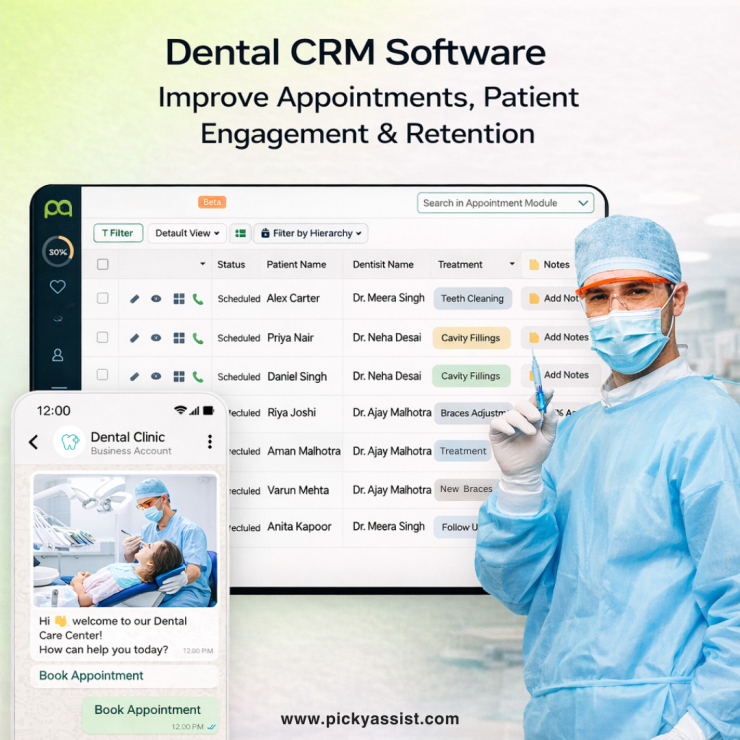
A patient walks into your clinic, completes a successful treatment, thanks you, and leaves. Clinically, the job is done. Most dental practices assume outcomes will happen naturally. In reality, they don’t. This is where the gap exists, not in treatment quality, but in patient engagement. And this gap is precisely what dental CRM software is designed to solve.
Operationally, the real journey begins when.
- The patient returns for a follow-up visit
- The next cleaning appointment or consultation is scheduled in your clinic
- And when someone asks for a recommendation, they suggest your clinic
Today’s dental clinics are no longer competing only on expertise. They are competing on responsiveness, convenience, and continuity of care. Patients expect reminders, quick replies, and seamless communication. If they don’t get it from you, they will find a clinic that offers it.
This guide goes beyond surface-level explanations. It will help you understand how a dental CRM transforms practice operationally, where traditional systems fall short, and how a solution like Picky Assist fits naturally into this ecosystem without disrupting your existing setup.
What is Dental CRM Software and Why it matters ?
A CRM for a dental clinic makes a structured way of managing relationships with patients across every stage of their journey. The CRM manages the very first second when a patient sends an enquiry to the moment they become a long-term client. Here every interaction matters. A CRM ensures those interactions are timely, relevant, and consistent.
Unlike conventional systems that store data, a CRM actively uses that data to drive communication. It connects information with action. For example, knowing that a patient needs a follow-up is useful. But reminding them at the right time, through the right channel, is what actually drives outcomes. That shift from passive data storage to active engagement, is what makes CRM indispensable today.
Why do Dental Clinics lose Patients without realizing it?
Most clinics don’t lose patients because of poor treatment. They lose them because of small operational gaps that compound over time. These situations must be avoided at all costs:
- A patient who intended to return but forgets
- The lead who showed interest, but never received a response.
- A follow-up that should have happened, but quietly disappeared from memory.
These are not isolated incidents. They are patterns that repeat when you probably don’t use a CRM at your dental clinic.
In a typical dental clinic, the front desk handles calls, manages appointments, responds to messages, and coordinates with doctors. Even with the best intentions, it becomes difficult to maintain consistency.
This is where the concept of a CRM for dental practice becomes critical. It removes dependency on memory and manual effort, replacing it with structured automation.
The silent revenue leak: Missed Appointments and Weak Follow-Ups
Consider a simple scenario. A patient books an appointment but forgets to show up. That slot goes unused. Another patient who needed that slot was turned away. Now multiply that across weeks and months. Missed appointments are not just scheduling issues. They directly affect revenue, resource utilization, and patient satisfaction.
Similarly, incomplete treatment journeys are another hidden loss. Many dental procedures require multiple visits. Without proper follow-ups, patients drop off midway, affecting both outcomes and trust. A well-implemented CRM for dental clinics ensures that these gaps are addressed proactively rather than reactively.
Where does Traditional Dental Software fails?
Most clinics already use some form of All-In-One dental practice management software. These systems are essential for handling clinical records, billing, and operational data. Picky Assist offers such a CRM solution for dental clinics.
However, they are not built for engagement. They tell you what has happened. They do not ensure what should happen next. For instance, a system may record that a patient completed a root canal. But it will not automatically send post-treatment care instructions. It will not check in after a few days. It will not remind the patient about future visits.
This is not a flaw. It is simply not what these systems were designed to do. That responsibility falls on CRM systems, which act as the communication and engagement layer on top of your existing tools.
How Picky Assist Dental CRM Software transforms everyday operations?
The impact of a CRM is not dramatic on day one. Instead, it quietly improves multiple touchpoints across your workflow.
When a patient sends an inquiry, they receive an instant response instead of waiting hours. An appointment is booked and reminders are sent automatically without staff intervention. When treatment is completed, follow-up messages are triggered without anyone needing to remember.
Over time, these small improvements create a significantly better patient experience. What changes is not just efficiency, but consistency. Every patient receives the same level of attention, regardless of how busy your clinic is.
The role of communication in Modern Dental Care Practice
Healthcare has become increasingly patient-centric. Communication is no longer optional; it is expected. Patients want clarity before a procedure, reassurance after it, and reminders when needed. They prefer channels they already use, such as messaging platforms, rather than formal emails.
This is where solutions like Picky Assist bring practical value. Instead of forcing patients to adapt to systems, it allows clinics to communicate through familiar channels while maintaining structure internally. This alignment between convenience and control is what makes communication effective.
Capabilities of a Picky Assist Dental CRM
Picky Assist offers a strong dental CRM that does not overwhelm you with features. Instead, it focuses on what actually improves outcomes.
The first is centralized communication. When conversations from multiple platforms are brought into a single interface, response times improve naturally. Teams no longer switch between tools or miss important messages.
The second is automation. Not in a complex, technical sense, but in simple, practical workflows. A missed appointment triggers a follow-up. A completed visit triggers a care message. A long gap triggers a re-engagement message.
The third is visibility. A unified dashboard allows your team to understand what is happening at a glance. Which patients are scheduled, who needs follow-up, and where attention is required.
These capabilities define what many consider the best CRM for dentists, not because of complexity, but because of usability and impact is what that counts!
Where Picky Assist Fits in your Dental Workflow?
See an example, when a patient reaches out through a messaging platform, your team can respond instantly from a centralized dashboard. When appointments are scheduled, reminders can be sent automatically without manual intervention.
More importantly, workflows can be built without technical expertise. A clinic can define simple rules that ensure no patient is forgotten, no follow-up is missed, and no inquiry goes unanswered. This is where the concept of an All-In-One Dental CRM Software becomes practical. It is not about replacing everything, but about enhancing what already exists.
A Realistic before-and-after scenario
Without a CRM, operations depend heavily on human effort. A receptionist notes down appointments, tries to remember follow-ups, and manages multiple conversations manually.
With a CRM in place, the same process becomes structured. A patient inquiry is acknowledged instantly. Appointment confirmations are automated. Follow-ups are scheduled systematically. Feedback is collected consistently. The difference is not just efficiency. It is reliable.
Choosing the right Dental CRM without overcomplications
Selecting a CRM does not need to be overwhelming. The most effective approach is to start with your core challenge.
If your clinic struggles with missed appointments, focus on scheduling and reminders. When follow-ups are inconsistent, prioritize automation. If lead management is weak, look for strong communication tracking.
Ease of use should be a priority. A system that your team can adopt quickly will always outperform a complex one that remains underutilized.
Integration is also important. The CRM should work alongside your existing setup rather than disrupt it.
The Long-Term Impact on Growth and Patient Retention
The real value of dental CRM software becomes visible over time. Patients begin to experience consistency. They receive timely reminders, helpful information, and quick responses. This builds trust. Staff experience reduced workload. They spend less time on repetitive tasks and more time on meaningful interactions. Clinic owners gain clarity. They understand patient behavior, engagement levels, and operational performance more clearly.
These outcomes are not isolated. They compound.
Better communication leads to higher retention. Higher retention leads to stable revenue. Stable revenue enables growth.
The Future of Dental Practices is Built on Relationships
Dental care is evolving from transactional visits to continuous relationships. Patients no longer choose clinics based only on expertise. They choose based on experience. A clinic that remembers, responds, and reconnects will always stand out. This is why dental CRM software is not just a tool for today, but a foundation for the future.
Conclusion
The modern dental clinic operates in an environment where expectations are high and attention spans are low. Patients want convenience, clarity, and consistency. Meeting these expectations manually is not sustainable.
Dental CRM software bridges this gap by turning fragmented interactions into structured experiences. It ensures that every patient journey is complete, not just clinically, but relationally.
When combined with a solution like Picky Assist, the impact becomes even more practical. Communication becomes seamless, follow-ups become automatic, and patient engagement becomes consistent.
If your clinic is aiming for sustainable growth rather than short-term fixes, investing in the right CRM approach is no longer optional. It is essential.
FAQs on Dental CRM Software
1. What is dental CRM software and how does it work?
Picky Assist Dental CRM software helps clinics manage patient communication, appointments, and follow-ups. It works by automating interactions and organizing patient data to ensure consistent engagement.
2. Is CRM different from dental practice management software?
Yes. Practice management software handles records and billing, while CRM focuses on communication, automation, and patient relationships.
3. Can dental CRM software reduce no-shows?
Yes. Picky Assist platform triggers automated reminders and confirmations significantly improve attendance rates by ensuring patients do not forget appointments.
4. Is CRM useful for small dental clinics?
Yes! Absolutely! Even small clinics benefit from improved organization, better communication, and reduced manual workload.
5. How does CRM improve patient retention?
By maintaining regular communication through reminders, follow-ups, and check-ins, CRM keeps patients engaged with your clinic.
6. Does Picky Assist replace existing dental systems?
Picky Assist adds communication and automation capabilities without interfering with clinical or billing systems you have in place currently. You can also use Picky Assist CRM system as a total replacement for your existing systems.
7. Can CRM handle multiple communication channels?
Yes. Modern CRM solutions centralize communication from various platforms into a single interface for easier management.
8. How long does it take to implement a dental CRM?
Basic implementation can begin within days, especially when starting with essential workflows like appointment reminders and follow-ups.

Add comment