
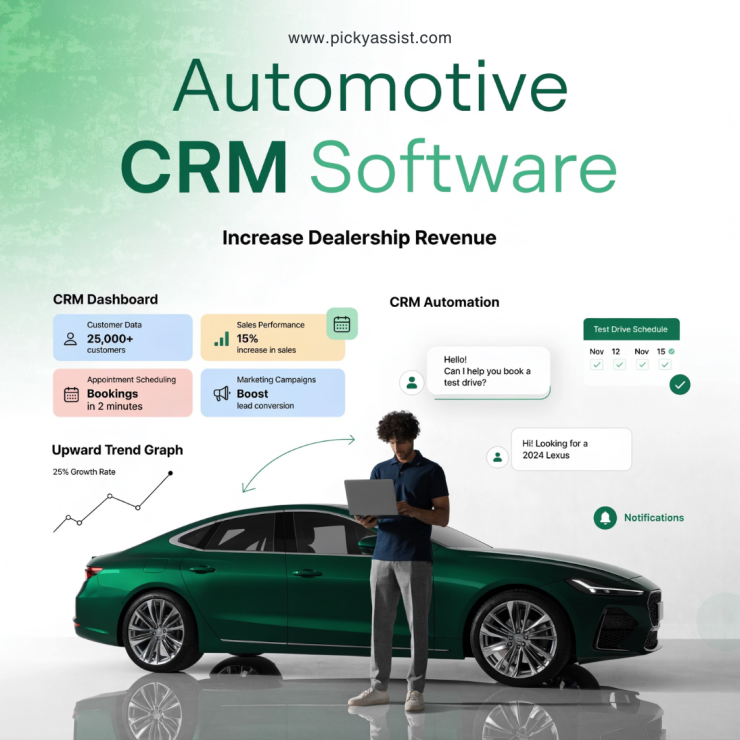
The modern car buyer does not behave the way dealerships expect them to. They browse listings late at night, message multiple dealers at once, compare prices across platforms, and often delay decisions while evaluating financing, resale value, and trustworthiness. This shift has quietly redefined how dealerships must operate. What used to be a walk-in driven business is now a fragmented, multi-touch, communication-heavy process. Here, one among the best car dealership CRM software becomes critical, not as a database, but as a revenue system.
Most dealerships assume CRM is about storing customer details. In reality, it is about controlling the speed, consistency, and quality of interactions across the entire buying journey. The dealerships that understand this distinction consistently outperform those that don’t.
This guide goes beyond surface-level explanations. It breaks down how CRM actually functions inside a dealership, where it directly impacts revenue, what to look for when choosing one, and how a communication-first solution like Picky Assist aligns with real dealership workflows.
What is a Car Dealership CRM Software? Understanding its Uses Beyond Definitions
When people search for CRM, they often look for features. However, in the automotive space, the more useful question is: what problem does it solve at each stage of the sales lifecycle?
Unlike retail or SaaS, where transactions can be quick and transactional, vehicle purchases are layered with emotional, financial, and comparative decision-making.
A car dealer CRM system is therefore designed to handle:
- Extended decision timelines where buyers revisit conversations multiple times
- Multi-channel communication that includes calls, messaging apps, and physical visits
- High dependency on follow-ups rather than immediate conversions
- The need to build trust progressively rather than instantly
In practice, this means a CRM must do more than record interactions. It must actively guide them.
Why Do Most Dealerships Lose Revenue Without Realizing it?
Dealership inefficiencies rarely appear as obvious failures. Instead, they show up as “missed potential” leads that could have converted but didn’t.
The Hidden Cost of Delayed Engagement
A typical inquiry today comes from a website form or a messaging channel. If that lead does not receive a response within minutes, the buyer often moves on. What’s important here is not just speed, but timing relative to intent.
Without a structured CRM for car dealerships, response times are inconsistent. Sales teams prioritize walk-ins or active conversations, leaving digital leads unattended during peak hours or off-hours.
Fragmented Communication
When conversations happen across WhatsApp, phone calls, and in-person visits, context gets lost. A buyer who has already discussed budget or preferences may need to repeat themselves. This breaks trust.
A well-implemented automotive dealership CRM ensures that every interaction builds on the previous one.
Follow-Up Fatigue
Sales teams often know they should follow up, but they lack a system to do it consistently. Over time, this leads to dropped conversations, especially for prospects who need time before making a decision.
This is where a car sales CRM transforms outcomes by structuring follow-ups rather than leaving them to chance.
The Core Architecture of an Effective Auto Sales CRM
To understand how CRM actually improves performance, it helps to break down its functional layers.
Lead Capture Layer
Every dealership generates leads from multiple sources; ads, websites, referrals, and walk-ins. The challenge is not generating leads, but capturing them without delay or loss.
A robust car dealer lead management software ensures that every inquiry enters the system automatically, without relying on manual entry. This eliminates a major point of leakage.
Engagement Layer
This is where most CRMs fall short.
Capturing leads is only the beginning. What matters is how quickly and effectively those leads are engaged. An advanced auto sales CRM software enables immediate responses, even outside working hours.
This is where Picky Assist’s communication automation becomes particularly relevant. Instead of waiting for a salesperson, the system initiates engagement instantly, keeping the buyer interested.
Follow-Up Layer
Car buying rarely happens in a single interaction. Buyers often require reminders, nudges, and additional information over time.
A structured auto sales management software introduces systematic follow-ups, ensuring that no lead is forgotten. It replaces memory-based selling with process-driven engagement.
Conversion Layer
At this stage, the CRM supports negotiation, test drive scheduling, and final decision-making by maintaining full visibility into the buyer’s journey. This continuity significantly increases the probability of conversion.
How CRM Impacts Each Stage of the Buyer Journey?
To understand the real value of CRM in automobile businesses, it is essential to map CRM functionality to actual buyer behavior.
Awareness Stage: First Contact Matters More Than Ever
When a potential buyer submits an inquiry, they are at peak curiosity. This moment is highly time-sensitive.
Without CRM, dealerships respond based on availability. With a system in place, responses are immediate and structured. This creates a strong first impression and increases the likelihood of continued engagement.
Consideration Stage: Building Trust Through Consistency
At this stage, buyers compare options. They evaluate pricing, features, financing, and dealership credibility.
An automotive dealer CRM ensures that communication remains consistent and informed. Instead of generic responses, interactions become personalized based on previous conversations.
Decision Stage: Timely Nudges Drive Conversions
Even interested buyers delay decisions. This is where follow-ups become critical.
A used car dealer CRM is particularly effective here because used car buyers often require more reassurance. Automated reminders, price updates, and availability notifications can influence decisions at the right moment.
Use Cases That Show CRM in Action
Multi-Channel Buyer Journey
A customer discovers a car through an online listing, sends a WhatsApp inquiry, visits the showroom, and later requests a price breakdown.
Without a CRM, these interactions remain disconnected. With a unified inbox inside your CRM, every touchpoint is recorded and accessible. The salesperson can continue the conversation seamlessly, which significantly improves trust.
Lead Overload During Promotions
During festive offers or clearance sales, dealerships experience a surge in inquiries. Without a system, response quality drops and leads are missed.
With a structured CRM for auto dealerships, automated engagement absorbs the initial load while sales teams focus on high-intent prospects.
Re-engaging Cold Leads
Many buyers do not convert immediately but remain potential customers.
An effective best CRM for auto dealerships allows dealerships to re-engage these leads with targeted communication rather than letting them go cold permanently.
Where Picky Assist Fits in as the Auto Dealership CRM?
Most traditional CRMs are built around data storage and reporting. While these are important, they do not directly address the biggest bottleneck in dealerships: communication delays.
Picky Assist approaches this differently.
Communication-First CRM Approach
Instead of treating communication as a feature, Picky Assist treats it as the core function. This aligns with how dealerships actually operate, where conversations drive conversions.
Real-Time Engagement Through WhatsApp Automation
In markets where messaging platforms dominate, response speed directly impacts sales outcomes. Picky Assist enables instant engagement, ensuring that no lead waits for a response.
Structured Yet Simple Workflows
Complex systems often fail because teams do not use them consistently. Picky Assist focuses on practical workflows that sales teams can adopt quickly without friction.
Bridging the Gap Between Lead Capture and Conversion
Many tools handle lead capture, but few ensure consistent engagement. Picky Assist closes this gap by connecting incoming leads with immediate and ongoing communication.
How to Evaluate the Best CRM Software for Car Dealerships?
Choosing the best CRM software for car dealerships is not about selecting the tool with the most features. It is about identifying the system that best aligns with your sales process.
Start With Your Sales Reality
Before evaluating tools, analyze how your dealership currently operates. Identify where delays happen, where leads are lost, and where communication breaks down.
Prioritize Engagement Over Complexity
A system that improves response speed and follow-up consistency will generate more revenue than one that offers complex analytics but weak execution.
Consider Adoption, Not Just Capability
Even the most advanced automotive dealership CRM will fail if your team does not use it consistently. Ease of use should be a critical factor.
Look for Integration With Communication Channels
Given the importance of messaging platforms, ensure your CRM integrates seamlessly with them. This is especially relevant for markets where WhatsApp is a primary communication channel.
Common Implementation Pitfalls and How to Avoid Them
CRM failures rarely happen because of the tool itself. They happen because of how it is implemented.
Treating CRM as a Reporting Tool
When CRM is used only for tracking performance, it does not influence daily operations. It must actively guide interactions.
Lack of Process Definition
Without clear workflows, even the best CRM for automobile industry solutions become underutilized.
Ignoring Behavioral Change
Sales teams need to shift from reactive to structured selling. This requires training and alignment, not just software installation.
The Strategic Impact of CRM on Dealership Growth
When implemented correctly, CRM does more than improve operations, it changes the growth trajectory of a dealership.
Response times become predictable. Follow-ups become consistent. Customer experience improves. Over time, these factors compound, leading to higher conversion rates and stronger brand perception.
This is why leading dealerships increasingly rely on structured systems rather than individual sales performance alone.
Conclusion
The shift in buyer behavior has made traditional dealership processes insufficient. Speed, consistency, and personalization now define success in auto sales.
Car dealership CRM software provides the framework to deliver all three.
However, not all CRMs are equally effective in this context. The most valuable systems are those that directly improve communication and engagement, because that is where most dealerships lose revenue.
Picky Assist fits this need by focusing on real-time interaction, automated engagement, and practical workflows that sales teams can actually use.
For dealerships aiming to increase conversions without adding complexity, adopting a communication-first CRM approach is not just beneficial, it is necessary.
FAQs on Car Dealership CRM Software
1. What is car dealership CRM software and why is it important?
It is a system designed to manage customer interactions, track sales pipelines, and automate communication. It is important because it improves response times, follow-ups, and overall conversion rates.
2. How does a car sales CRM improve lead conversion?
It ensures that every lead is captured, responded to quickly, and followed up consistently. This structured approach significantly increases the chances of closing deals.
3. What makes a CRM suitable for the automobile industry?
A CRM for this industry must handle long sales cycles, multi-channel communication, and high-value transactions. It should also support consistent follow-ups and personalized engagement.
4. Is CRM useful for used car dealerships?
Yes. A used car dealer CRM is especially valuable because used car buyers often require more information and reassurance before making a decision.
5. How does WhatsApp integration improve dealership CRM performance?
It enables instant communication, faster responses, and better engagement, which are critical for converting modern buyers.
6. What is the difference between auto sales CRM and general CRM?
An auto sales CRM is tailored for dealership workflows, focusing on lead tracking, follow-ups, and customer engagement rather than generic business processes.
7. How long does it take to see results from CRM implementation?
Basic improvements in response time and lead management can be seen within weeks. Long-term gains in conversion rates typically appear over a few months.
8. What should dealerships prioritize when choosing a CRM?
They should focus on ease of use, communication capabilities, automation features, and alignment with their existing sales process.
Add comment