
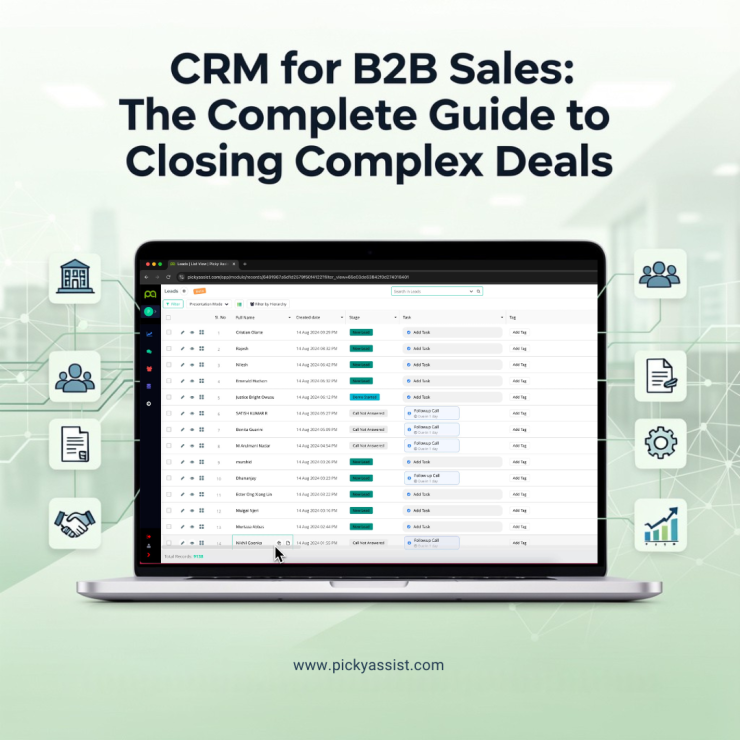
B2B sales rarely fail because of a weak product. They fail because information is scattered, follow-ups are missed, and relationships are managed in fragments. In a typical B2B sales cycle, multiple stakeholders are involved, decision timelines stretch for weeks or months, and every interaction influences trust. Spreadsheets, inboxes, and disconnected tools simply cannot keep up with this complexity. This is where CRM for B2B sales becomes foundational, not as software, but as the system that holds your entire revenue engine together.
A well-implemented B2B CRM does more than store contacts. It captures context, preserves continuity across teams, and turns sales activity into predictable outcomes. From lead qualification and deal tracking to long-term account management, CRM platforms shape how modern B2B businesses sell, scale, and retain customers.
This guide breaks down what CRM for B2B sales truly means, how it differs from B2C CRM, why it matters in today’s B2B market, and how to choose and use the best CRM for B2B sales effectively. Whether you’re evaluating your first CRM or refining an existing setup, this article will give you clarity, structure, and practical direction.
What is B2B CRM?
Before diving deep into features, benefits, and best practices, let’s start with a clear definition.
B2B CRM; the abbreviation for, Business-to-Business Customer Relationship Management, is a software solution designed to manage and optimize interactions between a business and its business customers. Unlike B2C CRMs that focus on high-volume individual transactions, CRM for B2B sales must handle complex deal cycles, multiple decision makers, and long negotiation timelines.
At its core, a B2B CRM centralises customer data, tracks interactions, supports pipeline management, and fosters collaboration across sales, marketing, and support teams.
Why Use a CRM for Sales?
Implementing a CRM system transforms the way B2B organisations operate. Here’s why:
1. Centralised Customer Data
A CRM consolidates contact information, communication history, and deal records in one place. This eliminates silos and enables your team to access real-time data.
2. Enhanced Pipeline Visibility
With dashboard views and deal stages, sales leaders gain clear visibility into the sales pipeline, forecast revenue, and identify bottlenecks early.
3. Improved Productivity
Automation of data entry, follow-up reminders, task assignments, and email templates reduces manual work and accelerates sales cycles.
4. Better Forecasting & Reporting
Integrated analytics and reporting tools in CRM systems help you understand trends, measure performance, and make informed strategic decisions.
5. Stronger Customer Relationships
Tracking every interaction, from initial contact to renewal, strengthens trust and improves long-term client retention.
How Does B2B CRM Differ from B2C CRM?
Understanding the unique nature of B2B sales helps you choose the right CRM solution.
| Feature | B2B CRM | B2C CRM |
| Sales Cycle | Long & complex | Shorter |
| Decision Makers | Multiple | Usually one |
| Deal Value | High | Lower |
| Contact Structure | Companies & contacts | Individual customers |
| Support Needs | Multi-touch | Direct |
B2B CRMs must support multi-layered sales processes, account hierarchies, and team collaboration, features less critical in B2C environments.
Best CRM for B2B Sales: Key Features to Look For
When evaluating solutions, the best CRM for B2B sales should include:
1. Contact & Account Management
Maintain profiles for businesses, subsidiaries, and key decision makers.
2. Lead Scoring & Qualification
Prioritise leads based on engagement, demographic fit, and buying signals.
3. Pipeline & Deal Management
Visualise deal stages, assign responsibilities, and forecast revenue.
4. Automation & Workflows
Automate repetitive tasks like follow-ups, data updates, and alert triggers.
5. Email Integration & Tracking
Sync with Gmail, Outlook, or other mail systems to track open and reply rates.
6. Analytics & Reporting
Custom dashboards and cross-functional insights (sales, marketing, finance).
7. Integration Capabilities
Seamless connection with tools like ERP, marketing automation, customer support, and e-commerce platforms.
8. Scalability & Security
Enterprise-grade security and the ability to grow with your business.
Top B2B CRM Examples & Platforms
While there are many CRMs available, here are well-regarded examples for B2B sales organisations:
Picky Assist Conversational CRM (WhatsApp-First B2B CRM with Chatbot)
Unlike traditional CRMs that rely heavily on manual data entry and email-based workflows, Picky Assist Conversational CRM is built for how modern B2B buyers actually communicate, through WhatsApp and conversational channels.
Picky Assist combines a CRM system for B2B with an intelligent chatbot-led conversation engine, allowing businesses to capture, qualify, and manage leads directly from WhatsApp, website chat, and other messaging touchpoints.
Key capabilities include:
- Automated lead qualification via AI chatbot before sales engagement
- WhatsApp-native CRM workflows for faster response and higher intent detection
- Conversation-based deal tracking instead of form-based data capture
- CRM sync with sales pipelines, contacts, and follow-ups
- Multi-agent collaboration with full conversation history preserved
For B2B businesses where buying decisions involve multiple conversations, follow-ups, and stakeholders, a conversational CRM bridges the gap between lead generation and deal closure.
Picky Assist is especially effective for:
- SaaS companies
- Service-based B2B businesses
- D2C brands with B2B sales arms
- Enterprises using Click-to-WhatsApp ads for lead generation
This makes Picky Assist a strong example of how CRM for the B2B market is evolving, moving beyond static dashboards toward real-time, conversation-driven selling.
Salesforce Sales Cloud
One of the most widely adopted platforms globally, known for powerful customisation and advanced analytics.
HubSpot CRM
A user-friendly solution that scales from startups to large enterprises, offering strong automation and marketing integration.
Microsoft Dynamics 365
Ideal for organisations integrated with Microsoft products; strong in process automation and enterprise data management.
Zoho CRM
Cost-effective, customisable, and rich in features for growing businesses.
These B2B CRM examples demonstrate the variety of solutions that cater to different sizes and sales strategies.
CRM for B2B Market: Strategic Impact
In the evolving B2B market landscape, CRM systems play a pivotal role in helping businesses stay competitive by:
- Enhancing customer experience with timely and personalised communication
- Shortening sales cycles through automation and visibility
- Aligning teams across sales, marketing, and service
- Measuring ROI through integrated analytics
CRM adoption is now a standard practice among top-performing B2B organisations, not just an optional tool.
Best Practices While Choosing CRM for B2B Sales
To ensure success with your CRM system, follow these proven best practices:
1. Define Clear Objectives
Start with measurable CRM goals: increase conversions, improve lead response time, or reduce churn.
2. Clean Up Data Before Migration
Ensure data hygiene before importing contacts and accounts to avoid inaccuracies.
3. Standardise Processes
Document and train teams on consistent stages for lead qualification, deal progression, and reporting.
4. Automate Smartly
Automate repeated tasks but keep human oversight for exceptions and high-value opportunities.
5. Train Teams Continuously
Regular training ensures adoption, prevents resistance, and unlocks the full potential of CRM features.
6. Monitor KPIs Regularly
Track key performance indicators (KPIs) such as lead response time, conversion rates, and sales cycle length.
7. Iterate & Optimise
Use feedback and analytics to refine workflows, pipelines, and automation rules.
Real-World Benefits: Business Outcomes with CRM
When implemented and used effectively, a B2B CRM delivers measurable business impact:
- Higher win rates due to structured pipeline management
- Improved customer retention through personalised lifecycle engagement
- Faster onboarding of new reps due to documented processes
- Greater predictability in forecasting revenue
- Better resource allocation through analytics-driven decision-making
Conclusion
Adopting the right CRM for B2B sales can be transformative for your organisation. It goes beyond managing contacts, it empowers teams to collaborate better, forecast intelligently, and convert opportunities into lasting business relationships.
The best B2B CRM solutions support scalability, automate routine tasks, and drive efficiency at every step of the sales journey. By following best practices and leveraging the right features, you equip your teams with a competitive edge in the modern B2B market.
Frequently Asked Questions (FAQs)
1. What is B2B CRM and why is it important?
A B2B CRM is a tool that helps businesses manage relationships with other businesses. It’s important because it centralises customer data, supports complex deal cycles, and improves pipeline visibility, all of which are critical for closing high-value B2B deals.
2. How does CRM for B2B sales differ from CRM for B2C?
B2B CRM focuses on long sales cycles, multiple stakeholders, and account hierarchies, whereas B2C CRM typically deals with individual customers and shorter purchase journeys.
3. What features should I look for in the best CRM for B2B sales?
Look for contact & account management, pipeline automation, lead scoring, integration capabilities, analytics, and scalability.
4. Can CRM software improve B2B sales performance?
Yes, CRM systems improve team productivity, help prioritise high-intent leads, automate repetitive tasks, and provide insights that drive strategic decisions.
5. What are some examples of B2B CRM platforms?
Popular B2B CRM platforms include Picky Assist Conversational CRM, Salesforce Sales Cloud, HubSpot CRM, Microsoft Dynamics 365, Pipedrive, and Zoho CRM.
6. What are CRM B2B best practices?
Best practices include defining clear goals, standardising processes, automating wisely, maintaining clean data, training teams, and tracking key metrics.




Add comment