
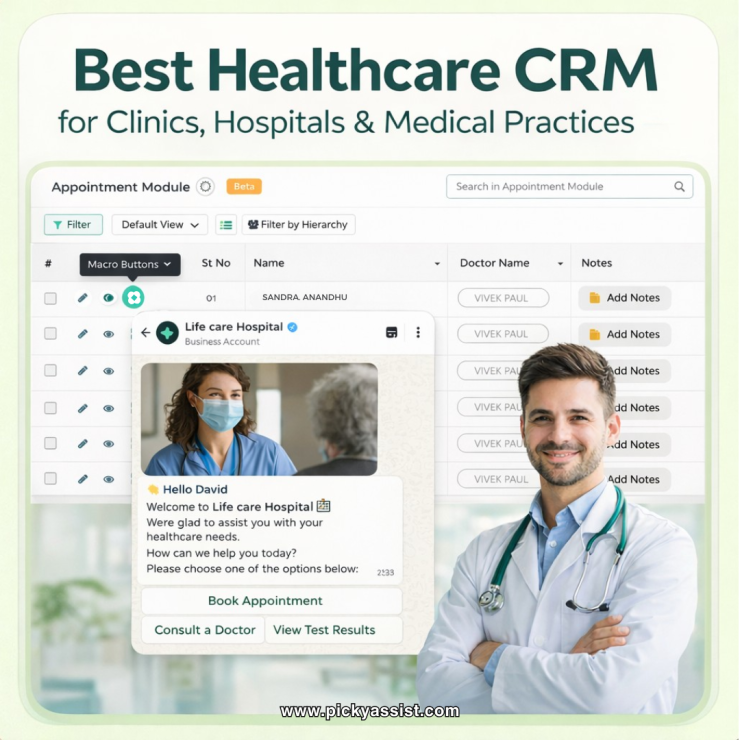
Running a clinic today takes more than good medical care. Patients expect timely replies, easy appointment coordination, personalized communication, and a smooth experience from their first enquiry to their post-visit follow-up. That is exactly why a CRM for clinic operations has become so important. It helps clinics manage patient communication, improve engagement, streamline follow-ups, and build stronger long-term relationships without losing valuable leads or missing routine touchpoints.
Whether you run a single-specialty practice, a multi-doctor clinic, or an expanding healthcare group, the right CRM can help you stay organized while improving the patient journey. More importantly, it helps your team communicate better, respond faster, and create a more consistent experience across channels.
In this guide, we will look at what a clinic CRM really does, why it matters, what features to look for, and where Picky Assist fits best for clinics that want to improve outreach, follow-up, and patient engagement.
What is a CRM for a Clinic?
A CRM for a clinic is a customer relationship management system designed to help clinics manage patient interactions, communication workflows, follow-ups, enquiries, appointment reminders, and engagement across the patient lifecycle.
Unlike a broad hospital management system, which often focuses on billing, administration, scheduling, inventory, and operational control, a hospital CRM is more focused on communication, relationship-building, and engagement. In other words, it helps your team handle the human side of healthcare communication more effectively.
Managing patient enquiries efficiently
When a potential patient reaches out through WhatsApp, a website form, social media, or phone, the CRM helps capture that lead and organize it properly. As a result, your team can respond quickly and avoid missed opportunities.
Tracking patient follow-ups
Many clinics lose potential appointments simply because nobody follows up on time. A CRM helps teams track pending conversations, callbacks, no-show follow-ups, and re-engagement opportunities.
Improving patient communication
A clinic CRM supports timely reminders, personalized messages, confirmations, feedback requests, and campaign communication. Therefore, patients feel more informed and cared for throughout their journey.
Supporting growth and retention
It is not just about new patient acquisition. A Hospital CRM also helps bring existing patients back for follow-up visits, preventive care, repeat consultations, and ongoing treatment communication.
Why Do Clinics Need a CRM Today?
The healthcare experience has changed. Patients no longer compare clinics only on medical expertise. They also notice how easy it is to book, how quickly they receive answers, and how consistently the clinic communicates.
Because of this shift, clinics need systems that go beyond static contact records.
Patient expectations are rising
Patients want prompt communication. They do not want to wait days for a response to a basic enquiry. They also expect reminders, updates, and convenient communication channels.
Manual follow-up is unreliable
When follow-ups depend on memory, sticky notes, or scattered spreadsheets, important conversations get missed. That directly affects appointment conversion, patient satisfaction, and retention.
Clinics need better visibility
Without a structured system, it becomes difficult to answer simple but important questions:
- How many new enquiries came in this week?
- How many patients confirmed appointments?
- How many leads went cold?
- Which campaigns generated actual bookings?
A CRM helps clinics answer these questions with more confidence.
Patient engagement directly affects growth
A clinic can spend heavily on marketing, yet still lose patients if communication is weak after the first enquiry. On the other hand, a clinic with strong follow-up and engagement workflows can improve conversions without constantly increasing ad spend.
Key Challenges Clinics Face Without a CRM
Many clinics feel busy all day but still struggle with conversions, engagement, and consistency. In most cases, the issue is not effort. It is a workflow.
Enquiries get lost across channels
A patient may message on WhatsApp, submit a website form, and call later. If these touchpoints are not tracked in one place, the clinic team may miss context or fail to follow up properly.
Follow-ups happen too late
Speed matters. If a clinic responds after several hours or days, the patient may already have booked elsewhere. This is especially true for high-intent enquiries.
Appointment reminders are inconsistent
Without structured reminder workflows, clinics often see avoidable no-shows, late arrivals, and scheduling confusion.
Patient communication feels disconnected
Patients may receive one type of communication before booking and another after consultation, with no continuity. That creates a fragmented experience.
Campaign performance is unclear
Clinics often run ads or outreach campaigns but struggle to connect leads with actual responses, follow-ups, and conversions.
Staff productivity drops
When teams spend too much time manually updating spreadsheets, searching chat histories, or checking missed calls, efficiency suffers.
Core Features to Look for in a CRM for Medical Clinic
Not every CRM fits a clinic’s needs. A generic sales CRM may feel too corporate, while an overly broad healthcare platform may be more complex than necessary. That is why clinics should focus on features that improve communication, follow-up, and patient engagement.
Centralized lead and patient enquiry capture
The CRM should help collect incoming enquiries from relevant channels and organize them clearly. This is especially useful for clinics handling website leads, campaign responses, calls, and messaging conversations.
Follow-up tracking
Every pending enquiry or appointment-related action should be easy to track. A strong CRM for medical clinic teams should help staff know who needs a callback, who has not responded, and who is ready for the next step.
Appointment reminder workflows
Automated reminders reduce no-shows and improve preparedness. They also reduce manual effort for front-desk teams.
Segmentation and contact organization
Clinics should be able to group contacts based on service interest, consultation history, campaign source, or follow-up status. This makes communication more targeted and more relevant.
Multi-channel communication support
Patients communicate in different ways. Clinics benefit when they can manage outreach and engagement across practical channels instead of relying on one method alone.
Internal team visibility
A CRM should make it easier for staff to understand where each patient conversation stands. That avoids duplication, confusion, and dropped communication.
Reporting and performance insights
A clinic needs visibility into lead flow, response time, appointment conversion, follow-up completion, and campaign performance. These insights help improve operations over time.
How CRM improves Patient Engagement and Clinic Communication?
A well-used CRM strengthens patient engagement by making communication timely, relevant, and consistent.
Faster first responses
When a patient reaches out, the clinic can respond quickly and direct the conversation properly. That immediately improves trust.
Better follow-up journeys
Not every patient books instantly. Some need more information, some need reminders, and some need time to decide. A CRM allows your team to follow up in a structured way rather than letting leads go cold.
Personalized communication
Patients respond better when messages are relevant to their needs. A CRM helps clinics segment communication, so outreach feels more useful and less generic.
Improved appointment adherence
Reminders, confirmations, and pre-visit communication help reduce missed appointments and scheduling confusion.
Stronger post-visit relationships
Engagement should not stop after the consultation. Clinics can use CRM workflows for feedback collection, review requests, wellness reminders, follow-up care communication, and reactivation campaigns.
CRM for Clinic vs Hospital Management System
This is where many teams get confused, so it is worth making the difference clear.
A CRM for clinics mainly focuses on communication, lead tracking, engagement, relationship management, and follow-up workflows.
A hospital management system usually covers broader administrative and operational functions such as:
- billing
- scheduling
- registration
- internal workflows
- inventory
- reporting
- hospital administration
Similarly, tools related to medical records management are generally designed to store, manage, and retrieve clinical or patient record data.
These systems may overlap in some areas, but they do not serve the same purpose.
Where does CRM fit best?
CRM fits best when your clinic wants to improve:
- response speed
- patient communication
- enquiry handling
- appointment reminders
- follow-up consistency
- campaign nurturing
- re-engagement
Where do other systems fit best?
A clinic may still use separate solutions for:
- clinical documentation
- operational management
- billing
- patient records
- broader hospital patient management system needs
- record-heavy workflows sometimes associated with a hospital database management system
So, CRM is not a replacement for every healthcare platform. Instead, it fills a highly valuable communication and relationship gap.
Where Picky Assist Fits Best for Clinics?
Picky Assist fits especially well where clinics want to strengthen communication-led workflows without overcomplicating operations.
Rather than positioning it as a full hospital CRM software suite for every backend healthcare function, it is more accurate and useful to understand it as a patient engagement and communication-focused solution that supports clinics in areas such as:
Lead capture and enquiry management
When patients enquire through digital channels like social media, website forms or webpages, clinics need a structured way to capture, organize, and respond. Picky Assist can support these communication-led workflows and help teams stay on top of incoming interest using CRM -led flows and AI chatbots.
Follow-up automation
Many clinics lose momentum after the first enquiry. Picky Assist is relevant where the goal is to automate follow-up touchpoints, reduce manual effort, and improve consistency. AI Chatbots are trained to send follow timely automated sequenced messages to keep a person engaged until they choose the service. The same also can be used for feedback collection after visits.
Appointment communication
Reminders, confirmations, and communication flows around visits are important for both patient experience and operational efficiency, which are communicated using AI chatbots.
Campaign and outreach support
Clinics often run awareness campaigns, promotional outreach, health checkup drives, or re-engagement communication. Picky Assist fits well in such use cases where outreach and follow-up need to be managed more effectively.
Patient engagement software
From enquiry to revisit, clinics need structured communication that keeps patients informed and connected. This is a strong area where Picky Assist aligns naturally.
Practical Use Cases for a Clinic CRM
A strong CRM becomes far more valuable when it supports real-world clinic workflows. Here are some practical use cases.
New patient enquiry handling
A prospective patient sees your ad, visits your website, or messages your clinic directly. The CRM helps capture the enquiry, assign follow-up, and track whether the patient booked.
Appointment reminders
Automated reminders can reduce no-shows and help patients prepare better for consultations, diagnostic visits, or follow-up appointments.
Missed appointment re-engagement
When a patient misses an appointment, the clinic can trigger a follow-up workflow to reschedule instead of losing the visit completely.
Consultation follow-up
After the first consultation, clinics may need to remind patients about next steps, follow-up visits, wellness plans, or diagnostic scheduling.
Preventive care and recall campaigns
Clinics can run re-engagement campaigns for annual checkups, vaccinations, screenings, or routine visits.
Feedback collection
A CRM can help organize post-visit feedback requests, which can improve patient experience and give the clinic useful operational insights.
Multi-location communication support
For clinic groups and expanding healthcare brands, a CRM improves consistency while still allowing local engagement workflows. AI Mate allows for translation of chat content and responds accordingly, without language barriers.
Benefits of CRM for Hospitals, Clinics, and Multi-Location Healthcare Providers
Even though this article stays focused on clinics, some principles also extend to larger care environments. The core idea remains similar: better communication leads to better engagement and more efficient care coordination.
For clinics specifically, the benefits are very practical.
Better patient experience
Patients value clarity, responsiveness, and convenience. A CRM helps clinics deliver all three more consistently.
Stronger conversion from enquiries
When follow-up improves, more interested patients turn into actual appointments.
Reduced no-shows
Structured reminders and confirmations make a visible difference.
Better team coordination
When communication is tracked properly, staff members work with more context and fewer gaps.
Smarter marketing decisions
With better visibility into lead sources and campaign outcomes, clinics can optimize outreach efforts.
Higher retention and repeat visits
Consistent post-visit engagement helps clinics build stronger long-term patient relationships.
How to Choose the Right CRM for Clinic Operations?
Choosing a CRM is not about picking the most complex platform. It is about finding the one that matches your clinic’s real workflow needs.
Start with your communication pain points
Look at where your clinic is currently losing time or patients. Is it slow response time? Poor follow-up? Missed reminders? No visibility into campaign results? Start there.
Prioritize ease of use
If the system is too complicated, teams will not use it properly. Simplicity matters.
Check fit with your engagement workflow
A clinic needs communication support, not just contact storage. Choose a platform that helps with reminders, nurturing, and patient engagement.
Think beyond acquisition
A good CRM should support not only new patient leads but also retention, follow-up care, and reactivation.
Look for scalability
Your clinic may grow in services, staff, channels, or locations. Your CRM should support that growth without becoming chaotic.
Evaluate reporting needs
You need enough visibility to improve performance. Otherwise, the CRM becomes a record system instead of a decision-making tool.
Why CRM Matters More Than Ever in the Clinic Industry?
Healthcare communication has become a competitive advantage. Patients remember whether they received a quick answer, whether reminders were clear, and whether follow-ups felt thoughtful rather than random.
That is why CRM in the clinic space is no longer just a “nice to have.” It is becoming an essential layer for growth, retention, and patient experience.
While CRM in the hospital industry may matter in larger healthcare setups, clinics often gain immediate value by improving everyday communication journeys first. In many cases, that is where the biggest operational and commercial gains happen.
Conclusion
A CRM for clinic operations helps bridge one of the most important gaps in healthcare communication: the space between patient interest and patient action. It gives clinics a better way to manage enquiries, improve follow-ups, send reminders, support engagement, and create a more consistent patient experience.
For growing clinics, this matters a lot. Better communication can lead to stronger trust, higher appointment conversion, fewer missed visits, and better retention over time.
Picky Assist fits best in this communication and engagement layer. It is especially relevant for clinics that want to improve patient outreach, follow-up workflows, appointment communication, and relationship management in a structured, scalable way.
In a healthcare environment where responsiveness and experience matter more than ever, the right CRM can help a clinic work smarter while staying more connected with every patient it serves.
FAQs on CRM for Clinics
1. What is a CRM for a clinic?
A CRM for a clinic is a system that helps clinics manage patient enquiries, communication, follow-ups, appointment reminders, and engagement. It supports better relationship management and helps clinics respond more efficiently across the patient journey.
2. Is a CRM for a medical clinic different from a hospital management system?
Yes. A CRM for medical clinic use is mainly focused on communication, follow-ups, and relationship management. A hospital management system usually handles broader operational functions such as billing, registration, administration, and internal workflows.
3. Can a clinic CRM replace medical records management or electronic health record management?
No. A clinic CRM does not usually replace systems built for clinical documentation, health record management system needs, or electronic health record management. Instead, it supports the communication and engagement side of the patient journey.
4. Is CRM useful only for large hospitals?
Not at all. Although terms like CRM for hospitals and hospital CRM systems are common in search, clinics also benefit significantly from CRM. In fact, smaller and mid-sized clinics often see fast value because communication gaps are easier to identify and improve.
5. What features should I look for in a CRM for a clinic?
Look for lead capture, follow-up tracking, appointment reminder support, segmentation, communication visibility, campaign support, and reporting. The best choice depends on your clinic’s patient engagement workflow. Consider Picky Assist as it offers most features relevant for managing a hospital.
6. How does CRM improve patient engagement?
CRM improves patient engagement by making communication faster, more organized, and more relevant. It helps clinics follow up on time, send reminders, collect feedback, and maintain meaningful contact before and after appointments.
7. Can a clinic CRM help reduce missed appointments?
Yes. One of the most practical benefits of using a CRM is better reminder and confirmation workflows. These reduce no-shows and help clinics improve scheduling efficiency.
8. Where does Picky Assist fit in for clinics?
Picky Assist fits best where clinics need stronger patient communication, enquiry management, follow-up workflows, outreach support, and engagement automation. It is especially useful for clinics or hospitals, dental clinic, fertility centers or dermatological centers that want to improve responsiveness and relationship management without overcomplicating operations.

Add comment