
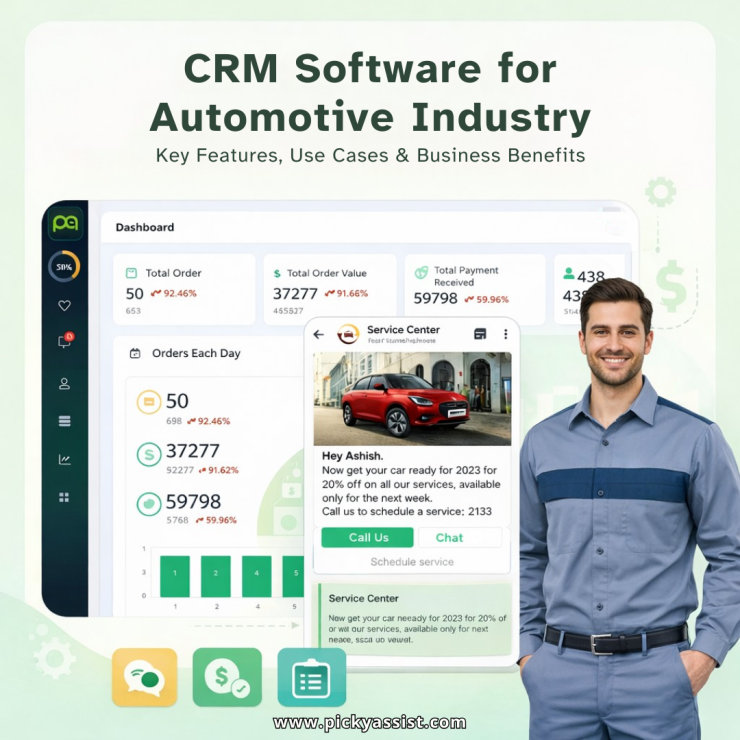
The automotive industry has evolved far beyond walk-in customers and manual follow-ups. Today, buyers research online, compare options across platforms, and expect instant responses. At the same time, dealerships, service centers, and automotive brands manage large volumes of leads, test drives, service appointments, and repeat interactions. This is exactly where CRM software for the automotive industry becomes critical.
A well-implemented system helps businesses track every customer interaction, automate follow-ups, and create a seamless experience from the first inquiry to post-sale service. However, not all tools are built with automotive workflows in mind. Choosing the right solution requires understanding your operational needs and how an automotive CRM can support them. This guide breaks down everything you need to know about features, use cases, benefits, and how platforms like Picky Assist fit into the automotive ecosystem.
What is CRM Software for the Automotive Industry?
CRM software in automotive is designed to manage customer relationships across the entire lifecycle from lead generation, sales, delivery, service, to retention.
Unlike generic CRMs, automotive-focused solutions are tailored for:
- High-volume lead management
- Test drive scheduling
- Service reminders and follow-ups
- Multi-channel communication (calls, WhatsApp, SMS, email)
- Dealer and showroom coordination
In simple terms, it helps automotive businesses organize data, automate processes, and improve customer engagement without losing opportunities.
Why Do Automotive Businesses Need a CRM Today?
Customer expectations have shifted significantly. Buyers expect quick responses, personalized communication, and consistent follow-ups.
Without a structured system, businesses often face:
- Missed leads due to delayed responses
- Poor coordination between sales and service teams
- Inconsistent follow-ups
- Lack of visibility into customer history
- Low conversion rates
A modern automotive CRM solves these issues by centralizing data and automating key workflows.
Key Features of Automotive CRM Software
Not all CRM platforms offer the same value. The most effective automotive CRM tools focus on operational efficiency and communication.
1. Lead Management and Distribution
Capture leads from multiple sources such as:
- Website forms
- Social media campaigns
- Walk-ins
- Third-party marketplaces
Automatically assign leads to sales representatives based on predefined rules.
2. Automated Follow-Ups
Timely follow-ups are critical in automotive sales. A CRM ensures:
- Instant responses to new inquiries
- Scheduled reminders for sales teams
- Automated nurturing sequences
3. Omnichannel Communication
This is where solutions like Picky Assist stand out.
Picky Assist enables businesses to manage conversations across:
- Calls
- SMS
- Web chat
All from a single inbox accessible to multiple team members, ensuring no customer interaction is missed.
4. Appointment and Test Drive Scheduling
Efficient scheduling helps reduce friction in the buying journey. CRM systems allow:
- Easy booking of test drives
- Calendar synchronization
- Automated reminders
5. Customer Data and Interaction History
Every interaction is recorded, including:
- Past inquiries
- Purchase history
- Service visits
- Communication logs
This allows teams to deliver personalized experiences.
6. Service and Maintenance Reminders
Retention in automotive depends heavily on after-sales service. CRM tools help:
- Send service reminders
- Track maintenance schedules
- Improve repeat business
7. Analytics and Reporting
Gain insights into:
- Lead conversion rates
- Sales performance
- Campaign effectiveness
- Customer engagement
How CRM Software Improves Automotive Sales?
A structured automotive CRM system directly impacts revenue by improving efficiency and visibility.
Faster Lead Response
Speed matters. Businesses that respond within minutes have significantly higher conversion chances. Automation ensures immediate engagement.
Better Lead Nurturing
Not all buyers are ready to purchase immediately. CRM workflows help nurture leads over time with relevant communication.
Improved Sales Tracking
Sales managers can monitor:
- Pipeline stages
- Team performance
- Deal progress
This leads to better forecasting and decision-making.
CRM in Automotive Service Operations
Sales is only one part of the journey. Service operations play a major role in customer retention.
Centralized Service Records
Track every service interaction to provide better support.
Automated Service Reminders
Send timely notifications for:
- Oil changes
- Routine maintenance
- Annual servicing
Enhanced Customer Experience
Customers appreciate proactive communication and transparency, which improves loyalty.
Use Cases Across the Automotive Industry
CRM software is not limited to dealerships. It supports multiple business models.
Dealerships
- Manage showroom and online leads
- Track test drives
- Improve conversion rates
Service Centers
- Schedule appointments
- Send service reminders
- Track service history
OEM Teams
- Monitor dealer performance
- Manage customer engagement across regions
Used Car Dealers
- Handle high lead volumes
- Track inventory-linked inquiries
Fleet Management Companies
- Maintain vehicle records
- Manage client communication
- Schedule maintenance
What Makes the Best CRM for the Automotive Industry?
Choosing the best automotive CRM depends on how well it aligns with your business workflows.
Look for:
Ease of Use
Your team should be able to adopt it quickly without extensive training.
Customization
The system should adapt to your sales and service processes.
Strong Communication Capabilities
Multi-channel engagement is essential in today’s environment.
Automation Features
From lead assignment to follow-ups, automation saves time and reduces errors.
Integration Capabilities
The CRM should integrate with:
- Marketing tools
- Telephony systems
- Messaging platforms
Where Picky Assist Fits in Automotive CRM?
Picky Assist is not positioned as a traditional, heavy CRM system. Instead, it plays a critical role in communication-driven CRM workflows, which are central to automotive businesses.
1. Lead Engagement at Scale
Automotive businesses receive leads from multiple channels. Picky Assist helps:
- Respond instantly via WhatsApp
- Automate initial conversations
- Qualify leads faster
2. Unified Communication Hub
Instead of managing multiple tools, teams can handle:
- Customer chats
- Calls
- Notifications
All in one place.
3. Automation for Follow-Ups
Follow-ups can be automated based on:
- Inquiry type
- Customer stage
- Service schedules
4. Appointment and Booking Support
Automate:
- Test drive bookings
- Service appointments
- Confirmation messages
5. Better Customer Experience
Consistent and timely communication improves trust and increases conversion chances.
When Picky Assist Works Best?
Picky Assist is especially effective when:
- You need strong communication automation
- Your team handles high lead volumes
- You rely heavily on messaging channels
It can also complement existing CRM systems by enhancing communication workflows.
Automotive CRM vs Generic CRM: Key Differences
Many businesses start with generic CRM tools but later face limitations.
| Feature | Generic CRM | Automotive CRM |
| Lead Handling | Basic | Industry-specific workflows |
| Test Drive Scheduling | Limited | Built-in support |
| Service Tracking | Not optimized | Fully integrated |
| Communication | Basic email focus | Multi-channel (including messaging) |
| Automation | General | Automotive-specific triggers |
This is why choosing the right CRM in automotive makes a measurable difference.
Common Challenges When Implementing Automotive CRM
Even the best CRM systems can fail without proper implementation.
Poor Adoption by Teams
If the system is complex, teams may avoid using it.
Lack of Customization
Generic workflows may not fit automotive operations.
Incomplete Data Entry
Missing data reduces the effectiveness of the system.
Overcomplicated Tools
Too many features can slow down operations instead of improving them.
Best Practices for Successful CRM Implementation
To get the most out of your CRM:
- Define clear workflows before implementation
- Train your team properly
- Start with essential features first
- Automate repetitive tasks
- Continuously monitor and optimize
Conclusion
The automotive industry demands speed, personalization, and consistency in customer interactions. Without the right system, managing leads, follow-ups, and service workflows becomes inefficient.
A well-chosen CRM software for the automotive industry helps businesses stay organized, improve conversions, and deliver better customer experiences.
While traditional automotive CRM systems focus on data and pipeline management, platforms like Picky Assist strengthen the most critical layer; communication. By enabling real-time engagement, automation, and multi-channel interactions, it ensures that no opportunity is missed and every customer receives timely attention.
For automotive businesses looking to improve both efficiency and customer experience, combining a structured CRM approach with strong communication automation is the most effective strategy.
FAQs on CRM Software for the Automotive Industry
1. What is CRM software for the automotive industry used for?
It is used to manage customer relationships, track leads, automate follow-ups, schedule test drives, and improve both sales and service operations.
2. How does automotive CRM improve sales conversions?
It ensures faster lead response, structured follow-ups, and better tracking of sales pipelines, which increases the chances of closing deals.
3. Can CRM software help in automotive service management?
Yes, it helps track service history, schedule appointments, and send maintenance reminders, improving customer retention.
4. Is WhatsApp integration important in automotive CRM?
Yes, many customers prefer messaging platforms. Tools like Picky Assist enable real-time communication and faster engagement.
5. What features should I look for in an automotive CRM?
Look for lead management, automation, communication tools, reporting, and integration capabilities.
6. Can small automotive businesses benefit from CRM software?
Absolutely. Even small dealerships and service centers can improve efficiency and customer experience using CRM tools.
7. How is automotive CRM different from general CRM?
Automotive CRM includes industry-specific features like test drive scheduling, service tracking, and multi-channel engagement.
8. Does Picky Assist replace a full CRM system?
Picky Assist is best used as a communication-focused solution that can either complement an existing CRM or act as a lightweight system for managing interactions and automation.

Add comment