
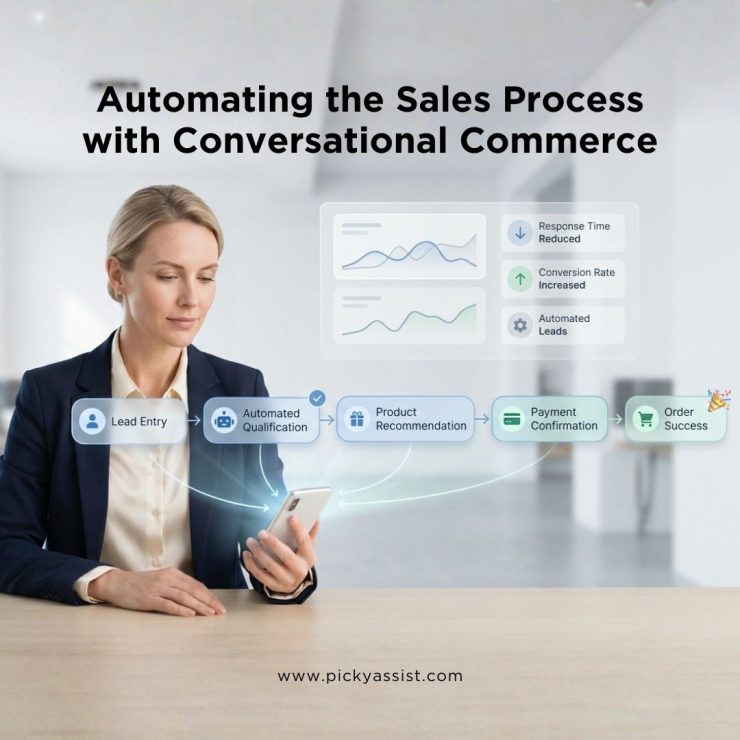
Understanding how to automate sales process has become a priority for modern businesses as buying behavior shifts toward real-time, conversational, and mobile-first interactions. Traditional sales models built around emails, forms, and manual follow-ups are no longer fast or efficient enough to meet customer expectations. Buyers now want instant responses, personalized recommendations, and frictionless purchasing journeys.
Conversational commerce addresses this gap by combining messaging platforms, automation, and intelligent workflows to guide prospects from discovery to purchase without human bottlenecks. By integrating chatbots, CRM logic, and automation tools, businesses can create scalable sales systems that operate continuously while still feeling personal. This approach is not about replacing sales teams but about augmenting them with automation that improves speed, consistency, and revenue outcomes.
Why Manual Sales Processes Are Giving Way to Conversational Automation?
Sales has historically been a people-driven function, but rising acquisition costs and longer decision cycles have exposed the inefficiencies of manual selling. Research indicates that sales representatives spend less than 35 percent of their time actually selling, with the remainder consumed by repetitive tasks such as lead qualification, follow-ups, and order coordination. This inefficiency is the primary reason businesses are exploring automating sales at scale.
Conversational commerce introduces a new operating model where messaging platforms like WhatsApp become the front door of the sales journey. Instead of pushing prospects through static funnels, businesses use dynamic conversational funnels that adapt to user intent. This is where concepts such as sales workflow automation and automated selling converge. Every interaction becomes part of a structured yet flexible sales workflow process that guides prospects logically toward conversion.
How to Automate Sales Process With Conversational Commerce at the Funnel Level?
One of the most effective ways to understand how to automate the sales process is by examining how conversational commerce reshapes the funnel itself. Traditional funnels are linear and rigid, while conversational funnels are adaptive and intent-driven. When businesses explore how to automate your sales process, they often begin by mapping each stage of the buyer journey into a conversation flow.
At the top of the funnel, automated prospecting plays a critical role. Instead of manual outreach, businesses deploy entry points such as click-to-WhatsApp ads, website chat widgets, and QR codes. These entry points feed into sales prospecting automation, where chatbots qualify leads in real time by asking contextual questions. This stage replaces cold outreach with automated sales prospecting that operates continuously.
As prospects move deeper into the funnel, automation transitions from qualification to education. This is where businesses begin to implement how to automate sales funnel logic. Product discovery, pricing explanations, objection handling, and comparisons are delivered conversationally. Unlike static landing pages, these interactions adjust dynamically, forming an automated sales funnel that feels human while remaining system-driven.
Automate Sales Process Across the Pipeline
To successfully automate sales process, businesses must think beyond lead capture and address the entire pipeline. Sales pipeline automation ensures that every qualified prospect is routed correctly, tracked accurately, and followed up consistently. Conversational platforms integrated with CRM systems allow businesses to automate lead scoring, stage progression, and task creation without manual intervention.
This level of orchestration is often referred to as intelligent sales automation because it relies on contextual data rather than fixed rules alone. For example, a prospect’s responses, browsing behavior, and engagement history determine the next step in the conversation. Over time, this intelligence improves conversion rates and shortens sales cycles.
Businesses that implement pipeline automation typically report a 20 to 30 percent reduction in deal slippage, largely because no opportunity is forgotten or delayed. This is a significant advantage in competitive markets where response time directly influences buying decisions.
Automating Order Management and Post-Conversion Sales Operations
Automation should not stop at conversion. Many businesses fail to realize that true scale comes from automating downstream processes such as order management and fulfillment. Sales order automation ensures that once a customer commits, the transition from conversation to transaction is seamless.
Conversational commerce platforms enable automated sales order processing by integrating chat flows with payment gateways, inventory systems, and order management tools. Customers can confirm orders, make payments, and receive updates within the same conversation. This continuity improves trust and reduces drop-offs during checkout.
Beyond order placement, automation extends to invoices, delivery notifications, and support handoffs. Businesses that automate sales processes end-to-end often see operational cost reductions of up to 25 percent due to fewer manual interventions and errors.
The Role of Automated Prospecting Systems in Scaling Revenue
One of the most underestimated components of sales automation is prospecting. Manual prospecting is slow, inconsistent, and difficult to scale. A well-designed automated prospecting system transforms this function by handling qualification at scale while preserving personalization.
Through automated prospecting, businesses can segment prospects based on responses, intent signals, and engagement patterns. This approach is more efficient than traditional lead forms because it captures richer data in real time. Sales prospecting automation also improves lead quality, allowing sales teams to focus only on high-intent conversations.
Organizations that deploy automated sales prospecting typically experience a 40 percent improvement in lead-to-opportunity conversion rates, primarily due to faster response times and better qualification accuracy.
Why Conversational Commerce Is Central to Automating the Sales Process?
Conversational commerce is not simply another automation layer; it is the interface through which automation becomes usable and effective. When businesses try to automate the sales process using only backend tools, they often fail to improve customer experience. Messaging platforms solve this problem by making automation feel natural.
WhatsApp, in particular, has emerged as a dominant conversational commerce channel due to its high open rates, familiarity, and real-time nature. WhatsApp automation platforms like Picky Assist enable businesses to design conversation-driven automation without coding, making advanced automation accessible to non-technical teams.
This approach aligns with modern buyer expectations, where customers prefer dialogue over forms and immediate responses over delayed callbacks. As a result, businesses using conversational commerce report higher engagement and stronger brand trust.
Measuring the Impact of Sales Automation
Any strategy focused on how to automate the sales process must be evaluated through measurable outcomes. Key performance indicators include conversion rate improvements, response time reductions, sales cycle duration, and cost per acquisition.
Industry data shows that businesses implementing conversational sales automation experience conversion lifts ranging from 15 to 45 percent, depending on industry and complexity. Additionally, automation reduces dependency on large sales teams, improving scalability without proportional cost increases.
These metrics demonstrate that automation is not merely an efficiency play but a revenue growth strategy.
Conclusion
Mastering how to automate the sales process is no longer optional for businesses competing in fast-moving digital markets. Conversational commerce provides a practical, scalable, and customer-friendly way to automate every stage of the sales journey without sacrificing personalization. By combining intelligent workflows, automated prospecting, pipeline automation, and order processing within conversational interfaces, businesses can achieve higher conversions, lower costs, and better customer experiences. WhatsApp automated platforms like Picky Assist make this transformation accessible by enabling no-code automation on channels customers already use. As buyer expectations continue to evolve, conversational sales automation will define the next generation of high-performing sales organizations.
FAQs on How to Automate Sales Process
1. How does conversational commerce help automate sales?
Conversational commerce automates sales by using chatbots and workflows to qualify leads, educate prospects, manage follow-ups, and process orders within messaging platforms.
2. Is sales automation suitable for complex B2B sales?
Yes. When designed correctly, conversational automation supports complex sales by handling early-stage qualification and routing high-intent leads to human sales teams.
3. Can automation replace sales teams entirely?
No. Automation complements sales teams by removing repetitive tasks, allowing human sellers to focus on negotiation, relationship building, and closing.




Add comment