
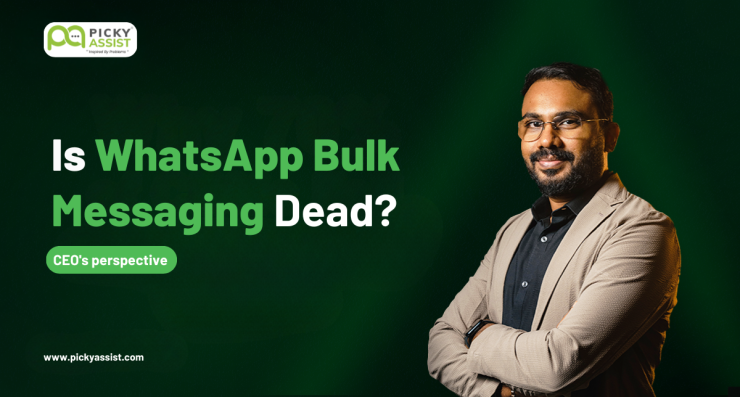
After spending years working closely with founders, CXOs, and marketing teams, I’ve arrived at a reality many businesses struggle to accept: WhatsApp bulk messaging simply does not work anymore, at least not in the way brands expect it to.
This conclusion wasn’t the result of a one-time failure. It was shaped by hundreds of campaigns, countless blocked numbers, leadership meetings filled with frustration, and repeated incidents where businesses pushed thousands of messages only to realise that nothing moved the needle.
One founder once proudly told me, “We sent 50,000 WhatsApp messages today, this campaign will crush it.”
A week later, he returned disappointed, saying, “We didn’t get any conversions.”
The issue was never the platform. The issue was the approach, the mindset, and the assumption that “more messages automatically equal more results.”
How WhatsApp Bulk Messaging First Started Falling Apart?
To understand the decline of WhatsApp bulk messaging, we need to revisit where the problem began.
Around 2019, WhatsApp became the prime channel for businesses. Open rates were unbelievably high. People responded instantly. The platform felt personal, familiar, and trusted. And because of these advantages, every business—big or small—jumped into WhatsApp marketing with the same tactic: sending out large volumes of messages to as many people as possible.
But the very thing that made WhatsApp promising—its personal and intimate nature—was quickly abused. Customers who once appreciated helpful updates started feeling invaded by unsolicited promotions. Instead of receiving meaningful messages, they were flooded with uninspired offers, irrelevant greetings, and repetitive announcements.
As this pattern grew, I began hearing the same complaints during every strategic review:
“Our customers aren’t responding.”
“Our number is getting blocked.”
“WhatsApp engagement is falling drastically.”
And every time, my response was consistent: WhatsApp didn’t change. Customers did.
They began expecting messages that were personal, timely, context-driven, and relevant to their needs. They no longer tolerated a marketing blast sent to thousands without distinction or consent.
The Misunderstood Reality of WhatsApp Broadcasts
One of the biggest misconceptions in business communication today is the belief that WhatsApp Broadcast is a bulk-messaging tool. In reality, it is far from that.
A WhatsApp broadcast list allows communication with only 256 people at a time, and even then, messages are delivered only to those who have saved your number. This means that a company with 50,000 contacts cannot reach all of them with a single click. Multiple lists must be created manually, and in most cases, the recipients who haven’t saved the sender’s number never receive the message at all.
This misunderstanding creates a dangerous illusion of scale. Businesses believe they are reaching thousands of customers, when in reality, only a small fraction receives the message. And the more they try to force delivery through repeated broadcasts, the faster they trigger spam-like behavior that leads to blocks, reports, and reduced trust.
Even automated tools that bypass these limitations come with significant risks. They may deliver messages at scale, but they do so by violating WhatsApp’s rules and mimicking spam behavior. The result is predictable: banned numbers, blacklisted devices, and damaged reputation. The brands that succeed today are not the ones trying to exploit loopholes, but the ones using automation thoughtfully to build meaningful conversations.
The Illusion That More Messages Bring More Conversions
The most persistent misunderstanding in WhatsApp marketing is the idea that sending more messages increases the chances of sales. But the opposite is often true.
Simply flooding people with messages does not create interest, it creates irritation. Customers no longer tolerate generic broadcast-style communication; they mute, block, and report numbers that feel intrusive. When businesses scale the wrong strategy, they don’t scale results; they scale disappointment.
I often tell founders that sending more messages is like shouting louder in a crowded room. You don’t stand out, you just annoy more people. Effective communication doesn’t come from volume, but from relevance, timing, and the value it creates.
Why WhatsApp Blocks Bulk Senders?
Brands often blame WhatsApp for being too strict. But WhatsApp is simply protecting the end user, which is exactly why it remains the most trusted communication channel.
Broadcast-style messages frequently get blocked because customers never saved the business number, never opted in, never expressed interest, or found the content irrelevant to them. When they encounter too many uninvited messages, they respond by reporting the sender.
Many companies also unknowingly use illegal WhatsApp bulk-messaging tools that simulate spam-like sending behavior. WhatsApp’s automated systems detect this instantly and react by blocking numbers, devices, or accounts to safeguard users.
The irony is that businesses are not being punished for reaching out, they are being penalized for doing it without permission, relevance, or value.
Where Automation Fails Most Businesses?
Automation has become a buzzword, but most companies misunderstand what it should do. Businesses try to automate everything, including relationships. But WhatsApp, unlike email or SMS, is not a broadcasting medium. It is a conversation-first platform where context matters more than volume.
I’ve seen brands achieve extraordinary results by focusing on high-quality, personalized conversations with a select audience, rather than chasing mass reach. Even simple, thoughtful, well-timed messages outperform complicated bulk campaigns.
Automation works only when it enhances human understanding, not when it replaces it. When used blindly, automation multiplies inefficiencies instead of fixing them.
WhatsApp Has Evolved—Businesses Haven’t
Over the past few years, WhatsApp has moved towards structured, compliant, and conversational business communication. Features like verified profiles, API automation, event-driven messages, in-chat payment flows, catalogs, and interactive buttons show how WhatsApp is transforming into a complete commerce layer.
But many businesses remain stuck in the old mindset, using outdated, spammy methods that were abandoned years ago by platforms like email and SMS.
The decline in WhatsApp campaign performance isn’t a platform issue. It’s a strategy issue. Businesses are using 2018 methods in a 2025 ecosystem.
What Still Works: Personalized and Timely Conversations
Despite everything said so far, WhatsApp continues to be one of the most powerful channels when used as intended. Messages that fit into a customer’s journey, such as abandoned cart nudges, appointment reminders, stock replenishment notifications, service updates, and personalized suggestions, perform exceptionally well.
These messages succeed because they address real needs, reflect user behavior, and arrive at the right moment. When context, personalization, and timing work together, WhatsApp engagement surpasses both email and SMS by a significant margin. The problem has never been the platform; it has been the quality of the message.
What Successful Leaders Understand About WhatsApp Growth?
The most successful businesses today know that sustainable growth doesn’t come from shouting at a large audience. It comes from speaking meaningfully to the right audience. They do not treat WhatsApp as a blasting tool. Instead, they use it to build journeys, create relevance, and enable conversations that customers welcome.
When leaders adopt this mindset, everything improves: trust, engagement, conversions, and repeat sales. When they don’t, they continue struggling and blaming WhatsApp for poor performance.
Case Studies: How Broadcast Works When Done Right?
To understand how WhatsApp can still deliver exceptional results, let’s explore four industries where intelligent broadcasting has transformed customer engagement.
Real Estate: The Power of Consistent Nurturing
A property agent in Malaysia generated leads through Facebook ads, but the long sales cycle meant most prospects became inactive quickly. By integrating Picky Assist, we automated instant responses, properly organized leads based on project type, and nurtured them with scheduled updates.
The agent also used WhatsApp broadcasts strategically, not to blast messages blindly, but to share meaningful updates like pricing changes, unit availability, and open-house invitations. This consistent, value-driven engagement increased footfall and resulted in more qualified buyers arriving at the sales gallery.
The lesson is simple: real estate doesn’t need more leads; it needs continuous, intelligent nurturing.
Hypermarkets: Winning the Customer at the Right Moment
Hypermarkets operate on rhythm and timing. Most customer buying decisions happen over weekends, especially Fridays. By sending targeted broadcasts at the exact moment customers think about shopping, hypermarkets influence decisions before the customer enters the store.
Integrating billing systems with WhatsApp enables businesses to send personalized nudges, refill prompts, and offers based on past purchases. These timely communications consistently increase footfall and strengthen brand recall.
The key insight is that customer decisions are shaped before they enter the store, your messages must reach them at that critical moment.
Retail (Baby Products Store): Behaviour-Based Selling
A baby-care retailer faced stagnant revenue despite stable footfall. The challenge wasn’t attracting customers, it was retaining them. We integrated their billing system with Picky Assist, allowing the store to track product lifecycle. Whenever a customer purchased diapers, the system estimated when they would run out and sent a timely reminder.
The reminder wasn’t a generic promotion; it was a warm, contextual message that showed the customer was valued and remembered. This small gesture dramatically increased repeat purchase rates and prevented customers from switching to nearby competitors.
The retailer learned that in a market full of choices, customers stay loyal to the brand that stays present and thoughtful.
Online Course Sellers: Trust Before the Sale
A coaching company used WhatsApp broadcasts primarily to nurture their audience rather than sell immediately. They shared value-driven content, tips, templates, short lessons, twice a week, establishing trust over time.
When they finally announced their new cohort, the momentum they had built helped them fill 70 percent of seats within 48 hours, without running any additional ads. This demonstrates that broadcasts work exceptionally well when they are used to build trust rather than aggressively push sales.
Final Takeaway
Across industries and business models, one truth remains unchanged: customers don’t owe you their attention, you must earn it. Sending 30,000 identical messages earns nothing but irritation and distrust.
WhatsApp bulk messagingis still one of the most powerful customer communication channels. But it works only when businesses shift from outdated messaging to intelligent, personalized, compliant, and conversation-focused strategies.
Those who evolve will grow effortlessly.
Those who don’t will keep wondering why WhatsApp “stopped working.”


Add comment