
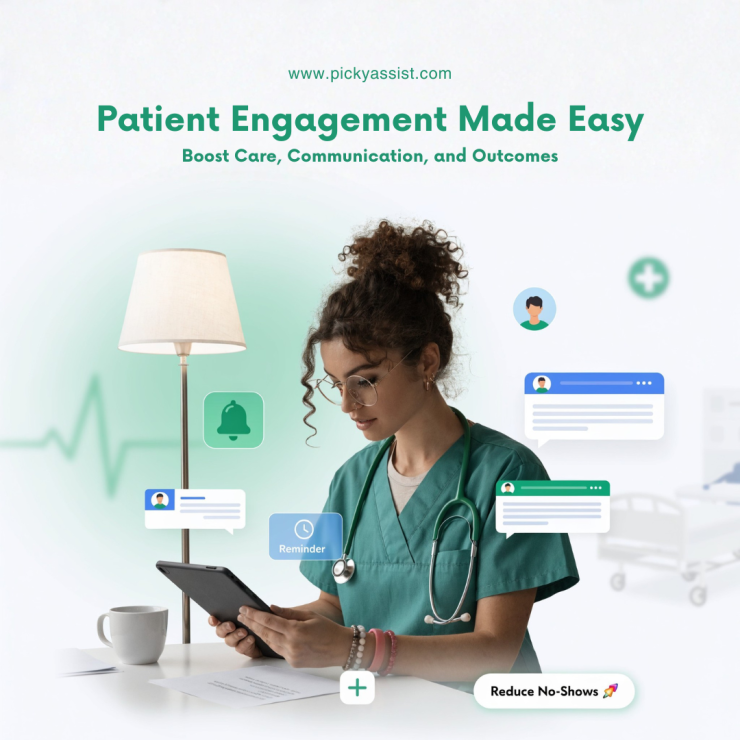
Healthcare has moved beyond episodic treatment. Today, it depends on continuous interaction, timely communication, and consistent follow-up across the entire patient journey. That shift is exactly why patient engagement solutions have become a core part of modern healthcare operations.
Hospitals, clinics, labs, and telemedicine providers are no longer asking whether they need engagement systems, they are asking which approach actually works. The challenge is not just choosing a tool, but selecting a solution that aligns with real workflows, patient behavior, and operational goals.
This guide breaks down how to evaluate, implement, and benefit from the right patient engagement platform, while also explaining where Picky Assist fits best in the hospitals.
What are Patient Engagement Solutions?
Patient engagement solutions are structured systems that help healthcare providers manage communication, automate interactions, and maintain consistent relationships with patients before, during, and after care delivery.
In practice, these patient support systems:
- Appointment confirmations and reminders
- Pre-visit instructions and preparation guidance
- Post-consultation follow-ups
- Medication and care adherence communication
- Feedback collection and patient satisfaction tracking
- Preventive and long-term health engagement
Unlike manual processes, a modern patient engagement system ensures that communication is timely, trackable, and scalable. This is especially critical in patient engagement in healthcare, where delays or missed interactions can directly impact outcomes.
Why is Patient Engagement critical?
The expectations of patients have changed. They now expect healthcare providers to offer the same responsiveness and convenience they experience in other industries. This shift has created operational pressure across healthcare organizations.
Communication Gaps Affect Outcomes
Patients often miss appointments or fail to follow treatment plans because communication is inconsistent. Without structured follow-ups, engagement becomes reactive instead of proactive. Picky Assist AI chatbots can interact with patients and continuously keep in touch to keep them engaged so that they won’t miss your scheduled appointments. Timely reminders and Chatbot communication could greatly benefit your business.
Operational Inefficiencies Increase Costs
Manual calls, scattered systems, and unstructured workflows increase staff workload. Over time, this reduces productivity and creates avoidable errors.
Retention and Experience Are Directly Linked
Patient loyalty is no longer guaranteed. A poor communication experience leads to drop-offs, while consistent engagement improves retention and referrals.
This is where digital patient engagement becomes essential. A well-implemented digital patient engagement platform transforms communication into a predictable, scalable process.
Core capabilities that define effective Patient Engagement Solutions
Not every platform delivers real value. The most effective patient engagement software solutions focus on practical functionality rather than feature overload.
Omnichannel Communication that matches Patient Behavior
Patients do not rely on a single communication channel. A strong healthcare engagement platform enables interaction across WhatsApp, SMS, email, and voice.
Picky Assist ensures omnichannel patient engagement, where patients receive messages on the channel they actually use. As a result, response rates improve without increasing effort.
Automation That Reduces Manual Workload
Automation is central to any modern software for patient engagement. However, it must be easy to implement and manage.
Common high-impact workflows include appointment reminders, follow-up messages, and diagnostic alerts. These use cases represent the foundation of automated patient engagement, helping providers reduce no-shows and improve adherence without increasing staff effort.
Personalization Without Complexity
Generic communication rarely works in healthcare. Patients respond better when messages are relevant to their condition or interaction stage.
A strong patient engagement platform enables segmentation, trigger-based messaging, and contextual communication. This ensures that engagement feels personalized, even at scale.
Integration with Healthcare Systems
A disconnected system limits effectiveness. A reliable patient engagement platform vendor ensures integration with hospital systems such as HIS, EMR, or CRM.
This integration allows data-driven communication instead of manual input, which improves both accuracy and efficiency.
Analytics That Drive Improvement
Without measurable insights, engagement strategies cannot evolve.
Effective patient engagement software provides visibility into message delivery, patient responses, and appointment conversion trends. These insights help healthcare providers refine workflows over time.
Types of Patient Engagement Platforms and Where They Fit
Healthcare organizations often evaluate multiple patient engagement vendors, but not all platforms are suitable for every use case.
Communication-Focused Platforms
These platforms specialize in messaging, reminders, and workflow automation. They are designed for speed, simplicity, and operational efficiency.
They are commonly used by clinics, diagnostic centers, and mid-sized hospitals that need reliable communication without enterprise complexity. This is where Picky Assist fits effectively, offering scalable messaging and workflow automation tailored to real-world healthcare operations. However it also offers insights into analytics on patient retention status and also on ROI obtained in hospitals and clinics using CRM data.
Full-Stack Digital Health Engagement Platforms
A digital health engagement platform typically includes patient portals, care management tools, and advanced analytics.
These solutions are better suited for large hospital networks that require centralized control across multiple departments. However, they often involve higher costs, longer onboarding, and heavier system dependencies.
Specialized Engagement Systems
Some platforms are designed for niche use cases such as chronic care or mental health. For example, a pharmacy patient engagement platform may focus on medication adherence and refill reminders, while a telehealth-focused system prioritizes virtual consultation workflows. Picky Assist is the best suggested solution if you need your patients to come back to your pharmacy by sending them timely reminders for refills.
Real-World Use Cases Across Healthcare Segments
Understanding practical applications helps clarify how patient engagement digital health systems deliver value.
Hospitals
Hospitals require structured communication across large patient volumes. A well-implemented patient engagement solutions for hospitals approach improves appointment adherence, discharge communication, and preventive care outreach. This results in better patient flow, reduced no-shows, and improved satisfaction scores.
Clinics and Private Practices
Clinics benefit from simplicity and speed. A lightweight patient engagement software setup can automate reminders and follow-ups, helping doctors focus more on care rather than coordination.
Diagnostic Centers and Labs
Labs rely heavily on timely communication. A structured digital patient engagement software setup ensures patients receive booking confirmations, preparation instructions, and report alerts without delays.
Telemedicine Providers
Telehealth depends on consistent interaction. A digital patient engagement for hospitals or telemedicine workflows includes pre-consultation guidance, follow-ups, and medication reminders to maintain continuity.
Wellness and Preventive Care Centers
Engagement in this segment is ongoing rather than episodic. A digital platform for patient engagement approach helps deliver health tips, reminders, and long-term program communication.
How to Choose the Best Patient Engagement Software?
Searching for the best patient engagement software often leads to confusion because requirements vary widely. A structured evaluation approach helps narrow down the right option.
Align With Your Use Case
Not all providers need enterprise-grade platforms. Clinics and mid-sized hospitals often benefit more from flexible, communication-driven systems like Picky Assist automation platform.
Evaluate Ease of Use
A system that requires heavy training slows adoption. The best solutions are intuitive and quick to deploy.
Check Channel Relevance
If your patients actively use WhatsApp, your health engagement platform must support it effectively.
Assess Automation Capabilities
Automation should be configurable without technical complexity. This ensures your team can adapt workflows independently.
Compare Cost vs Value
Many patient engagement software companies offer extensive features, but not all are necessary. The goal is to invest in functionality that directly impacts patient experience and operations.
Where Picky Assist fits in the Patient Engagement Ecosystem?
Picky Assist is positioned as a practical, communication-first solution within the broader category of patient engagement software solutions. It is not designed to replace complex hospital systems. Instead, it complements them by improving how healthcare providers communicate with patients at scale.
Why Does It Work Well?
Picky Assist is particularly effective for providers who need:
- Consistent, high-volume patient communication
- Automation without technical complexity
- Strong WhatsApp-based workflows
- Scalable engagement across multiple patient touchpoints
Practical Benefits
Picky Assist enables healthcare organizations to implement digital patient engagement without the overhead of large enterprise platforms. It supports structured workflows such as reminders, follow-ups, and alerts, while also enabling CRM-driven communication that improves continuity. Because it focuses on messaging and automation, it aligns well with real-world operational needs across clinics, hospitals, labs, and wellness providers.
Common Mistakes to avoid when implementing Patient Engagement Systems
Even the best healthcare engagement solutions can fail if implemented incorrectly.
One common mistake is selecting feature-heavy platforms without a clear use case. This leads to underutilization and unnecessary costs.
Another issue is ignoring patient communication preferences. If engagement does not happen on the right channel, even the most advanced system will underperform.
Finally, many organizations fail to define workflows before implementation. Technology should support a strategy, not replace it.
Implementation framework for sustainable results
Successful implementation of patient engagement solutions requires a structured approach.
First, define measurable goals such as reducing no-show rates or improving follow-up adherence. Without clear targets, it becomes difficult to evaluate success.
Next, map patient journeys across key touchpoints. This helps identify where communication gaps exist and where automation can add value.
Then, prioritize high-impact workflows. Appointment reminders and follow-ups typically deliver immediate results.
Finally, track performance and continuously refine the system. Engagement improves over time when data is used effectively.
What’s ahead in Digital Patient Engagement?
Healthcare is gradually shifting toward preventive and continuous care models. This transition increases the importance of structured communication.
A well-designed digital health patient engagement strategy ensures that providers stay connected with patients beyond clinical visits. Over time, this leads to better outcomes, improved efficiency, and stronger patient relationships.
As technology evolves, top patient engagement platforms will continue to focus on automation, personalization, and integration, making engagement more seamless and scalable.
To Conclude
Patient engagement is no longer a secondary function. It is a core capability that directly impacts outcomes, efficiency, and patient experience.
The right patient engagement solutions help healthcare providers streamline communication, reduce manual workload, and build long-term patient relationships.
However, success depends on choosing a system that aligns with real operational needs.
For organizations that prioritize communication, automation, and ease of use, Picky Assist offers a strong and practical fit. It enables scalable engagement without unnecessary complexity, making it particularly valuable for clinics, hospitals, labs, and growing healthcare providers.
FAQs on Patient Engagement Solutions
1. What are patient engagement solutions and why are they important?
Patient engagement solutions are systems that help healthcare providers communicate with patients, automate interactions, and improve care continuity. They are important because they directly impact patient outcomes, operational efficiency, and retention.
2. How does a patient engagement platform differ from a healthcare engagement platform?
A patient engagement platform focuses specifically on patient communication and interaction, while a healthcare engagement platform may include broader operational and administrative functionalities.
3. What is the role of digital patient engagement in hospitals?
Digital patient engagement improves communication across the patient journey, from appointment booking to post-discharge follow-ups. This helps hospitals reduce no-shows and improve patient satisfaction.
4. Are patient engagement software solutions suitable for small clinics?
Yes, especially communication-focused solutions. Clinics benefit from automation, improved follow-ups, and better time management without needing complex systems.
5. What features should I look for in a patient engagement system?
Key features include omnichannel communication, automation, personalization, integration with existing systems, and performance analytics.
6. How do patient engagement vendors differ from each other?
They differ in terms of features, complexity, pricing, scalability, and target audience. Some focus on enterprise hospitals, while others focus on communication and workflow automation.
7. Can patient engagement software integrate with existing healthcare systems?
Most modern platforms support integration with HIS, EMR, and CRM systems, enabling seamless data flow and more personalized communication.
8. How does Picky Assist support patient engagement?
Picky Assist enables communication-driven engagement through automation, CRM integration, and scalable messaging workflows, making it ideal for healthcare providers seeking practical and efficient solutions.

Add comment