
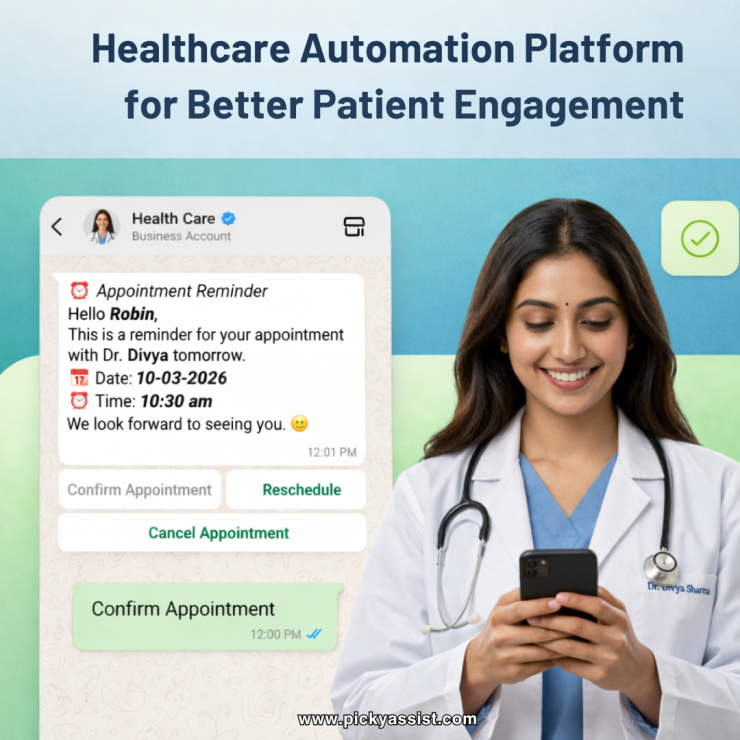
Healthcare organizations can no longer depend on disconnected calls, manual reminders, scattered spreadsheets, and one-size-fits-all outreach. Today, patients expect fast responses, timely reminders, clear communication, and a seamless experience across every touchpoint. That is exactly why healthcare marketing automation has become essential.
At its core, healthcare marketing automation helps providers, clinics, hospitals, diagnostic centers, dental practices, and wellness brands automate patient communication, lead nurturing, appointment reminders, follow-ups, reactivation campaigns, and engagement journeys. More broadly, it connects appointment scheduling, sending reminders and healthcare marketing into one structured system.
Picky Assist’s CRM-backed communication, AI chatbots, WhatsApp appointment booking, patient follow-ups, and no-show reduction can significantly benefit healthcare centers around the globe. Those capabilities map directly to what modern organizations expect from a healthcare automation platform: stronger patient engagement, faster responses, lower manual workload, and better conversion from inquiry to appointment.
At the same time, leading industry sources describe marketing automation as technology that automates campaigns and communication across channels, while healthcare CRM and patient engagement platforms centralize patient data and personalize outreach throughout the care journey.
So, if you are evaluating how to improve patient outreach, reduce no-shows, streamline engagement, and create a more scalable growth engine, this guide will show you exactly how healthcare automation platform fits into modern patient acquisition and retention.
What is Healthcare Marketing Automation?
Healthcare marketing automation is the use of software, workflows, CRM data, AI, and communication tools to automate and personalize outreach to patients, prospects, referrers, and care audiences.
In practical terms, it helps healthcare organizations:
- capture inquiries
- respond instantly
- schedule and confirm appointments
- send reminders
- share educational content
- nurture patient interest
- re-engage inactive patients
- collect feedback
- support retention and repeat visits
General marketing automation is defined as a technology that manages marketing processes and multi-channel campaigns automatically. In healthcare, that same logic becomes more patient-centric and journey-driven. Instead of generic lead nurturing alone, the focus expands to communication that supports access, adherence, engagement, and satisfaction.
That is why medical automation platforms are becoming more important. Healthcare buyers and patients move through complex journeys. They may inquire, wait for a callback, reschedule, ask questions, miss an appointment, and return weeks later. Without automation, those journeys easily break.
Why Healthcare Marketing Automation Matters Now?
Healthcare communication has changed dramatically. Patients do not want to wait for office hours just to book, confirm, or clarify basic questions. They expect speed, convenience, and personalization.
At the same time, provider teams are under pressure. Front-desk staff manage calls, appointment changes, reminders, follow-ups, and paperwork. Sales or outreach teams in diagnostics, elective care, dental, fertility, wellness, and specialty practices often juggle campaign inquiries manually. As a result, response times slow down, no-shows rise, and opportunities get lost.
This is exactly where healthcare automation software creates value.
The patient engagement software helps providers communicate clearly with patients through timely, personalized information and guidance. HubSpot’s healthcare CRM positioning similarly emphasizes automated, personalized patient engagement based on behavior and journey signals.
Meanwhile, Picky Assist’s own healthcare platform focuses on reducing no-shows, automating reminders, improving patient communication, and centralizing outreach through CRM and conversational automation.
Therefore, healthcare marketing automation now matters because it helps organizations:
- improve inquiry response time
- reduce no-shows
- automate appointment workflows
- increase patient engagement
- personalize outreach
- retain more patients
- reduce administrative burden
- create measurable growth systems
How Healthcare Marketing Automation Works?
A strong healthcare marketing automation platform does not just send messages. It creates structured patient journeys.
For example, a patient may fill out a consultation form. Immediately, the system sends a confirmation message. Then, it asks a few basic qualification questions. After that, it routes the inquiry to the right team member, creates a task in CRM, and triggers reminders before the consultation. If the patient does not book, the system can send a follow-up series. If the patient books but misses the appointment, the system can trigger a rescheduling flow.
That is the real power of automation. It turns fragmented interactions into a coordinated experience.
Picky Assist is particularly aligned with this model because its published healthcare workflows emphasize CRM integration, chatbot-led interaction, automated booking, and follow-up journeys through channels like WhatsApp.
Core Benefits of Healthcare Marketing Automation
1. Faster Patient Response
Response speed shapes conversion. When a patient or prospect makes an inquiry, delay causes drop-off. Automation can acknowledge, qualify, and route the inquiry instantly.
2. Better Patient Engagement
Patient engagement improves when communication is timely, personalized, and consistent. Patient engagement using personalized insights and recommendations help patients start and stay on treatment for long. Automation supports that consistency at scale.
3. Reduced No-Shows
One of the clearest use cases is automated reminders. Picky Assist’s healthcare and dental reminder specifically ties appointment automation to fewer no-shows and better clinic revenue performance.
4. Lower Administrative Burden
By automating confirmations, reminders, FAQs, and follow-ups, staff spend less time repeating routine communication.
5. Improved Retention
Patients often need nudges for follow-up visits, preventive care, repeat services, or wellness programs. Automation makes that sustainable.
6. Better Conversion from Marketing Efforts
Whether the lead comes from ads, web forms, campaigns, or referrals, automation helps move that interest toward an appointment or consultation.
7. More Actionable Reporting
Automation platforms tied to CRM make it easier to measure lead source quality, booking performance, reminder outcomes, and campaign results.
Healthcare Marketing Automation vs General Marketing Automation
General marketing automation focuses on lead generation, campaign workflows, and conversion. Healthcare marketing automation includes those goals, but it adds patient communication, scheduling support, care journey reminders, and operational coordination.
That difference matters. A healthcare system cannot rely on generic workflows alone. It needs communication that respects real patient journeys and often requires data visibility, segmentation, and workflow routing across departments.
This is where business process automation in healthcare connects. Outreach does not stop at the ad click. It continues through intake, scheduling, reminders, follow-ups, and feedback. Picky Assist automation can manage these entire processes for your healthcare organization.
How Picky Assist Supports Healthcare Marketing Automation
Picky Assist fits this space strongly because its capabilities overlap with the most practical and high-impact needs in patient outreach and engagement.
CRM-Backed Patient Communication
Picky Assist’s healthcare CRM highlights centralized patient data and communication workflows. That is a major strength because outreach works better when every interaction has context.
WhatsApp-Based Appointment and Reminder Automation
Picky Assist’s published workflows around WhatsApp appointment booking and dental reminders directly support healthcare marketing automation goals. Clinics can automate confirmations, reminders, patient replies, and rescheduling paths in a channel patients actually use.
AI Chatbots for Healthcare
Picky Assist’s chatbot-for-healthcare positions automation as a way to answer common questions, book appointments, reduce no-shows, and improve revenue performance. That directly supports both patient engagement and healthcare growth.
Omnichannel Journey Automation
The platform’s CRM and automation shows how conversational automation, lead workflows, and connected campaigns can improve follow-up and engagement across the journey.
Strong Fit for Outreach-Heavy Healthcare Segments
Picky Assist is especially relevant for clinics, dental practices, diagnostic centers, specialty practices, wellness providers, elective care providers, and other patient-facing organizations that need structured communication and follow-up.
Use Cases of Healthcare Marketing Automation
Appointment Booking Automation
Patients can inquire and move directly into an automated booking flow. This improves access and reduces staff burden.
Reminder Campaigns
Automated reminders before visits, diagnostics, consultations, or procedures help reduce no-shows and improve readiness.
Missed Appointment Recovery
If a patient misses an appointment, the system can automatically send a follow-up and rescheduling prompt.
New Patient Nurturing
Prospective patients who inquire but do not book immediately can enter an automated nurture sequence.
Preventive Care Campaigns
Practices can send reminders for annual checkups, dental cleanings, screenings, vaccinations, and follow-up care.
Review and Feedback Collection
Post-visit automation can request reviews and feedback, which helps both reputation and service improvement.
Re-Engagement Campaigns
Inactive patients can receive reminders, wellness prompts, checkup nudges, or service reactivation offers.
Health Education Workflows
Educational communication can support ongoing patient engagement when done appropriately and clearly.
These are all practical automation in healthcare examples, and they show why automation in the healthcare industry is now tightly connected with patient communication and growth.
Healthcare Sales Automation and Patient Acquisition
Although some organizations think only in terms of patient communication, healthcare sales automation also matters. Elective healthcare, diagnostics, specialist clinics, dental practices, cosmetic centers, fertility clinics, and wellness providers often manage inquiry-to-booking funnels that look very similar to sales pipelines.
That is why healthcare sales automation includes:
- instant inquiry acknowledgment
- lead qualification
- follow-up sequences
- consultation scheduling
- team assignment
- status tracking
- reactivation campaigns
A strong system does not treat this as random admin work. It creates a repeatable process that improves conversion from campaign to consultation.
Picky Assist’s CRM, chatbot, and follow-up capabilities make it especially relevant here because the platform supports conversational conversion flows instead of passive lead storage.
Medical Marketing Automation for Modern Practices
Medical marketing automation is especially useful for private practices, specialty clinics, dental centers, diagnostics providers, and wellness brands because these organizations often depend on responsive communication and repeated patient touchpoints.
In these settings, medical practice marketing is not only about visibility. It is also about what happens after the inquiry.
For example:
- A dermatology clinic may run campaigns for consultations.
- A dental practice may nurture whitening or implant inquiries.
- A diagnostics chain may automate test booking reminders.
- A physiotherapy center may re-engage previous patients.
- A fertility clinic may segment leads by treatment interest.
The more complex the journey, the more valuable automation becomes.
Healthcare Workflow Automation and Operational Efficiency
Healthcare workflow automation overlaps heavily with marketing automation because patient outreach affects operations.
For instance, a campaign generates leads. Those leads need qualification. Qualified patients need appointment booking. Booked patients need reminders. Attended visits need follow-up. Missed appointments need recovery. Everything is connected.
That is why healthcare process automation matters so much. Automation is not just a marketing add-on. It becomes part of the operational engine.
Picky Assist’s healthcare CRM proves how appointment and communication workflows can reduce friction in everyday patient care operations.
Intelligent Automation in Healthcare
Intelligent automation in healthcare takes basic workflow automation further by adding AI-driven logic, contextual engagement, and smart routing.
This can include:
- AI chatbots that answer FAQs
- lead or inquiry qualification
- workflow branching based on patient responses
- personalized reminders
- automated routing to the right team
- smart follow-up timing
In broader terms, healthcare intelligent automation, brings together rules, CRM data, conversational tools, and AI decision support.
Picky Assist’s AI-powered chatbot and workflow fit naturally into this category, especially where organizations want 24/7 inquiry handling and structured patient journeys without heavy manual work.
Intelligent Document Processing in Healthcare
Healthcare automation is not limited to outreach. Administrative efficiency matters too. These areas cover data handling, paperwork, patient intake, records movement, and back-office consistency.
While Picky Assist is more closely aligned with patient engagement, reminders, CRM-backed communication, and conversational workflows than with full clinical records automation, those communication flows can still reduce document-related friction by guiding patients through pre-visit and post-visit steps. This is an inference based on Picky Assist’s workflow and communication capabilities rather than a claim that it replaces medical records systems.
Revenue and Payment Automation in Healthcare
Another adjacent area is financial operations. Healthcare payment automation helps for easier hospital administration as much time could be saved when large queues for payments are eliminated .These focus more on billing, claims, eligibility, collections, and payer workflows. Picky Assist is more directly suited to the communication side of the journey, such as reminders, confirmations, follow-ups, and patient engagement, and has a dedicated auto-payment system. Communication automation can still send payment reminders as part of a broader patient communication workflow. That is a practical extension, though not the same as specialized RCM software.
Automation in Healthcare Examples
Here are realistic automation in healthcare examples that show how the concept works in practice:
- A clinic runs ads for specialist consultations. New leads receive instant replies, qualification questions, and booking prompts.
- A dental practice sends pre-appointment reminders, rescheduling options, and post-treatment feedback requests automatically.
- A diagnostic center confirms bookings, shares preparation instructions, and sends follow-up messages after the test.
- A wellness clinic reactivates inactive patients with targeted checkup campaigns.
- A hospital outpatient department uses automated reminders and FAQ chatbots to reduce front-desk call load.
These examples show how automation in hospitals often begin with communication workflows that reduce manual effort and improve patient access.
Healthcare Marketing Agencies vs Automation Platforms
Many organizations compare healthcare marketing agencies and medical marketing companies when trying to grow. Agencies can help with strategy, campaigns, design, and media buying. However, without automation, those campaigns often leak value after the lead arrives.
That is the missing piece.
A campaign may generate demand, but a healthcare marketing automation platform helps convert that demand into appointments and long-term patient relationships. So the best model is often not agency versus automation. It is agency plus automation.
In other words, health marketing works better when patient journeys are automated after the click.
Why is Picky Assist a Strong Choice for Healthcare Marketing Automation?
Picky Assist stands out because it matches real-world healthcare communication needs.
It helps organizations move beyond manual calling and one-off reminders. Instead, it supports CRM-backed communication, chatbot-led engagement, WhatsApp workflows, follow-up automation, and appointment-driven interaction. Picky Assist is a strong fit for healthcare organizations that want to:
- automate patient outreach
- improve inquiry handling
- reduce no-shows
- centralize communication
- scale follow-up
- strengthen patient retention
For Picky Assist, the best-fit narrative is not “replace every hospital system.” It is “improve patient engagement and outreach through conversational automation, CRM integration, and journey-based communication.” and to offer the best all-in-one platform that can manage appointment scheduling, sending appointment reminders to millions with a single click or to manage marketing initiatives like sending offers, discounts or free consultation campaigns to many without account blocks or spamming.
Best Practices for Healthcare Marketing Automation
To succeed with automation, healthcare teams should follow a few practical rules.
- Start with one or two high-impact workflows, such as appointment reminders and missed-appointment recovery.
- Use CRM data to personalize messages.
- Keep communication clear, respectful, and useful.
- Map journeys around real patient behavior, not idealized assumptions.
- Measure response rates, bookings, no-shows, and reactivation results.
- Connect marketing activity with operational workflows so the journey stays smooth.
- Most importantly, choose a platform that your team will actually use.
Common Mistakes to Avoid
Many healthcare organizations make the same automation mistakes.
- Automating too much and too fast.
- Sending generic messages without context.
- Ignoring the booking and post-booking journey.
- Failing to track results.
- Treating automation as a campaign tool only, instead of a patient experience tool.
They choose disconnected tools that create more admin work. A better approach is to build around patient communication first. That is also where Picky Assist has a practical advantage.
Conclusion
Healthcare marketing automation is no longer a nice extra. It is now a core growth and engagement system for modern healthcare organizations. It helps providers and patient-facing healthcare businesses respond faster, communicate better, reduce no-shows, improve retention, and create smoother patient journeys.
For organizations evaluating tools in this space, Picky Assist is a strong option because it aligns closely with the communication and outreach challenges healthcare teams actually face. Its healthcare-focused consistently highlights AI chatbots, CRM-backed workflows, WhatsApp appointment booking, automated reminders, and patient engagement journeys. Those capabilities directly support better outreach, stronger patient communication, and more efficient operations.
So, if your goal is to modernize patient communication and build a scalable engagement engine, a platform built around automation, CRM, and conversational outreach is no longer optional. It is the direction healthcare growth is already moving.
FAQs About Healthcare Marketing Automation
1. What is healthcare marketing automation?
Healthcare marketing automation is the use of software and workflows to automate patient outreach, reminders, follow-ups, nurturing, and communication across channels. It helps healthcare organizations improve engagement, reduce manual workload, and increase conversion from inquiry to appointment.
2. How is healthcare marketing automation different from general marketing automation?
General marketing automation focuses on leads and campaigns. Healthcare marketing automation includes those functions, but it also supports patient engagement, appointment reminders, care journey communication, and operational workflows.
3. What are examples of healthcare automation?
Examples include appointment reminders, chatbot-based inquiry handling, booking confirmations, no-show recovery workflows, preventive care follow-ups, reactivation campaigns, and patient feedback collection.
4. How does automation improve patient engagement?
Automation improves patient engagement by delivering timely, personalized communication and by helping patients move through their care or appointment journey with less confusion and delay. Patient engagement automation is essential in terms of personalized communication and patient journey support.
5. Is Picky Assist suitable for healthcare marketing automation?
Yes. Picky Assist is well suited for patient engagement and outreach use cases such as healthcare chatbots, CRM-backed communication, WhatsApp booking automation, and appointment reminders.
6. Can healthcare marketing automation reduce no-shows?
Yes. Automated reminders, confirmations, and rescheduling prompts are among the most effective uses of healthcare automation for reducing no-shows. Picky Assist’s own healthcare examples directly highlight this outcome.
7. What is a healthcare marketing automation platform?
A healthcare marketing automation platform is a system that combines communication automation, CRM, segmentation, workflows, and reporting to help healthcare organizations manage patient outreach and engagement at scale.
8. Does healthcare marketing automation help with sales?
Yes, especially in healthcare segments where patient acquisition includes inquiry handling, lead nurturing, consultation scheduling, and follow-up. That is where healthcare sales automation becomes valuable.
9. Can automation replace front-desk staff?
No. Automation works best as support, not as a total replacement. It handles repetitive communication and helps teams focus on higher-value patient interactions.
10. What should I look for in healthcare automation software?
Look for CRM integration, appointment workflow support, chatbot capabilities, reminder automation, patient segmentation, analytics, and practical ease of use.

Add comment