
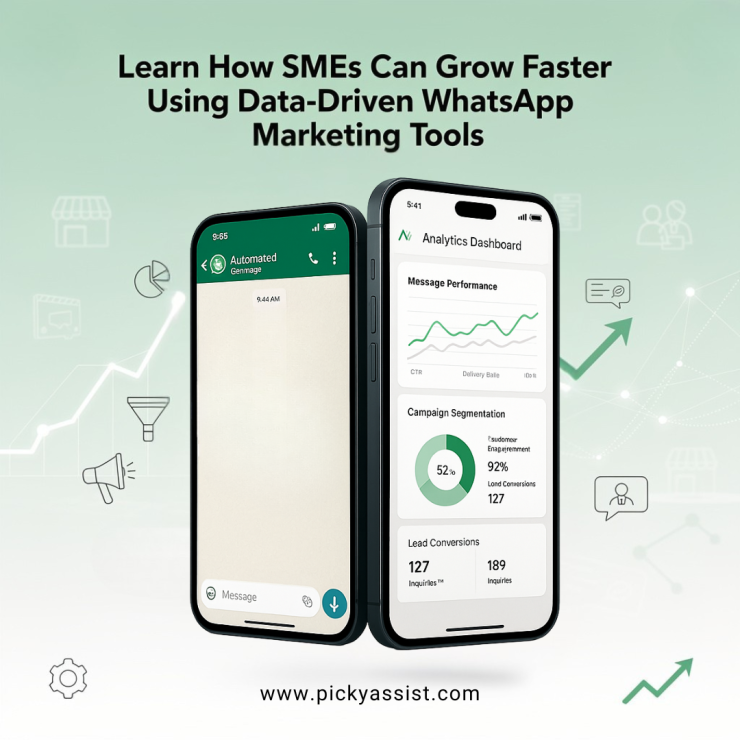
Small and Medium Enterprises (SMEs) compete on speed, trust and convenience. A thoughtfully chosen WhatsApp Marketing Tool lets you meet customers where they already spend time, deliver timely offers, and convert conversations into sales without complex stacks.
More than 92% of Indian SMEs rely on WhatsApp as their primary communication channel with customers. With over 2.8 billion monthly active users globally, WhatsApp automation has evolved from a simple messaging app to a high-value business ecosystem, one where customer engagement, sales conversions, and retention can all be driven from a single interface.
For Indian and global SMEs alike, messaging-first engagement now drives measurable gains in response rates, repeat purchases and support efficiency.
Why SMEs Should Care: Facts & Business Impacts
- WhatsApp reaches billions globally and over half a billion users in India alone, making it one of the most cost-effective channels for local businesses.
- Companies that add automation to messaging report faster lead responses and higher engagement, automation decreases follow-up time and helps scale outreach without linearly increasing headcount.
- WhatsApp’s messaging guidelines and Business API rules require careful handling of template messages and consent; compliance protects deliverability and reputation.
What a good WhatsApp Marketing Tool Actually Does?
A modern messaging solution for SMEs should combine several capabilities so that small teams can act like large ones:
- Centralized contact management and segmentation so you can target relevant customers.
- Campaign orchestration with personalization tokens and scheduled sends.
- Two-way conversational flows with chatbots and human handoffs for sales and support.
- Analytics and campaign tracking to measure opens, clicks and conversions.
- Integrations with CRMs, payment gateways and e-commerce platforms to close the purchase loop.
When these capabilities are combined, a WhatsApp program stops being a broadcast channel and becomes a repeatable revenue engine.
Key Features to Evaluate in a WhatsApp Marketing Tool and How they affect ROI?
- Automation & Templates — Look for a platform that supports reusable templates for time-sensitive promotions and automated follow-ups triggered by events (abandoned cart, appointment reminders). This is where WhatsApp marketing automation produces real ROI by converting leads faster.
- Segmentation & Personalization — Segment customers by purchase history, location or lifecycle stage and send tailored WhatsApp marketing messages that feel personal rather than generic. Personalized messages significantly outperform mass blasts.
- Compliance & Template Management — Because bulk or unsolicited sending is restricted, choose a platform that helps manage approved templates and opt-in lists to protect your business from penalties. Refer to WhatsApp’s official messaging guidelines for best practices.
- Broadcast vs Conversational Flows — Effective tools combine one-to-many announcements with one-to-one conversational funnels that move prospects down the funnel without manual effort. Platforms that mix both deliver better conversion lift.
- Analytics — Track delivery, response rates and conversions so you can optimize copy, timing and audience. Start small, measure, then scale.
Comparing Common Tool Types for SMEs
SMEs usually choose between three categories:
- Simple broadcast tools (easy, low-cost): suited for announcements but risk lower engagement and compliance issues if used for mass unsolicited outreach. Many of these are marketed as bulk senders. If you evaluate bulkWhatsApp sender software, prioritize platforms that respect API rules rather than unofficial scrapers.
- Automation-first platforms (balanced): integrate chatbots, templates and CRM syncing. These excel at WhatsApp marketing automation and are best when you need both marketing campaigns and conversational support. Picky Assist is a representative provider in this space, offering conversational funnels, template management and marketplace integrations for SMEs.
- Enterprise-grade platforms (scalable): built for high volume, multi-agent routing and deep analytics. These are appropriate when you have large user bases and strict compliance or SLA requirements.
Practical Use Cases for SMEs
- Local retail: Send a timed discount to segmented customers (repeat buyers within 90 days) and measure uplift. Even modest campaigns can improve weekly footfall by mid-teens percentage points when targeted correctly.
- Service businesses: Automate appointment reminders and follow-up satisfaction surveys via WhatsApp marketing for business, reducing no-shows and improving NPS.
- E-commerce: Recover abandoned carts with an interactive message that includes a quick checkout link; tag customers who click but don’t buy for a follow-up discount.
Choosing between “bulk” and “permissioned” strategies
While bulk WhatsApp marketing sounds attractive for reach, WhatsApp’s platform is not a permission-free broadcast channel. A compliant program uses opt-ins, approved templates for notifications outside the 24-hour window, and conversational flows for engagement. Tools labeled simply as bulkWhatsApp sender software often rely on unofficial methods that risk account bans; prefer certified platforms or providers that use the official Business API.
Why Do SMEs Consider Picky Assist as their Most Trusted Automation Partner?
Picky Assist positions itself as a messaging-first automation and social CRM solution that helps SMEs build conversational funnels, automate follow-ups, and integrate leads from marketplaces and web forms. Their offering includes a free tier and workflow builders that simplify common SME use cases like catalog automation and broadcast scheduling. If your growth depends on messaging, consider platforms that combine campaign orchestration with compliant template handling.
Best Practices Checklist before you launch
- Collect explicit opt-ins and keep a consent log.
- Use approved message templates for notifications that fall outside the standard session window.
- Stagger sends and respects customer time zones to avoid fatigue.
- Personalize at scale with simple tokens (name, order id, last purchase).
- Monitor bounce rates and responses; route high-intent replies to sales agents quickly.
- Prefer platforms that offer native WhatsApp marketing platform features and support the Business API.
Conclusion
WhatsApp has become the new business battleground, fast, personal, and incredibly powerful for driving revenue.
For SMEs, a well-architected messaging program creates disproportionate returns: higher open rates, faster conversions and happier customers. Choose a solution that balances reach with compliance, one that provides WhatsApp marketing software capabilities without exposing your business to policy risk. Prioritize tools that enable meaningful conversation (automated workflows, consent management and analytics) rather than one-off blasts. Begin with a pilot, track conversions, and iteratively expand successful flows into full campaigns.
When combined with smart automation, AI-driven workflows, and structured campaign strategies, WhatsApp becomes a complete sales and retention engine. SMEs using tools like WhatsApp marketing software, WhatsApp marketing automation, and WhatsApp campaign tools report up to 3× higher lead engagement, 50% faster sales closure, and significantly lower customer support costs.
FAQs on WhatsApp Marketing Tools
1. What is a WhatsApp Marketing Tool and how does it help SMEs?
A WhatsApp Marketing Tool centralizes contact lists, automates message sequences, and tracks campaign performance so SMEs can run targeted promotional and support programs with minimal manual work. It reduces lead response time and increases engagement when used with consent.
2. Are bulk WhatsApp campaigns allowed?
Unsolicited mass messaging is against WhatsApp’s policies. Use approved templates, manage opt-ins, and rely on Business API-integrated platforms rather than unauthorized bulk senders to avoid penalties.
3. Which features should small businesses prioritize?
Prioritize automation for follow-ups, segmentation for targeted offers, template management for compliance, and analytics to measure ROI. Start small with A/B tests and scale what works.
4. How much can SMEs expect to improve response rates?
While exact uplift varies, case studies and industry data show automation and messaging-first workflows commonly produce double-digit improvements in response and significant reductions in lead conversion time. Measure your baseline and set conservative targets for the first 90 days.
Add comment