
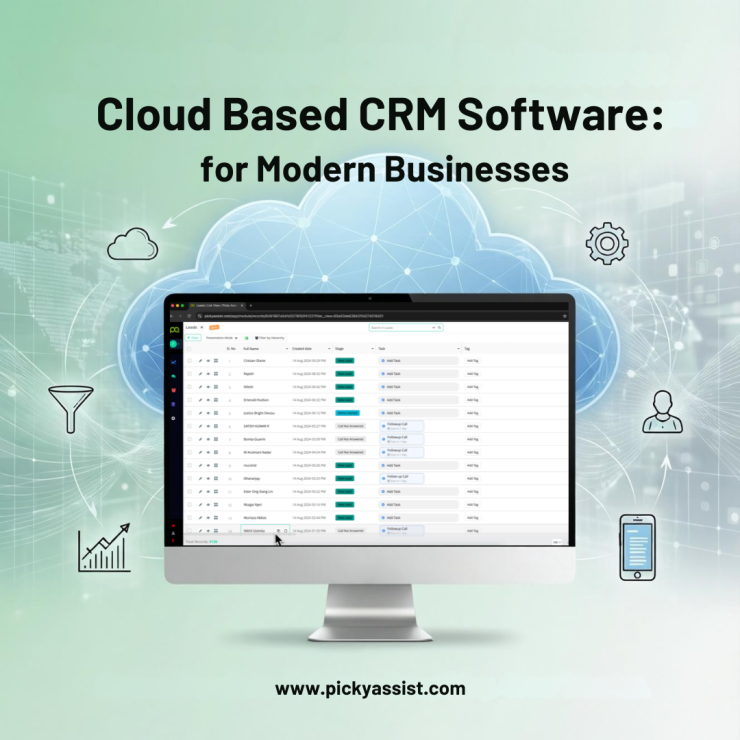
Businesses can no longer rely on spreadsheets, disconnected tools, or legacy systems to manage customer relationships. Cloud based CRM software has become the foundation of scalable sales, marketing, and service operations.
For a startup, an SME, or an enterprise organization, adopting a cloud based CRM system is a strategic necessity. This comprehensive guide explains everything you need to know about cloud based CRM software, including features, benefits, use cases, comparisons, implementation strategy, and FAQs.
What is Cloud Based CRM Software?
Cloud based CRM software is a customer relationship management solution hosted on remote servers and accessed through the internet. Unlike traditional on-premise CRM systems, cloud based CRM platforms do not require physical installation, hardware infrastructure, or complex IT maintenance.
It is also commonly referred to as:
- Cloud based CRM
- Web based CRM
- Online customer management software
- Cloud based customer relationship management software
Users can securely log in from any device; desktop, tablet, or mobile; making it highly accessible and scalable.
How Cloud Based CRM Works?
A cloud based CRM system operates on a Software-as-a-Service (SaaS) model. The CRM provider hosts the software on secure cloud servers, manages updates, ensures data security, and maintains uptime.
Businesses subscribe to the platform and access it via a web browser.
Key operational components include:
- Centralized customer database
- Lead and opportunity tracking
- Sales pipeline management
- Automated workflows
- Reporting dashboards
- Customer support ticket management
This architecture eliminates infrastructure costs and reduces dependency on internal IT teams.
Why Are Businesses Moving to Cloud Based CRM Systems?
1. Scalability Without Infrastructure
Cloud based CRM systems grow with your business. You can add users, storage, and features without investing in physical servers.
2. Lower Upfront Costs
Unlike traditional CRM software, cloud based CRM solutions operate on subscription models. This reduces capital expenditure.
3. Remote Accessibility
With a web based CRM, teams can access data from anywhere, essential for hybrid and remote work environments.
4. Automatic Updates
The vendor manages upgrades, security patches, and feature releases.
5. Enhanced Collaboration
Cloud based CRM platforms enable shared dashboards, internal notes, and centralized communication.
Core Features of Cloud Based CRM Software
Contact & Lead Management
A cloud based contact management software centralizes customer details, interaction history, communication logs, and transaction data.
Sales Pipeline Management
Cloud based sales management software tracks leads through stages, from prospecting to deal closure.
Marketing Automation
Campaign tracking, segmentation, email automation, and performance analytics are integrated within modern cloud based CRM tools.
Customer Support Management
Cloud based customer service management software enables ticketing systems, SLA tracking, and automated responses.
Workflow Automation
Automated follow-ups, reminders, task assignments, and approvals reduce manual work.
Reporting & Analytics
Real-time dashboards provide performance insights for sales, marketing, and service teams.
Cloud Based CRM for Small Business
Small and medium enterprises benefit significantly from cloud based CRM for small business because:
- It eliminates hardware investment.
- It offers predictable monthly pricing.
- It supports rapid scaling.
- It provides professional-grade sales tools.
Cloud based CRM systems for small business often include:
- Lead tracking
- Email integration
- Deal forecasting
- Automated follow-ups
- Team performance monitoring
For startups, cloud based CRM software for small businesses becomes a growth accelerator.
Cloud Based CRM vs Traditional CRM
| Feature | Cloud Based CRM | On-Premise CRM |
| Deployment | Online | Local Server |
| Cost Model | Subscription | High upfront cost |
| Maintenance | Vendor managed or No-code minimal | In-house IT Team |
| Accessibility | Anywhere | Limited network access |
| Scalability | Instant | Complex |
Cloud based customer relationship management offers superior flexibility and cost efficiency compared to legacy systems.
Types of Cloud Based CRM Solutions
Operational CRM
Focuses on automation of sales, marketing, and service processes.
Analytical CRM
Emphasizes data analysis and business intelligence.
Collaborative CRM
Enhances communication across departments.
Most cloud based CRM platforms combine all three functionalities.
Industries Using Cloud Based CRM Platforms
- Real Estate
- Education
- Healthcare
- E-commerce
- SaaS
- Financial Services
- Manufacturing
Every sector benefits from centralized online customer management software.
Benefits of Cloud Based Customer Relationship Management Software
Improved Sales Productivity
Cloud based sales management software reduces time spent on administrative tasks.
Better Customer Experience
Centralized history enables personalized communication.
Data-Driven Decisions
Advanced analytics improve forecasting accuracy.
Faster Implementation
Cloud based CRM systems can be deployed within days.
Business Continuity
Cloud hosting ensures high availability and disaster recovery.
Key Features to Look for in a Cloud Based CRM Tool
When selecting cloud based CRM software, evaluate:
- Data security and compliance
- Customization options
- API integrations
- Automation capabilities
- Mobile accessibility
- Reporting depth
- Multi-user access controls
Choosing the right cloud based CRM solutions determines long-term ROI.
Implementation Strategy for Cloud Based CRM Systems
Step 1: Define Objectives
Clarify whether your goal is sales growth, service optimization, or full digital transformation.
Step 2: Map Customer Journey
Identify touchpoints across marketing, sales, and service.
Step 3: Data Migration Planning
Clean and structure existing data before importing into the cloud based CRM system.
Step 4: Team Training
Ensure all departments understand usage workflows.
Step 5: Performance Monitoring
Track KPIs using built-in analytics.
Security in Cloud Based CRM Software
Modern cloud based customer relationship management systems use:
- End-to-end encryption
- Role-based access control
- Multi-factor authentication
- Secure data centers
- Regular backups
Data security standards are often stronger than internal IT setups.
Integration Capabilities
A high-performance cloud based CRM tool integrates with:
- Email platforms
- Marketing automation software
- Accounting tools
- ERP systems
- Customer support platforms
- Telephony solutions
Seamless integration increases operational efficiency.
Future of Cloud Based CRM
The evolution of cloud based CRM software includes:
- AI-powered lead scoring
- Predictive analytics
- Conversational automation
- Advanced personalization
- Omnichannel engagement
As digital ecosystems expand, cloud based CRM platforms will become even more intelligent and proactive.
Conclusion
Cloud based CRM software is the backbone of modern business operations. It empowers organizations with centralized data, automated workflows, improved collaboration, and scalable infrastructure.
From cloud based CRM for small business to enterprise-grade cloud based CRM systems, companies that adopt digital customer management platforms gain a significant competitive advantage.
Investing in cloud based customer relationship management software is not just about managing contacts, it is about building sustainable, data-driven growth.
FAQs on Cloud Based CRM Software
1. What is cloud based CRM software?
Cloud based CRM software is an online customer management system hosted on remote servers, accessible via the internet, and designed to manage sales, marketing, and customer service operations.
2. Is cloud based CRM suitable for small businesses?
Yes. Cloud based CRM software for small businesses provides cost-effective scalability, automation, and professional sales management tools without infrastructure investment.
3. What is the difference between cloud based CRM and web based CRM?
There is no major difference. Web based CRM is another term for cloud based CRM systems accessed through internet browsers.
4. How secure is cloud based customer relationship management?
Modern cloud based CRM solutions use enterprise-grade encryption, access controls, and secure hosting environments to protect data.
5. Can cloud based CRM integrate with other software?
Yes. Most cloud based CRM platforms support API integrations with accounting, marketing, support, and ERP tools.
6. How long does it take to implement a cloud based CRM system?
Implementation can range from a few days to a few weeks depending on data migration, customization, and team onboarding requirements.
7. What industries benefit most from cloud based CRM?
Industries such as real estate, healthcare, education, retail, SaaS, and financial services widely use cloud based CRM systems for centralized customer management.





Add comment