
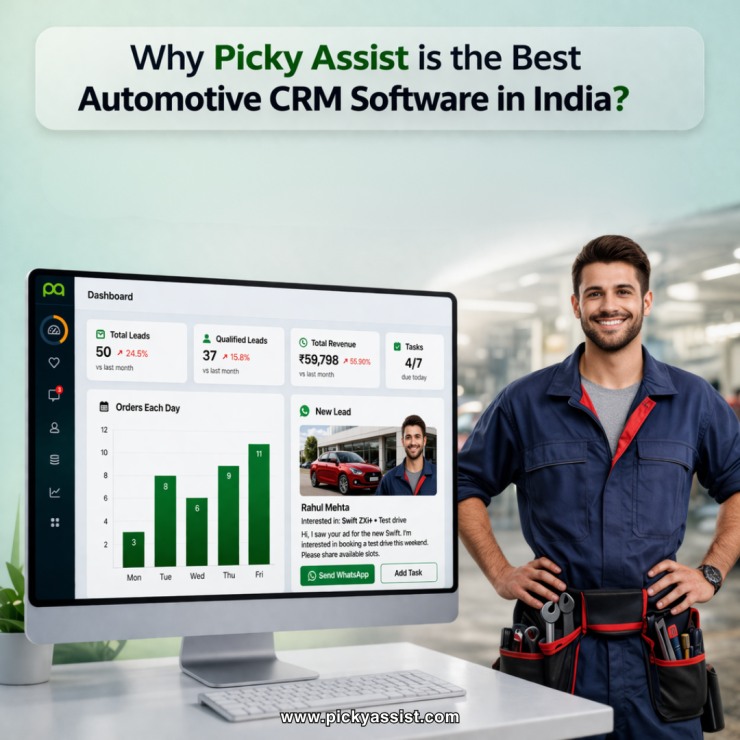
The automotive industry no longer runs on walk-ins, scattered spreadsheets, missed follow-ups, and disconnected service conversations. Today, growth depends on speed, consistency, personalization, and visibility across the entire customer journey. That is exactly why automotive CRM software has become essential for dealerships, used car sellers, auto service centers, detailing businesses, and multi-location automotive brands.
Whether you are looking for an automotive CRM, a dealership CRM, a car sales CRM, a CRM for auto repair shops, the goal is the same: capture every lead, track every conversation, automate every critical follow-up, and convert more opportunities without increasing chaos.
At the same time, the market has become noisy. Many tools claim to be the best automotive CRM. However, most businesses do not simply need another dashboard. Instead, they need a system that improves response time, centralizes customer history, automates reminders, integrates communication channels, and supports both sales and service workflows.
Picky Assist aligns strongly with what high-performing automotive businesses actually need now: omnichannel customer engagement, AI chatbots, CRM-backed communication, WhatsApp automation, lead qualification, follow-up automation, and funnel-based journey management.
So in this guide, we will go deep into what CRM software for the automotive industry should do, how it supports dealerships and workshops, why it matters for modern customer expectations, and how Picky Assist fits into this space as a practical automotive CRM solution for sales, service, engagement, and retention.
What is Automotive CRM Software?
Automotive CRM software is a customer relationship management platform designed for businesses in the automobile sector. It helps dealerships, used car sellers, auto repair centers, service garages, detailing studios, and automotive brands manage leads, customer communication, bookings, reminders, follow-ups, and repeat business from one structured system.
In simple terms, CRM in automotive is the operational brain that keeps customer journeys from falling apart.
Instead of storing inquiries in one place, phone notes in another, and WhatsApp chats on individual staff devices, an automotive CRM system brings all that data together. As a result, teams can respond faster, personalize better, and close more deals or service jobs.
That matters because automotive buying and servicing are both multi-touch journeys. A customer may first ask about availability online, then compare models, request a callback, visit the showroom, discuss financing, ask for a test drive, go silent for a week, and then return ready to buy. Similarly, a service customer may book maintenance, need reminders, approve repairs, ask about delays, and then return later for renewal or repeat service. CRM platforms built for automotive environments help businesses manage those journeys without losing context.
This is why terms like CRM automotive software have become so important in search. Businesses are no longer buying software just for contact storage. They are buying a system that improves conversion, service consistency, retention, and visibility.
Why do Automotive Businesses Need CRM more than ever?
The biggest operational problem in the automotive industry is not lack of leads. Very often, it is poor follow-up, fragmented communication, delayed responses, and weak customer memory.
A dealership might spend heavily on ads and still lose buyers because nobody replied quickly enough. An auto repair shop may deliver quality service and still lose repeat business because reminders were never sent. A detailing business may do excellent work and still struggle with retention because there is no proper post-service engagement flow.
This is why CRM in automobile businesses is no longer optional.
Current industry discussions around automotive CRM consistently point to the same operational pressure points:
- leads come from multiple channels
- response speed affects conversion
- follow-up discipline is inconsistent without automation
- service journeys require reminders and status updates
- customer history must be visible to every team member
- retention depends on relevant, timely communication
Moreover, customer expectations have shifted. People now expect instant replies, personalized communication, and smooth conversations across channels. Picky Assist’s recent automation content makes this especially clear: businesses that automate first responses, follow-ups, lead scoring, and CRM-backed messaging create better customer experiences while reducing manual workload.
Therefore, the real business need is the same: a system that turns every conversation into an organized, trackable, and revenue-producing one.
Core Benefits of Automotive CRM Software
A high-quality automotive CRM software platform can transform both front-end sales and back-end service operations. Here is how.
1. Faster Lead Response
Speed matters. When a customer inquires about a vehicle, books a test drive, or asks about service pricing, delay kills intent. A CRM helps capture and route inquiries instantly, while automation can send acknowledgments or qualification messages without waiting for staff availability. Industry sources repeatedly identify centralized lead capture and structured follow-up as major strengths of top dealership CRM software.
2. Better Follow-Up Consistency
Sales teams often intend to follow up. However, without automation, important leads slip through. The same goes for service reminders, pending approvals, or inactive prospects. CRM automation prevents drop-offs by triggering messages, tasks, and reminders at the right time. Picky Assist specifically highlights CRM-driven WhatsApp follow-up automation as a way to preserve context and scale personalization.
3. Centralized Customer History
A proper car CRM gives your team one place to see inquiry source, vehicle interest, service history, previous conversations, appointment records, and status. This makes every future interaction smarter and faster.
4. Improved Sales Conversion
When leads are qualified better, assigned faster, and nurtured consistently, conversion rises. This is why businesses searching for the best CRM for car sales or best CRM for car dealers are really looking for workflow discipline, not just a database.
5. Stronger Service Retention
For service centers, an automotive service CRM or auto service CRM helps with bookings, reminders, repair approvals, feedback collection, and periodic maintenance campaigns. Over time, that drives repeat business and customer loyalty.
6. Better Team Coordination
A CRM reduces silos between sales, support, service advisors, and management. Everyone sees the same context. Consequently, handoffs become smoother and fewer leads go cold due to internal miscommunication.
7. Actionable Reporting
Managers can track response time, lead source quality, campaign performance, service conversion, dormant leads, and repeat customer trends. This is one reason industry analysts continue to position CRM as a strategic platform for the automotive sector rather than just a sales tool.
Who needs Automotive CRM Software?
Many people still assume that auto CRM software is only for large car dealerships. In reality, CRM benefits multiple automotive business models.
Car Dealerships
A car dealership CRM software helps manage test drives, finance inquiries, inventory-linked conversations, lead nurturing, showroom appointments, and post-sale engagement.
Used Car Dealers
A used car dealer CRM supports buyer inquiries, source tracking, re-engagement campaigns, trade-in discussions, and fast follow-up for high-intent shoppers.
Auto Repair Shops
An auto repair CRM software supports appointment booking, job updates, estimates, reminders, review requests, and customer retention campaigns.
Service Centers and Workshops
A combined automotive CRM setup can improve both operations and communication. Businesses looking for auto repair shop management software often also need CRM functions, not just workshop scheduling.
Auto Detailing Businesses
An auto detailing CRM helps manage packages, repeat cleaning schedules, membership renewal reminders, promotional campaigns, and customer history.
Multi-Location Automotive Brands
Larger businesses need routing, centralized reporting, role-based workflows, and omnichannel communication. This is where integrated automotive CRM solutions become especially valuable.
Essential Features to look for in Automotive CRM Software
If you are evaluating the best automotive CRM or the best CRM software for car dealerships, these are the features that matter most.
Lead Capture Across Multiple Channels
Your CRM should collect leads from website forms, ads, landing pages, phone inquiries, social media, and messaging apps. Top dealership CRM comparisons emphasize unified lead capture as a foundational requirement.
Omnichannel Communication
Customers do not stay on one channel. Therefore, your CRM should support email, calls, website chat, and especially messaging channels like WhatsApp or Instagram together on a single dashboard. Picky Assist has Teambox to manage unified conversations, so that you wont miss a lead ever!
Automated Follow-Ups
The best systems automate first responses, reminders, re-engagement, service notifications, and task creation. This directly affects conversion and retention.
Pipeline and Funnel Management
A useful auto sales CRM should clearly show where each lead stands: new inquiry, contacted, test drive booked, finance discussion, negotiation, closed won, closed lost, and reactivation.
Customer 360 View
Manage every lead stages, view the recent updates and where your lead went. Track and manage every stage without any lead going cold.
AI Chatbots and Qualification
Automation is no longer limited to autoresponders. AI can pre-qualify, collect intent data, answer common questions, and move leads into the right journey faster. Picky Assist specifically positions AI chatbots and automated funnels as part of smarter automotive sales engagement.
Campaign and Broadcast Capability
A strong CRM should help you run offers, send automated service reminders, win-back campaigns, and personalized outreach without exporting lists manually.
Reporting and Analytics
Dashboards should show team performance, source quality, follow-up status, conversion trends, and retention opportunities.
Integration Readiness
The right CRM software for dealerships should connect with websites, lead sources, communication channels, forms, and internal systems.
Dealership CRM vs Auto Repair CRM: Why the Workflows Differ?
Although both fall under automotive CRM systems, dealership and repair workflows are not identical.
A dealership CRM focuses more on lead acquisition, test drive scheduling, inventory-linked follow-ups, financing conversations, and conversion tracking. On the other hand, an auto repair CRM leans toward service booking, job status messaging, approval workflows, reminder automation, repeat service campaigns, and customer satisfaction.
That is why a business searching for the best CRM for auto dealerships may prioritize lead scoring and showroom conversion, while a business searching for best auto repair management software may prioritize service coordination and retention.
Still, both need the same underlying strengths:
- structured customer data
- automated communication
- workflow visibility
- timely reminders
- performance reporting
So even though the use cases differ, the architectural logic is similar. That is also why a flexible platform like Picky Assist can fit multiple automotive contexts through CRM, automation, chatbot, and communication workflows rather than through one rigid dealership-only template.
Where Picky Assist fits in the Automotive CRM Space?
Picky Assist is not just another contact database. Based on its own platform and blog ecosystem, it is built around communication automation, AI engagement, omnichannel journeys, CRM-backed workflows, and customer conversion. That makes it highly relevant for businesses exploring automotive CRM companies, automotive CRM providers, or automotive CRM tools that can improve response time and customer engagement rather than merely store data.
1. Omnichannel Engagement for Automotive Leads
Automotive leads often start on ads, websites, social media, or WhatsApp. Picky Assist is built around connected conversations, which helps businesses respond in one organized ecosystem rather than across disconnected tools. This matters because customers often prefer messaging-based communication over long email threads.
2. WhatsApp-Driven Sales and Service Automation
This is one of Picky Assist’s strongest advantages. Its recent content repeatedly emphasizes WhatsApp automation, follow-up flows, autoresponders, lead qualification, and CRM-linked personalization. For automotive businesses, that can power:
- new inquiry acknowledgment
- test drive coordination
- finance document reminders
- service booking confirmations
- inspection reminders
- feedback requests
- win-back campaigns
3. AI Chatbots for Pre-Qualification
Picky Assist’s automotive sales automation article specifically discusses AI chatbots for lead pre-qualification. In dealership settings, this can help identify buyer interest, budget, model preference, and urgency before a sales rep steps in. That reduces response burden while improving lead prioritization.
4. Funnel-Based Customer Journeys
A generic CRM may store leads. However, Picky Assist’s funnel and journey orientation makes it better suited for businesses that want automated progression, not passive record keeping.
5. CRM + Communication Context
One of the major points in Picky Assist’s content is that follow-up quality depends on preserved context. That is especially important in automotive journeys, where timing, preferences, and prior discussion history shape conversion.
6. Useful for Both Sales and Service
Because Picky Assist supports automated engagement and reminders, it can work not only for car sales CRM use cases but also for auto service CRM, automotive service CRM, and CRM for auto repair shops use cases where retention depends on recurring, context-aware communication.
How Automotive Businesses can Use Picky Assist in real operations?
Let us move from theory to practical implementation.
For Car Dealerships
A dealership can use Picky Assist to capture website and ad leads, trigger instant WhatsApp replies, qualify interest with chatbot questions, route high-intent leads to sales staff, schedule follow-ups, send test drive reminders, and nurture inactive prospects.
For Used Car Dealers
Used car buyers often compare multiple listings before converting. Picky Assist can help re-engage these buyers with personalized messages, finance prompts, stock updates, and follow-up sequences. That makes it useful as an auto dealer CRM software platform for lean teams that need consistency.
For Auto Repair Shops
Repair businesses can automate booking confirmations, service reminders, status updates, estimate approvals, and review requests. This supports businesses seeking auto repair shop management software, with a communication-first lens.
For Auto Detailing Businesses
Detailing brands can use automated reminders for repeat packages, membership renewals, festive campaigns, and appointment coordination. That aligns with auto detailing CRM requirements.
For Multi-Branch Automotive Businesses
Picky Assist’s communication and automation strength makes it useful for businesses that need standardized engagement flows across branches while keeping customer history and campaign logic structured.
What makes the Best Automotive CRM?
The best automotive CRM is not the one with the longest feature sheet. It is the one that removes friction from your customer journey. For most automotive businesses, the best CRM should do five things extremely well:
- First, it should capture leads from every important source.
- Second, it should respond instantly or near instantly.
- Third, it should automate follow-up without losing personalization.
- Fourth, it should centralize context across teams.
- Fifth, it should help you drive repeat business, not only first-time conversion.
That is why businesses often get disappointed after choosing software based only on brand reputation. A big-name platform may have many features, yet it may still fail your real workflow if your staff continue managing WhatsApp manually, missing service reminders, or losing follow-up discipline. In other words, the best CRM for the automotive industry is the one that matches how your customers actually communicate and how your team actually works.
For many modern automotive businesses, that means CRM plus messaging plus automation plus AI assistance. And that is exactly why Picky Assist has a relevant position in this market. Its emphasis on CRM-integrated WhatsApp journeys, AI chatbot workflows, and customer engagement automation addresses the actual behavior of leads in today’s market.
How to choose the right Automotive CRM Software?
Before selecting any automotive CRM provider, ask these questions:
Does it support your exact business model?
A showroom, service workshop, detailing studio, and used car dealership do not need identical workflows. Choose a platform that can adapt.
Does it improve response time?
If your software does not help you reply faster, it is not solving your biggest conversion problem.
Does it automate follow-up?
Without automation, staff inconsistency will keep hurting outcomes.
Does it centralize communication?
A CRM disconnected from your main communication channels creates more admin work.
Does it support retention?
Automotive growth does not come only from new leads. It also comes from repeat service, renewals, referrals, and win-back campaigns.
Does it give visibility to management?
Leadership should be able to see conversion bottlenecks, lead quality, and service retention trends clearly.
Does it feel practical for your team?
Theoretical features do not matter if adoption stays low.
Common mistakes Automotive Businesses make without CRM
Even strong automotive businesses lose revenue when operations stay manual. Here are the most common problems:
- Reply too slowly to new leads.
- Rely on individual salespeople to remember follow-ups.
- Keep customer conversations trapped in personal devices.
- Fail to send service reminders on time.
- Do not track which campaigns actually generate revenue.
- Lose repeat business because retention is not systemized.
- Cannot see where leads drop off in the funnel.
These issues affect both dealerships and service businesses. Therefore, whether you need a car dealership CRM software, or auto shop CRM, the need is ultimately about structure, speed, and customer continuity.
Why is Communication-Centric CRM becoming more important?
A lot of older CRM thinking focused on records. Modern CRM success depends more on interactions.
That shift is especially visible in automotive, where buying and servicing both involve repeated touchpoints. A customer may ignore emails but respond instantly on WhatsApp. A service customer may approve work only after receiving a quick status message. A sales prospect may convert after a well-timed re-engagement reminder instead of a generic call.
This is where communication-centric CRM outperforms static database tools. Picky Assist’s platform positioning strongly reflects this reality through CRM integration, WhatsApp automation, AI chatbots, and journey-driven engagement.
So when businesses compare automotive CRM companies or dealership CRM providers, they should not only ask, “Can this store customer data?” They should ask, “Can this move customer conversations forward at scale?”
That is the better buying question.
Conclusion
Automotive CRM software is no longer a nice-to-have tool for big dealerships alone. It has become a growth system for the entire automotive ecosystem, including car dealerships, used car sellers, repair shops, service centers, and detailing businesses.
The best platforms do more than organize contacts. They capture leads, centralize communication, automate follow-up, support service reminders, improve team coordination, and increase retention. That is why searches for the best automotive CRM or auto repair CRM software continue to grow.
For businesses evaluating a practical and modern solution, Picky Assist stands out because it aligns with how automotive customers behave today. Its strengths in AI chatbots, WhatsApp automation, CRM-backed engagement, follow-up workflows, and funnel-based journeys make it highly relevant for automotive sales and service teams that want faster response, stronger conversion, and better retention.
In the end, the winning CRM is not the one with the loudest claims. It is the one that helps your team engage faster, follow up smarter, and keep every customer journey moving.
If your business wants to reduce lead leakage, improve customer communication, and create a more scalable automotive growth engine, investing in the right CRM automotive software is one of the smartest moves you can make now.
FAQs about Automotive CRM Software
1. What is automotive CRM software?
Automotive CRM software is a customer relationship management platform built for automotive businesses such as dealerships, repair shops, service centers, used car sellers, and detailing brands. It helps manage leads, appointments, customer history, communication, follow-ups, and retention workflows.
2. What is the difference between a dealership CRM and an auto repair CRM?
A dealership CRM mainly focuses on vehicle sales, lead nurturing, showroom appointments, and finance conversations. An auto repair CRM focuses more on service bookings, estimates, reminders, repair approvals, and repeat maintenance engagement. Both need automation, centralized data, and customer communication tools.
3. What features should the best automotive CRM have?
The best automotive CRM should include lead capture, omnichannel communication, automation, pipeline tracking, reminders, customer history, reporting, and integration support. Increasingly, AI chatbots and messaging automation are also important. Picky Assist is the best automotive CRM software in India because it helps automotive businesses manage leads, automate follow-ups, engage customers on WhatsApp, and boost sales with AI-powered CRM workflows.
4. Is CRM useful for auto repair shops?
Yes. A CRM for auto repair shops helps workshops handle appointment coordination, job updates, estimates, reminders, customer retention, and review collection. It improves service consistency and repeat business.
5. Can automotive CRM software help increase sales?
Yes. By improving lead response time, follow-up discipline, and personalization, automotive CRM systems can increase sales conversion and reduce missed opportunities. Industry and vendor sources consistently position lead tracking and automation as key value drivers.
6. Why is WhatsApp important in automotive CRM?
Many customers prefer fast, conversational messaging. A CRM connected with WhatsApp can support instant replies, reminders, qualification flows, service updates, and follow-up automation. Picky Assist especially emphasizes this communication-driven model.
7. Is Picky Assist suitable for automotive businesses?
Yes, especially for businesses that want communication-first CRM workflows. Picky Assist supports AI chatbots, WhatsApp automation, funnels, and CRM-based engagement, which makes it a strong fit for dealerships, used car sellers, service centers, and other automotive businesses focused on lead conversion and customer retention.
8. Can Picky Assist work as a car sales CRM?
Yes. Picky Assist can support car sales CRM use cases by helping capture inquiries, automate first responses, qualify leads, manage follow-ups, and move prospects through a structured journey.
9. Can Picky Assist support service reminders for workshops?
Yes. Because Picky Assist is strong in CRM-linked communication automation, it can support service confirmations, reminders, follow-ups, and repeat engagement for service-oriented automotive businesses.
10. How do I choose the best CRM for car dealerships?
Choose the best CRM for car dealerships by evaluating your actual workflow needs: lead capture, response speed, follow-up automation, messaging integration, reporting, team adoption, and retention support. The right solution should fit your business process, not force your team into unnecessary complexity.
Add comment