
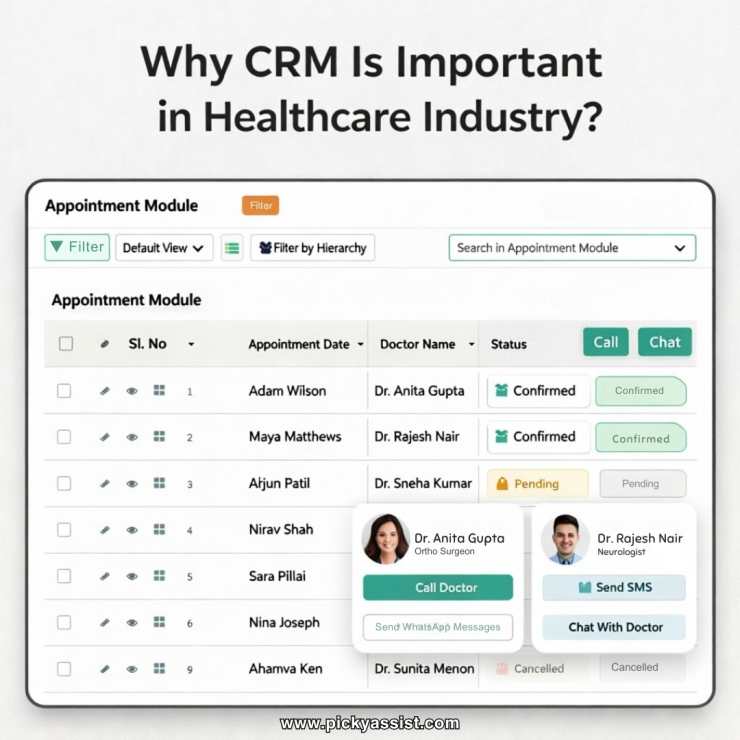
Healthcare has changed. Today, patients expect fast responses, timely reminders, easy appointment booking, and personalized communication from hospitals and clinics. At the same time, hospitals must handle rising patient volumes, service coordination, follow-ups, and outreach without creating operational chaos. That is exactly why CRM for hospital management has become essential.
A modern healthcare CRM does much more than store contact details. It helps hospitals manage patient communication, automate follow-ups, organize enquiries, improve outreach, and strengthen patient relationships across the care journey. A healthcare CRM is a centralized system for managing patient interactions, communication, workflow automation, and connected data across teams.
For hospitals, clinics, and multi-specialty centers, this matters because patients often interact across many touchpoints. They may enquire about a service, schedule a consultation, ask for a reminder, request a test update, or need post-visit follow-up. Without a structured CRM, these interactions get scattered across calls, desks, emails, and WhatsApp chats. As a result, response time slows down, follow-up quality drops, and patient experience suffers.
This is where Picky Assist becomes highly relevant. Its healthcare-focused content highlights integrated CRM, automated patient outreach, WhatsApp engagement, conversational AI chatbots, reminders, and unified communication workflows that help providers improve patient engagement and reduce no-shows. In other words, while a hospital management system may handle operational records and administration, a CRM layer strengthens the patient relationship side of the hospital journey.
What is CRM for Hospital Management?
CRM for hospital management is a customer and patient relationship platform that helps hospitals manage enquiries, appointments, communication, follow-ups, engagement, and outreach in one organized system. It supports non-clinical relationship workflows that improve how hospitals connect with patients before, during, and after care.
This makes it different from a standard hospital management system, which usually focuses on operations such as admissions, billing, scheduling, inventory, or internal hospital administration. A CRM complements these systems by improving patient-facing communication and service continuity.
That is why many healthcare organizations also search for related solutions such as CRM for hospitals. They want tools that help them answer practical questions like:
- Which patients missed appointments and need reminders?
- What all enquiries came from website forms, ads, or WhatsApp?
- Which patients need follow-up after consultation or diagnostics?
- What departments receive the most patient enquiries?
- Which patients have gone inactive and need re-engagement?
When hospitals can answer those questions quickly, they improve patient experience and operational discipline at the same time.
Why Do Hospitals Need CRM Today?
Hospitals are no longer judged only by clinical care. Patients also judge them by communication quality, convenience, response speed, and continuity. Therefore, customer relationship management in hospital settings has become a major competitive advantage.
A strong CRM helps because hospitals face several recurring communication challenges. First, patient enquiries come from many channels, including calls, website forms, ads, and messaging apps. Second, front-desk teams often struggle to follow up consistently. Third, patients expect quick appointment confirmations and reminders. Finally, hospitals need better ways to maintain ongoing relationships rather than treating every visit as an isolated event.
Research on CRM in healthcare environments shows that relationship management systems support service quality, engagement, and patient-centered coordination when implemented correctly. That is why both large hospitals and smaller clinics now invest in CRM for medical clinic workflows as well as enterprise-grade hospital CRM software.
Core Benefits of Hospital CRM Software
The biggest value of hospital CRM systems lies in structured communication. When patient interactions are centralized, hospitals can reduce delays, improve visibility, and make outreach more consistent.
A CRM helps hospitals deliver faster response times, reduce missed appointments, automate routine reminders, improve campaign-based outreach, and personalize patient interactions. It also helps management monitor service performance and enquiry trends across departments.
For example, Picky Assist’s healthcare content emphasizes automated patient outreach, conversational AI, WhatsApp-based engagement, appointment reminders, and CRM-driven communication. These functions directly support hospitals that want to improve patient handling without increasing manual workload.
As a result, patient relationship management in hospitals becomes more proactive. Instead of waiting for patients to remember appointments, ask for updates, or return for follow-ups, the hospital can guide the journey through automation and timely communication.
CRM vs Hospital Management System
Many decision-makers confuse CRM with a hospital patient management system or hospital database management system. However, they are not the same.
A hospital management system generally handles internal operations such as admissions, scheduling, billing, medical records management, and departmental processes. A medical record management system is a platform that focuses on storing and organizing patient health data and documents.
By contrast, CRM focuses on patient engagement, communication, outreach, follow-up, enquiry tracking, and retention. It works best when integrated with existing systems rather than replacing them. Official healthcare CRM guidance from Salesforce and Zoho also points to CRM as a communication and engagement layer that can integrate with EHR environments and existing healthcare workflows.
So, hospitals should not treat CRM as a replacement for health records management. Instead, they should view it as the missing engagement engine that improves the patient experience around those systems.
Key Features to Look For in CRM for Hospitals
When choosing CRM for hospitals, hospitals should focus on real patient engagement needs.
First, the CRM should capture enquiries from multiple channels. Second, it should centralize communication history. Third, it should support automated appointment reminders and follow-up flows. Fourth, it should allow segmentation for different services, departments, or patient groups. Fifth, it should support team collaboration and visibility.
Picky Assist aligns strongly with these requirements because it offers unified communication, WhatsApp CRM, chatbot workflows, appointment-related automation, and broadcaster-style outreach tools. Its official content also highlights integrations and CRM-linked messaging journeys.
For hospitals, useful CRM features include appointment reminders, lead and patient tagging, service-based segmentation, chatbot-led enquiry collection, campaign outreach, and team inbox visibility. These are especially valuable for departments such as diagnostics, dental care, fertility, pediatrics, dermatology, and elective procedures, where communication quality directly affects conversions and attendance.
How Picky Assist Fits Hospital Management Needs?
Picky Assist is especially useful for hospitals and clinics that want to strengthen patient engagement and outreach. Its healthcare-focused articles explain how providers can use an integrated CRM, WhatsApp automation, broadcaster tools, and AI chatbots to engage patients, automate reminders, and manage follow-up communication more efficiently.
This makes Picky Assist a strong fit for hospitals that need help with appointment confirmation, missed-visit reduction, patient enquiry handling, service promotion, and post-visit engagement. It also matches organizations that rely heavily on WhatsApp communication, since Picky Assist supports WhatsApp CRM workflows and official integration approaches.
Importantly, this does not mean Picky Assist replaces a hospital facility management platform, health facilities management software, or a full hospital administration suite. Instead, it complements those systems by improving the patient communication layer, which is often where hospitals lose time, leads, and satisfaction.
Practical Use Cases for Hospitals and Clinics
A hospital can use CRM to automate appointment reminders before consultations and diagnostics. A clinic can use it to capture website and WhatsApp enquiries, then assign them to staff for faster response. A specialty center can build service-based campaigns for preventive checkups, seasonal health packages, or follow-up screenings. A front office can use chatbot workflows to answer common questions and collect booking preferences even after business hours.
These are not abstract benefits. Picky Assist’s healthcare and appointment automation content directly references reminders, patient engagement, chatbot-led assistance, booking support, and continuous communication.
That is why CRM is increasingly important for both large hospitals and CRM for medical clinic deployments.
Conclusion
CRM for hospital management is no longer optional for healthcare providers that want to improve patient experience, outreach, and communication efficiency. While a hospital management system, hospital patient management system, or medical record management system handles operational and record-based functions, CRM strengthens the patient relationship side of healthcare.
For hospitals, the real value lies in faster response times, automated reminders, centralized communication, better follow-up, and more consistent engagement across the patient journey. Picky Assist matches these needs well through its healthcare-oriented CRM, WhatsApp communication workflows, chatbot automation, and patient outreach tools.
In a competitive healthcare environment, better communication is not a bonus. It is a core part of better care delivery.
FAQs on CRM for Hospital Management
1. What is a CRM for hospital management?
It is a system that helps hospitals manage patient enquiries, communication, reminders, follow-ups, and outreach in a structured way.
2. How is CRM different from a hospital management system?
A hospital management system focuses on operations and administration, while CRM focuses on patient communication and relationship management.
3. Can CRM for hospitals work with electronic health record management?
Yes. Healthcare CRM platforms are commonly designed to complement and integrate with EHR or existing healthcare systems rather than replace them.
4. Is Picky Assist suitable for patient relationship management in hospitals?
Yes. Picky Assist supports patient outreach, WhatsApp communication, reminders, chatbot automation, and CRM-style engagement workflows for healthcare providers.
5. Does CRM help reduce no-shows in hospitals?
Yes. Automated reminders and timely communication help reduce missed appointments and improve attendance.
6. Can small clinics use CRM for medical clinic workflows?
Absolutely. Clinics can use CRM to manage enquiries, automate reminders, improve follow-up, and maintain better patient communication.
Add comment