
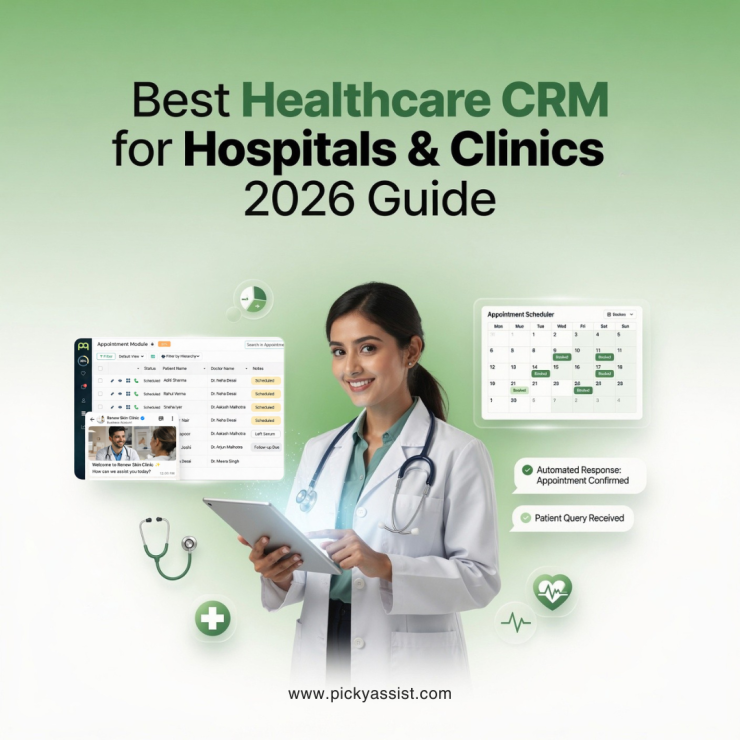
Healthcare organizations today operate in an environment where patient expectations, operational complexity, and competition are all increasing at once. Patients expect faster responses, personalized communication, and seamless experiences across channels. At the same time, providers must manage enquiries, appointments, follow-ups, and internal coordination without creating bottlenecks. This is exactly why the demand for the best healthcare CRM software has grown significantly. However, selecting the right solution is not just about features, it is about choosing a system that aligns with how your organization attracts, engages, and manages patients.
In this guide, we will break down what makes a healthcare CRM truly effective, how different types of organizations should evaluate options, and where Picky Assist fits into the ecosystem, especially when communication and automation are the core challenges.
What is Healthcare CRM Software and Why does it matter?
Healthcare CRM software is designed to manage patient relationships, communication, and engagement across the entire lifecycle, from first enquiry to post-treatment follow-up.
Unlike generic CRM tools, a medical CRM system focuses on healthcare-specific workflows such as appointment coordination, patient communication, and service inquiries. It acts as a central layer that connects marketing, front desk operations, and patient engagement.
The importance of a healthcare CRM platform lies in its ability to bring structure to fragmented processes. Without it, enquiries remain scattered across calls, messages, and emails, making it difficult to track interactions or ensure timely responses.
Why are Healthcare Organizations investing in CRM Systems?
The shift toward digital healthcare experiences has made CRM adoption a necessity rather than a choice. Hospitals, clinics, and diagnostic centers are increasingly relying on structured systems to manage patient interactions.
One of the biggest drivers is patient expectation. People now expect instant responses when they enquire about services, availability, or pricing. If a healthcare provider fails to respond quickly, patients often move on to another option.
At the same time, internal inefficiencies can slow down operations. Without a centralized hospital CRM software, teams struggle to coordinate enquiries, assign responsibilities, and track follow-ups. This leads to missed opportunities and inconsistent patient experiences.
A well-implemented CRM for healthcare providers addresses these challenges by improving visibility, response time, and operational efficiency.
Features that define the Best Healthcare CRM Software
When evaluating options, it is important to look beyond generic feature lists and focus on capabilities that directly impact patient engagement and operational flow.
Centralized Patient Communication
The foundation of any effective patient CRM system is centralized communication. All enquiries; whether from calls, websites, or messaging platforms, should be managed in one place. This ensures that teams have full context when interacting with patients, reducing confusion and improving response quality.
Automated Responses and Workflows
Automation is critical for handling high volumes of enquiries without overwhelming staff. A strong medical CRM software should enable automated replies, follow-ups, and reminders.
This is where Picky Assist becomes particularly relevant. It allows healthcare organizations to automate responses to incoming enquiries, ensuring that patients receive immediate information without waiting for manual replies.
Appointment Coordination Support
While not all CRM systems handle scheduling directly, they should integrate smoothly with appointment workflows. A reliable CRM for medical practice helps guide patients from enquiry to confirmed appointments without friction.
By automating confirmations and reminders, the system reduces missed appointments and improves overall efficiency.
Lead and Enquiry Management
In healthcare, every inquiry is a potential patient. A structured health CRM helps track these interactions, categorize them, and ensure timely follow-ups.
Without this capability, valuable leads can easily be lost due to delayed responses or lack of tracking.
Multi-Channel Engagement
Patients interact with healthcare providers through multiple channel integrated inbox. A modern CRM in the healthcare sector should support communication across platforms such as websites, messaging apps, and social media.
Picky Assist strengthens this capability by enabling omnichannel communication and ensuring that all conversations are handled consistently.
Understanding Different Use Cases Across Healthcare Segments
The definition of the best CRM for healthcare varies depending on the type of organization. Each segment has distinct operational needs.
Hospitals and Multi-Specialty Providers
Large hospitals require structured hospital CRM systems to manage high enquiry volumes, coordinate departments, and ensure consistent communication across teams.
Clinics and Independent Practices
Smaller setups benefit from a simpler CRM software for medical practice that focuses on patient communication, appointment coordination, and follow-ups without unnecessary complexity.
Diagnostic Centers and Labs
For diagnostic centers, timely communication is critical. A patient CRM software helps manage test bookings, share updates, and handle enquiries efficiently.
Health Insurance Providers
In the insurance space, a health insurance CRM is used to manage policy enquiries, customer support, and ongoing engagement with clients.
Medical Device and Pharma Companies
These organizations use CRM systems differently, focusing on relationship management with healthcare providers. A CRM for medical device sales supports lead tracking, communication, and sales workflows.
Where do most Healthcare CRM implementations fall short?
Despite investing in CRM systems, many organizations fail to see expected results. The issue often lies not in the software itself but in how it is used.
One common gap is slow response time. Even with a CRM in place, if responses depend on manual effort, delays are inevitable. This directly affects patient acquisition.
Another challenge is fragmented communication. If conversations are not centralized, teams struggle to maintain context, leading to inconsistent interactions.
Additionally, many systems focus heavily on data management but neglect real-time engagement. Without strong communication capabilities, even the most advanced healthcare CRM systems can fall short in practical use.
How Picky Assist complements Healthcare CRM Systems?
Picky Assist is not positioned as a full-fledged hospital management or billing system. Instead, it focuses on a critical layer that many CRM solutions overlook, real-time communication and automation.
When integrated into a healthcare workflow, it enhances how enquiries are handled and converted into appointments.
Instant Response to Patient Enquiries
When a patient reaches out, speed matters. Picky Assist ensures that responses are delivered instantly, reducing the chances of drop-offs.
Automated Conversation Flows
Instead of relying on manual replies, healthcare providers can automate conversations that guide patients through service information, availability, and next steps.
Improved Lead Conversion
By responding quickly and consistently, the system increases the likelihood of converting enquiries into confirmed appointments or consultations.
Efficient Query Routing
In larger organizations, enquiries can be directed to the appropriate team or department, ensuring faster resolution and better coordination.
Works Alongside Existing CRM Systems
If you already use a CRM software for the healthcare industry, Picky Assist can integrate into your workflow by enhancing communication without replacing your existing system.
How to Choose the Best Healthcare CRM Software for your needs?
Selecting the right solution requires a clear understanding of your organization’s priorities and challenges.
Ease of use should be a top consideration. A system that is difficult to navigate will not be adopted effectively by staff.
Automation capabilities are equally important. The ability to handle repetitive tasks and respond instantly can significantly improve efficiency.
Integration is another key factor. Your CRM for the healthcare industry should work seamlessly with communication tools, appointment systems, and marketing platforms.
Scalability also matters, especially for growing organizations. The system should support increased volumes without compromising performance.
Finally, consider the patient experience. The best solutions are those that make interactions smoother, faster, and more convenient.
The Healthcare Roadmap from Lead Management to Patient Transition
To understand how CRM and communication automation work together, consider a typical scenario. A patient visits your website and sends an enquiry about a service. Instead of waiting for a response, they receive immediate information through an automated system powered by Picky Assist.
The conversation continues, guiding the patient toward booking an appointment. Once confirmed, reminders are sent automatically, ensuring the patient does not miss the visit. This streamlined process reduces manual effort while improving both efficiency and patient satisfaction.
Why does the right CRM strategy matter more than the tool alone?
It is important to understand that no single tool can solve all challenges. The effectiveness of a top healthcare CRM depends on how well it is implemented and integrated into your workflow.
Organizations that focus only on features often overlook the importance of communication and engagement. As a result, they fail to achieve the expected return on investment.
A balanced approach, combining a reliable CRM system with strong automation and communication tools, delivers better outcomes. This is where solutions like Picky Assist add meaningful value.
Conclusion
Choosing the best healthcare CRM software is not just about comparing features or pricing. It is about identifying the gaps in your current workflow and selecting a solution that addresses them effectively.
While CRM systems provide structure and data management, the real impact comes from how patients are engaged. Fast responses, consistent communication, and smooth booking experiences are what drive conversions and satisfaction.
Picky Assist fits into this ecosystem by strengthening the communication layer. It ensures that enquiries are handled instantly, conversations are automated intelligently, and no opportunity is missed due to delays.
For healthcare organizations looking to improve patient engagement without overcomplicating operations, combining a CRM system with smart automation is a practical and scalable approach.
FAQs on Healthcare CRM Software
1. What is the best healthcare CRM software for small clinics?
The best option depends on your needs, but small clinics should prioritize ease of use, automation, and communication capabilities to handle patient enquiries efficiently.
2. How does a healthcare CRM improve patient engagement?
It centralizes communication, enables faster responses, and allows personalized interactions, which improves the overall patient experience.
3. Can healthcare CRM systems reduce missed appointments?
Yes, by sending automated reminders and confirmations, CRM systems help reduce no-shows and improve scheduling efficiency.
4. Is a healthcare CRM different from hospital management software?
Yes. CRM focuses on patient communication and engagement, while hospital management software includes billing, inventory, and operational processes.
5. Can I use CRM software for healthcare marketing?
Yes, many systems support marketing workflows such as lead tracking, campaign management, and follow-ups.
6. How does Picky Assist support healthcare CRM workflows?
Picky Assist enhances communication by automating responses, managing enquiries, and improving lead conversion without replacing your CRM system.
7. What features should I prioritize in a healthcare CRM platform?
Focus on centralized communication, automation, integration, scalability, and patient experience.
8. How long does it take to implement a healthcare CRM?
Implementation time varies, but most systems can be set up within days. However, optimizing workflows and automation may take longer.
Add comment