
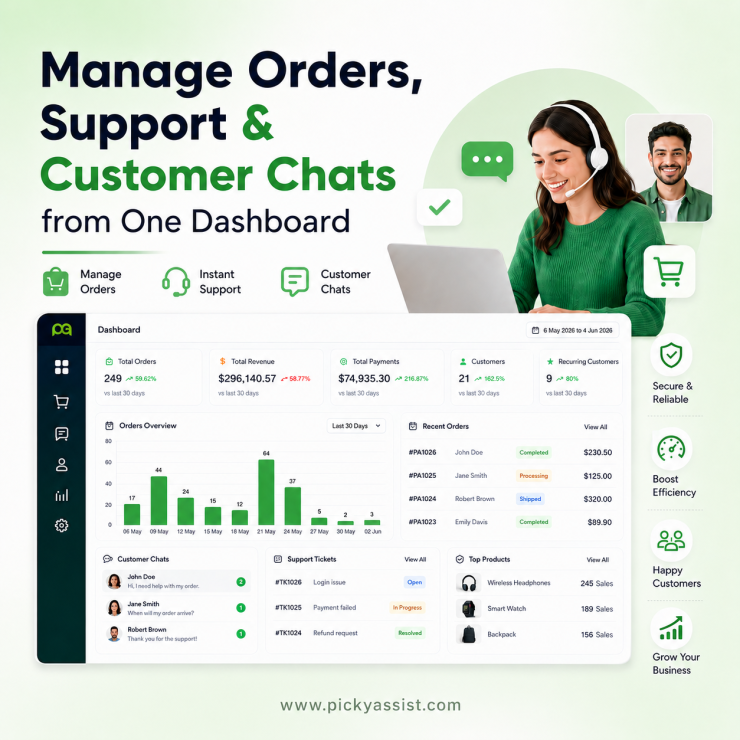
Running an ecommerce business today involves far more than processing orders and managing inventory. As ecommerce competition intensifies, businesses can no longer afford to manage customer relationships through spreadsheets, disconnected tools, or fragmented communication channels. This is why investing in CRM software for ecommerce has become a strategic necessity rather than an operational upgrade.
A well-implemented CRM helps businesses centralize customer information, streamline communication, automate engagement workflows, improve customer experiences, and create more personalized buying journeys.
However, not all CRM platforms are built with ecommerce requirements in mind. Online retailers need solutions that connect customer data with conversations, purchase behavior, support interactions, and marketing activities.
This guide explores how CRM software for ecommerce works, why it matters, key features to evaluate, and how businesses can use platforms like Picky Assist to build stronger customer relationships while improving operational efficiency.
What is CRM Software for Ecommerce?
CRM software for ecommerce is a customer relationship management system designed to help online businesses organize, track, manage, and optimize customer interactions throughout the buying lifecycle. Unlike traditional CRM systems that primarily focus on sales pipelines, ecommerce CRM solutions help businesses manage:
- Customer profiles
- Purchase history
- Customer inquiries
- Lead interactions
- Marketing campaigns
- Customer support conversations
- Retention initiatives
- Repeat purchase opportunities
The goal is to create a unified customer view that enables more informed decision-making and personalized engagement.
Why Ecommerce Businesses Need a CRM?
Customer acquisition costs continue rising across digital channels. As a result, businesses increasingly focus on maximizing customer lifetime value rather than simply generating more traffic. A CRM helps ecommerce businesses achieve this by improving visibility into customer behavior and communication history. Without a CRM, businesses often struggle with:
- Disconnected customer data
- Inconsistent communication
- Missed sales opportunities
- Poor follow-up processes
- Limited personalization
- Fragmented support workflows
As customer volumes increase, these challenges can significantly impact growth.
How CRM Software Improves Ecommerce Operations?
Centralized Customer Information
One of the biggest advantages of CRM ecommerce systems is having customer information in a single location. Instead of switching between:
- Ecommerce platforms
- Email tools
- Messaging platforms
- Support software
Businesses can access a consolidated customer profile containing:
- Contact information
- Purchase history
- Support interactions
- Communication records
- Customer preferences
This creates better context for every customer interaction.
Improved Customer Retention
Acquiring a customer is only the beginning. The most successful ecommerce brands focus heavily on retention because repeat customers often generate significantly more revenue over time. A CRM helps businesses:
- Track customer activity
- Identify inactive customers
- Launch re-engagement campaigns
- Automate follow-ups
- Personalize offers
These activities contribute to stronger customer loyalty and increased repeat purchases.
Better Sales and Marketing Alignment
Many ecommerce businesses operate marketing and customer engagement activities separately.
A CRM bridges this gap by providing shared visibility into customer behavior. Marketing teams can:
- Segment audiences
- Build targeted campaigns
- Personalize communication
Sales and support teams can:
- Access customer histories
- Understand previous interactions
- Respond more effectively
This alignment creates a more consistent customer experience.
Features to Look for in the Best CRM for Ecommerce
Customer Segmentation
Not all customers behave the same way. Effective segmentation allows businesses to group customers based on:
- Purchase history
- Order frequency
- Location
- Product interests
- Engagement levels
Workflow Automation
Automation reduces repetitive manual work while improving responsiveness. Examples include:
- Welcome messages
- Cart abandonment follow-ups
- Order updates
- Customer reactivation campaigns
- Review requests
Workflow automation enables ecommerce businesses to scale engagement without increasing workload proportionally.
Multi-Channel Communication Management
Customers interact across multiple channels. These may include:
- Website chat
- Facebook Messenger
Picky Assist is one among the best ecommerce CRM platforms that help businesses manage customer conversations from a centralized environment.
Customer Journey Tracking
Understanding the complete customer journey helps businesses optimize conversion pathways. CRM platforms should provide visibility into:
- Lead sources
- Product interest
- Purchase activity
- Support interactions
- Repeat purchases
This information supports better decision-making and customer experience improvements.
Reporting and Analytics
Data-driven growth requires actionable insights. CRM reporting helps businesses monitor:
- Customer acquisition trends
- Conversion rates
- Retention metrics
- Engagement levels
- Campaign performance
Strong analytics enable continuous optimization.
CRM for Ecommerce and Customer Communication
Many ecommerce businesses underestimate the role communication plays in customer retention. Customers often have questions regarding:
- Products
- Shipping
- Returns
- Refunds
- Availability
- Warranty information
Managing these conversations efficiently requires more than email. Modern ecommerce businesses increasingly use conversational channels such as WhatsApp to engage customers in real time. This is where CRM platforms integrated with communication workflows become especially valuable.
Why Messaging Channels Matter for Ecommerce CRM?
Customers increasingly prefer messaging because it feels faster and more convenient than traditional communication methods. Businesses using conversational engagement often experience:
- Faster response times
- Higher engagement rates
- Improved customer satisfaction
- Better lead conversion opportunities
When messaging channels connect directly to CRM workflows, businesses gain greater visibility into customer relationships.
CRM WooCommerce Integration: Why Does It Matters?
Many online stores operate on WooCommerce. While WooCommerce provides strong ecommerce functionality, businesses often need additional customer management capabilities as they scale.
A CRM WooCommerce integration helps businesses:
- Sync customer information
- Track purchase activity
- Manage follow-ups
- Automate engagement workflows
- Improve retention initiatives
This allows store owners to move beyond transaction management toward relationship management.
Shopify CRM Integrations and Customer Growth
Shopify businesses face similar challenges as they scale. Customer information often becomes scattered across multiple tools. Shopify CRM integrations help consolidate customer data and communication history, making it easier to:
- Personalize engagement
- Manage support inquiries
- Automate customer journeys
- Improve retention campaigns
A connected ecosystem enables businesses to create more consistent customer experiences.
Common Ecommerce CRM Use Cases
Cart Abandonment Recovery
Customers frequently add products to their cart without completing purchases.
CRM automation can trigger:
- Reminder messages
- Follow-up communication
- Promotional offers
This helps recover potential revenue opportunities.
Post-Purchase Engagement
The customer journey continues after checkout.
Businesses can automate:
- Order confirmations
- Shipping notifications
- Product education
- Feedback requests
These interactions improve customer satisfaction and retention.
Customer Reactivation
Some customers stop engaging after their first purchase. CRM workflows can identify inactive customers and launch re-engagement campaigns to encourage repeat purchases.
VIP Customer Management
High-value customers often deserve specialized treatment. CRM segmentation allows businesses to create personalized experiences for loyal customers.
Challenges Ecommerce Businesses Face Without a CRM
Disconnected Customer Data
Without a centralized system, customer information becomes fragmented across tools. This reduces visibility and increases inefficiencies.
Inconsistent Communication
Different teams may communicate differently with customers, leading to inconsistent experiences.
Missed Revenue Opportunities
Without automation and tracking, businesses often miss opportunities for upselling, cross-selling, and retention.
Limited Customer Insights
Growth becomes difficult when businesses lack visibility into customer behavior and engagement patterns.
How Picky Assist Supports Ecommerce Customer Management?
While many CRM platforms focus primarily on customer records, ecommerce businesses increasingly need systems that combine customer data with conversational engagement. Picky Assist helps businesses manage customer communication and engagement workflows through:
- CRM capabilities
- WhatsApp integration
- Shared team inbox
- Customer communication tracking
- Workflow automation
- Lead management
- Chatbot automation
- Multi-channel engagement
This enables ecommerce businesses to connect customer conversations with relationship management processes in a centralized environment. For businesses relying heavily on WhatsApp, social messaging, and conversational commerce, this creates a more connected customer experience.
How to Choose the Best E-commerce CRM?
Selecting the best CRM for ecommerce depends on business requirements rather than popularity alone. Businesses should evaluate:
Communication Capabilities
Can the CRM support messaging channels customers actively use?
Automation Flexibility
Can workflows be customized for customer engagement, support, and retention?
Integration Ecosystem
Does the platform integrate with ecommerce systems, communication tools, and business applications?
Scalability
Can the platform support future growth without operational limitations?
Customer Experience Focus
Does the CRM help improve engagement throughout the customer lifecycle?
Conclusion
CRM software for ecommerce has evolved far beyond contact management. Modern ecommerce businesses require platforms that connect customer data, communication history, automation workflows, and engagement strategies into a unified operational framework.
As competition increases and customer expectations rise, having a centralized system for managing relationships becomes a significant competitive advantage.
The most effective ecommerce CRM solutions help businesses improve retention, streamline communication, automate repetitive processes, and create personalized customer experiences across the entire buying journey.
Picky Assist supports these goals by combining CRM functionality with conversational engagement, workflow automation, WhatsApp communication, and customer management capabilities that help ecommerce businesses strengthen customer relationships at scale.
FAQs on CRM Software for Ecommerce
1. What is CRM software for ecommerce?
CRM software for E-commerce helps online businesses manage customer information, communication history, purchase behavior, support interactions, and engagement workflows from a centralized platform.
2. Why do ecommerce businesses need a CRM?
A CRM helps businesses improve customer retention, streamline communication, automate workflows, personalize engagement, and gain better visibility into customer behavior.
3. What features should the best ecommerce CRM include?
Key features include customer segmentation, workflow automation, communication management, reporting, analytics, customer journey tracking, and integration capabilities.
4. Can a CRM improve ecommerce customer retention?
Yes. CRM platforms help businesses identify customer behavior patterns, automate follow-ups, launch retention campaigns, and personalize customer interactions.
5. What is a CRM WooCommerce integration?
A CRM WooCommerce integration connects customer and order data with CRM workflows, helping businesses improve customer engagement and relationship management.
6. How do Shopify CRM integrations help ecommerce businesses?
Shopify CRM integrations centralize customer data, automate engagement workflows, improve customer support visibility, and enhance retention efforts.
7. Is WhatsApp important for ecommerce CRM strategies?
Yes. WhatsApp enables real-time customer engagement, support, order communication, and relationship-building, making it increasingly valuable for ecommerce businesses.
8. How does Picky Assist support ecommerce businesses?
Picky Assist helps ecommerce businesses manage customer communication through CRM workflows, WhatsApp engagement, chatbot automation, lead management, shared inbox for multi-channel customer interactions.


Add comment