
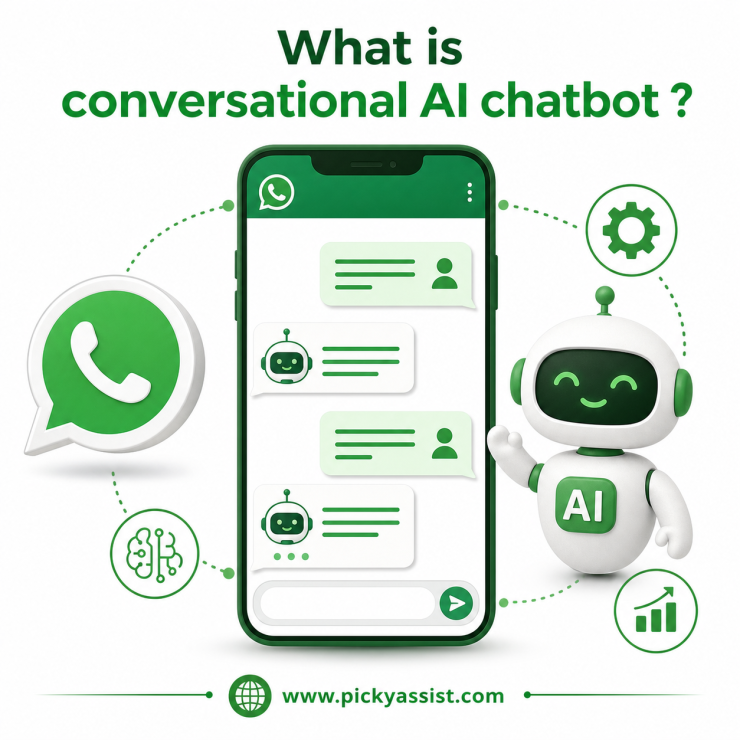
Customers don’t judge your business by your product first. They judge it by how fast you respond when they ask a question. And in most companies, that first interaction is already broken. Leads wait. Support queues build up. Sales teams reply too late. Meanwhile, competitors are already inside the conversation. This is where the conversational AI chatbot is quietly changing how modern businesses operate.
Chatbots are a revenue enabler, a lead qualification engine, and a 24/7 digital assistant that works across sales, support, and marketing. For businesses using platforms like Picky Assist, conversational AI becomes even more powerful, because it connects conversations directly to workflows, automation, and CRM intelligence.
What is a Conversational AI Chatbot?
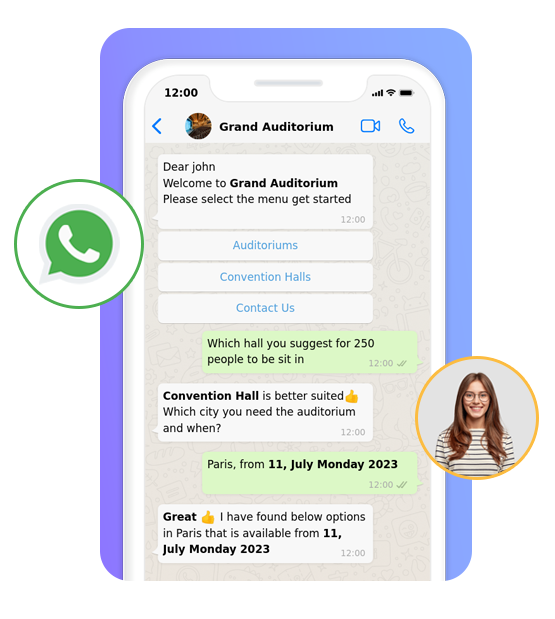
A conversational AI chatbot is an intelligent software system designed to understand human language, interpret intent, and respond naturally through text or voice. Unlike traditional bots that rely on fixed scripts, conversational systems understand context and meaning. They don’t just respond, they converse. At its core, a conversational AI chatbot:
- Understands user intent instead of just keywords
- Responds in natural, human-like language
- Learns from past interactions
- Handles complex and open-ended queries
This makes it fundamentally different from rule-based automation systems.
How a Conversational AI Chatbot Actually Works?
To understand its value, you need to see what happens behind the scenes when a user sends a message.
1. Natural Language Processing (NLP / NLU)
The first layer breaks down human input. It analyzes:
- Sentence structure
- Intent behind the message
- Emotional tone
- Key entities (like names, dates, products)
This allows the system to understand what the user means, not just what they type.
2. Machine Learning (ML)
Machine learning allows the system to improve over time. Every interaction becomes training data. Over time, the system learns:
- Common user patterns
- Better response paths
- Contextual variations in language
- Industry-specific behavior
This is why modern AI chat bots improve continuously without manual rewriting.
3. Natural Language Generation (NLG)
Once the system understands the intent, it generates a response. NLG ensures that replies:
- Sound natural
- Match context
- Maintain conversational flow
- Avoid robotic phrasing
This is what makes conversational AI feel less like software and more like a real assistant.
Conversational AI Chatbot vs Traditional Chatbots
Understanding this difference is critical for decision-makers.
Rule-Based Chatbots
These are older systems built on strict logic flows. They:
- Follow predefined scripts
- Break when users ask unexpected questions
- Depend heavily on manual setup
- Work like decision trees
Example:
“If the user says ‘pricing’ → show a pricing menu.”
If the user asks something outside the script, the system fails or escalates.
Conversational AI Chatbots
Modern conversational AI tools behave differently. They:
- Understand context
- Handle unstructured questions
- Remember conversation history
- Adapt responses dynamically
Instead of rigid flows, they simulate real conversations. This is what defines a true conversational AI assistant.
Why Conversational AI Chatbots Are Transforming Business Operations?
Businesses are adopting conversational AI chatbot systems not because they are trendy, but because they solve real operational problems.
1. Always-on customer support
Customers expect instant answers. A conversational system enables:
- 24/7 support availability
- Instant query resolution
- Reduced dependency on human agents
2. Faster lead qualification
Instead of manually filtering leads, a chatbot can:
- Ask qualifying questions
- Segment users automatically
- Route high-intent leads to sales teams
3. Improved conversion rates
Speed matters. When responses are instant, users are more likely to:
- Complete purchases
- Request demos
- Engage further
4. Reduced operational load
Support teams spend less time on repetitive queries like:
- Order status
- Refund policies
- Basic troubleshooting
5. Scalable communication
Whether you handle 100 or 100,000 conversations, AI systems scale without proportional cost increases.
Real-World Use Cases of Conversational AI Chatbots
Customer Support Automation
A conversational AI chatbot can resolve:
- Order tracking
- Refund requests
- Account issues
- Frequently asked questions
This reduces ticket volume significantly.
E-commerce Assistance
In online retail, chatbots act like shopping assistants:
- Recommend products
- Compare options
- Assist checkout
- Reduce cart abandonment
Sales Engagement
AI bots can guide users through:
- Product discovery
- Pricing questions
- Booking demos
- Purchase decisions
Virtual Assistants
Beyond business use, conversational systems power:
- Voice assistants
- Scheduling tools
- Smart device interactions
Conversational AI Chatbot in Modern Customer Journeys
A modern customer journey is not linear anymore. Users move between:
- Websites
- Social media
A chat bot for a website or messaging platform becomes the central interaction layer that keeps conversations connected across touchpoints. This is where businesses gain a competitive edge, by maintaining continuity across fragmented channels.
Conversational AI Tools vs Legacy Automation Systems
Most older systems focus on automation. But automation alone is not enough anymore. Modern conversational AI tools combine:
- Automation
- Context awareness
- Human-like dialogue
- Behavioral learning
This combination allows businesses to deliver personalized experiences at scale.
Why Are Businesses Moving Toward Conversational AI Chatbot Platforms?
A conversational AI chatbot platform is not just software, it is infrastructure for customer engagement. Businesses adopt it for three key reasons:
1. Centralized communication control
All conversations across channels are unified.
2. Better customer intelligence
Every interaction becomes usable data.
3. Revenue-driven engagement
Chatbots no longer support tools, they drive conversions.
How Picky Assist Enhances Conversational AI Chatbot Systems?
A conversational system becomes significantly more powerful when connected to execution workflows. With platforms like Picky Assist, businesses can:
- Connect chatbot conversations to CRM actions
- Automate follow-ups based on user behavior
- Route leads to sales teams instantly
- Trigger workflows from conversations
This turns a simple chatbot into a conversational AI agent ecosystem that drives business outcomes instead of just answering questions.
The Strategic Shift from Chatbots to Conversational AI Agents
The industry is moving beyond basic bots. We are now entering the era of conversational AI agents, where systems:
- Understand goals
- Take actions
- Execute workflows
- Make decisions within defined rules
This is not just support automation, it is operational intelligence.
Common Mistakes Businesses Make With AI Chatbots
Despite adoption, many businesses fail to get results due to:
- Over-reliance on rule-based flows
- Lack of training data
- Poor integration with CRM systems
- No escalation logic to humans
- Generic, non-personalized responses
A conversational system only performs well when connected to business context.
Conclusion
A conversational AI chatbot is no longer just a support automation tool. It is becoming the core interface between businesses and customers. It combines language understanding, machine learning, and intelligent response generation to create real conversations, not scripted interactions.
For businesses aiming to scale efficiently, reduce response time, and improve conversions, conversational AI is no longer optional. When integrated with execution platforms like Picky Assist, it becomes a complete system for managing customer journeys, from first contact to conversion and retention.
FAQs on Conversational AI Chatbot
1. What is a conversational AI chatbot?
It is a smart software that understands human language and responds naturally like a real conversation instead of using fixed scripts.
2. How is conversational AI different from traditional chatbots?
Traditional bots follow rules and scripts, while conversational AI understands intent, context, and can handle complex questions.
3. What technologies power a conversational AI chatbot?
It uses Natural Language Processing (NLP), Machine Learning (ML), and Natural Language Generation (NLG).
4. Can a conversational AI chatbot improve over time?
Yes, it learns from interactions and becomes more accurate with continuous usage.
5. What are the main business uses of conversational AI chatbots?
They are used in customer support, sales assistance, e-commerce guidance, and virtual assistants.
6. Can conversational AI chatbots work on websites and WhatsApp?
Yes, modern systems integrate across websites, WhatsApp, Instagram, email, and other channels.
7. Are conversational AI chatbots better than rule-based chatbots?
Yes, because they handle natural language, context, and unpredictable queries more effectively.
8. How does Picky Assist enhance conversational AI chatbots?
It connects chatbot conversations with CRM workflows, automation, and business actions to improve conversions and efficiency.



Add comment