
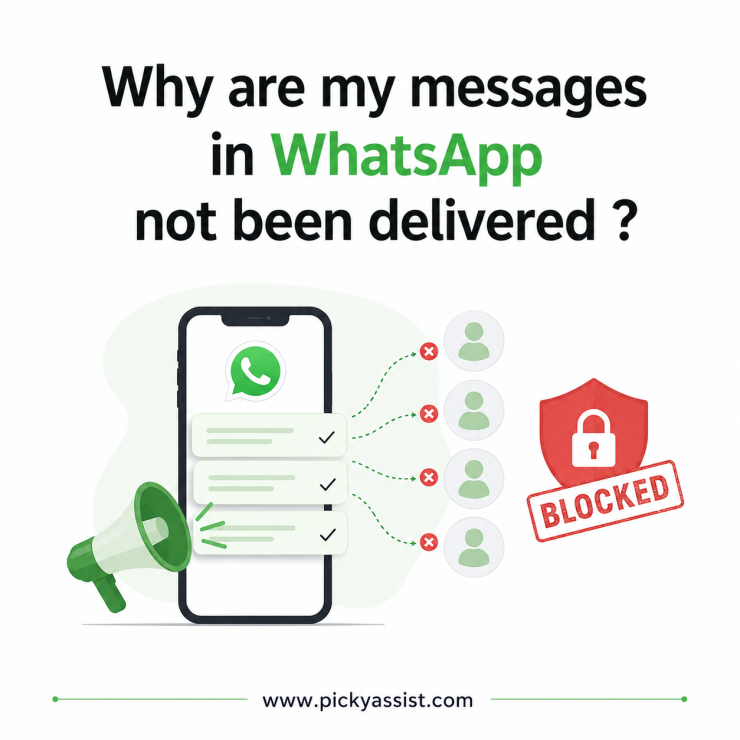
Bulk messaging on WhatsApp looks simple on the surface; send, deliver, engage. But in reality, WhatsApp runs a highly sensitive enforcement system designed to protect users from spam, automation abuse, and irrelevant outreach. That’s why businesses often run into a frustrating situation: messages appear sent, but never get delivered at scale. This leads directly to the common concern why my WhatsApp message is not delivered when sending bulk communication campaigns.
The issue is rarely random. It is usually a signal that WhatsApp has detected risk patterns in messaging behavior, audience quality, or sending infrastructure. This guide breaks down exactly why bulk messages get blocked, what triggers delivery failures, and how businesses can send high-volume WhatsApp messages safely using structured systems like Picky Assist without risking account restrictions.
Why Do Bulk WhatsApp Messages Get Blocked?
WhatsApp is not designed as a broadcast marketing channel by default. It is a conversation-first ecosystem, meaning its algorithms prioritize:
- User trust
- Message relevance
- Engagement quality
- Spam prevention
When bulk messaging appears unnatural or uncontrolled, WhatsApp’s system reacts in one of three ways:
- Message delivery throttling (delays or partial delivery)
- Reduced reach (messages not delivered to all users)
- Account-level restrictions (temporary or permanent limits)
So when businesses ask why my WhatsApp messages are not delivering, the answer is often rooted in behavioral detection, not technical failure.
Reasons Why Bulk WhatsApp Messages Fail to Deliver
1. Low-quality or cold contact lists
One of the strongest triggers for delivery failure is messaging users who:
- Did not opt in
- Have no prior interaction
- Are scraped or outdated contacts
WhatsApp closely monitors engagement signals. If users do not respond or ignore messages, the system quickly classifies future messages as low-quality traffic. This is a major reason why bulk campaigns silently fail.
2. High-volume sending without warm-up
Sending thousands of messages immediately from a new or inactive number creates a predictable risk pattern. WhatsApp expects gradual scaling. Sudden spikes in activity often lead to:
- Delivery throttling
- Reduced message visibility
- Temporary account restrictions
This is especially common when businesses try to scale outreach too quickly.
3. Repetitive or identical messaging patterns
Bulk messages that look identical across recipients are easily flagged.
Examples include:
- Same promotional text sent repeatedly
- No personalization
- No conversational variation
The system interprets this as automation abuse rather than human communication.
4. Low engagement rates from recipients
WhatsApp does not only track sending, it tracks reactions:
- Replies
- Message opens
- Blocks
- Reports
If engagement drops below expected thresholds, delivery begins to degrade over time. This is often why aWhatsApp messages are not delivered to one person or gradually across segments.
5. Frequent user blocking or reporting
If recipients frequently:
- Block the sender
- Mark messages as spam
- Ignore repeated outreach
WhatsApp reduces the sender’s reputation score. This directly impacts future delivery rates.
6. Using multiple unverified numbers or unstable sending systems
When businesses rely on fragmented tools or unmanaged SIM-based sending, WhatsApp cannot establish trust consistency. This leads to:
- Unstable delivery performance
- Random message drops
- Account inconsistencies
The Hidden Concept Most Businesses Miss: WhatsApp Works on Trust Scoring
WhatsApp does not treat all senders equally. Instead, every number builds a reputation score based on:
- Contact quality
- Engagement history
- Reporting behavior
- Sending patterns
Think of it like a credit score for messaging. If trust drops, delivery performance declines, even if the messages are technically sent correctly. This is why many businesses experience confusion around why my WhatsApp message is not delivered despite no obvious technical issue.
Why Traditional Bulk Messaging Fails at Scale?
Most businesses attempt bulk WhatsApp messaging using manual or semi-automated methods. These approaches fail because they lack:
- Controlled pacing logic
- Audience segmentation intelligence
- Delivery monitoring
- Behavioral adaptation
In short, they treat WhatsApp like an email blast tool, which it is not.
How to Send Bulk WhatsApp Messages Without Getting Blocked?
Scaling WhatsApp messaging safely requires shifting from “broadcast thinking” to structured communication design.
1. Use opt-in based audience systems
Only send messages to users who:
- Have explicitly consented
- Have interacted previously
- Expect communication from your brand
This alone significantly reduces delivery failure rates.
2. Segment audiences before sending
Instead of one mass blast, break audiences into:
- New leads
- Warm leads
- Existing customers
- Re-engagement groups
Segmentation improves engagement, which improves delivery stability.
3. Control sending velocity (message pacing)
Safe sending is not about volume, it is about consistency.
Effective patterns include:
- Gradual ramp-up over time
- Distributed sending windows
- Avoiding sudden spikes
This helps maintain platform trust.
4. Personalize message structure
Even small variations matter:
- Name-based personalization
- Context-based messaging
- Behavior-driven content
Personalized messages reduce block rates and improve engagement signals.
5. Track delivery and engagement signals continuously
Instead of guessing performance, businesses should monitor:
- Delivery rates
- Response rates
- Block rates
- Drop-off patterns
Without analytics, optimization becomes impossible.
How Picky Assist Helps Prevent WhatsApp Delivery Blocks?
If you still dont know why my WhatsApp message is not delivered consider platforms like Picky Assist are designed specifically to solve the core problem behind bulk messaging failures: lack of controlled communication structure. Instead of sending messages blindly, businesses operate through a managed messaging ecosystem.
Here’s how it changes bulk messaging behavior:
1. Structured automation instead of random sending
Messages are triggered based on user actions, not manual blasting.
2. Audience segmentation built into workflows
Businesses can group users by behavior, stage, or intent before messaging.
3. Controlled messaging flow
Instead of overwhelming WhatsApp systems, messages are distributed intelligently.
4. Unified CRM visibility
Teams can see exactly how users respond across journeys, reducing guesswork.
5. Reduced risk of spam-like patterns
Communication becomes conversational and behavior-driven rather than repetitive broadcasting.
The Shift From Bulk Messaging to Intelligent Conversations
The biggest misconception is that WhatsApp success depends on “how many messages you send.” In reality, it depends on:
- How relevant your messages are
- How users respond to them
- How structured your communication flow is
Businesses that still rely on raw bulk messaging eventually encounter delivery degradation and rising block rates. Those that transition to structured automation systems achieve:
- Higher delivery consistency
- Better engagement rates
- Lower account risk
- More predictable revenue outcomes
Conclusion
If you are trying to understand why my WhatsApp message is not delivered, especially during bulk messaging, the root cause is rarely technical. It is behavioral, structural, and trust-based.
WhatsApp actively filters communication that resembles spam, lacks engagement, or ignores user consent. As a result, traditional bulk messaging methods fail as scale increases.
The solution is not to send more messages but to send them smarter.
With structured systems like Picky Assist, businesses move from uncontrolled broadcasting to intelligent, automated, and engagement-driven communication. This shift directly improves delivery reliability and reduces the risk of blocks while maintaining scalability.
FAQ’s on WhatsApp messages not being delivered
1. Why do my bulk WhatsApp messages suddenly stop delivering?
This usually happens due to poor engagement rates, high sending volume, or detection of spam-like messaging patterns.
2. Why are my WhatsApp messages not delivering even after being sent successfully?
A sent message can fail delivery if the recipient blocks the sender, is offline, or if WhatsApp reduces sender trust due to behavior signals.
3. Can sending bulk messages get my WhatsApp number blocked?
Yes. Uncontrolled bulk messaging, especially without opt-in consent or engagement, can lead to restrictions or temporary bans.
4. Why are my WhatsApp messages not delivered to one person only?
If you are worried why my WhatsApp message is not delivered consider these specific reasons. This is often caused by blocking, inactive accounts, or the recipient having disabled notifications or background data.
5. How does WhatsApp decide if a message is spam?
It evaluates engagement patterns, user reports, sending frequency, and contact quality to determine spam likelihood.
6. Is there a safe way to send bulk WhatsApp messages?
Yes. Using opt-in lists, segmentation, gradual sending, and structured automation significantly reduces delivery risks.
7. Why does personalization improve WhatsApp message delivery?
Personalized messages increase engagement rates, which improves sender reputation and overall delivery consistency.
8. How does Picky Assist help prevent WhatsApp message blocking?
It structures communication workflows, controls message flow, enables segmentation, and ensures messaging patterns remain engagement-focused rather than spam-like.

Add comment