
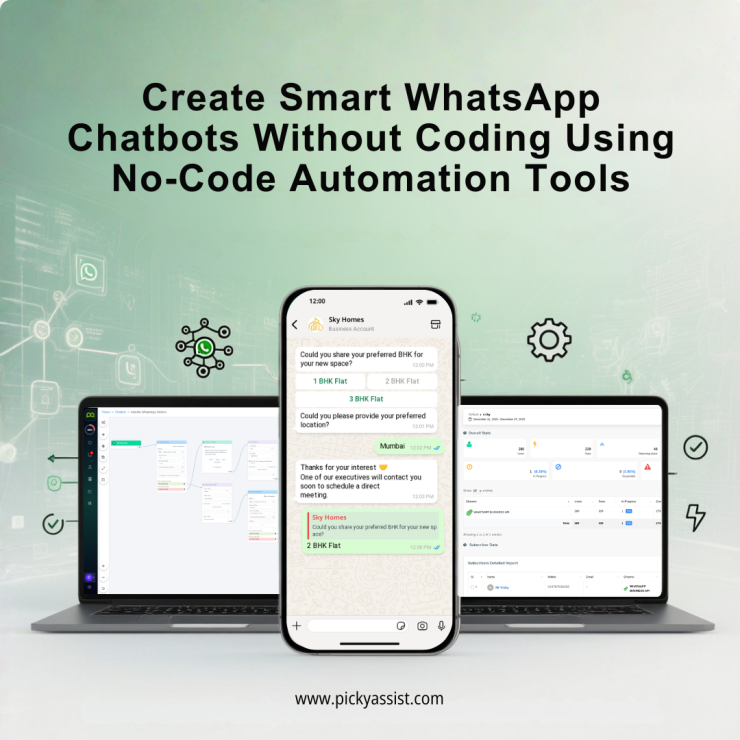
Imagine a customer browsing your website at 11:47 PM. They have intent, urgency, and one simple question before purchasing. Your sales team is offline. Email feels slow. A phone call made may not be answered. So they open WhatsApp. What happens next determines whether you convert or lose them. This is where a chatbot in WhatsApp quietly takes over, responding instantly, guiding the conversation, qualifying the lead, and even closing the sale before your team logs in the next morning.
A decade ago, businesses fought for attention through emails and landing pages. Today, decisions are made inside chat windows. A prospect asks one question on WhatsApp, waits for a response, and forms a perception of your brand within seconds. According to industry data, over 70% of users expect an instant reply on messaging apps, and more than 55% abandon a purchase if responses are delayed.
What is a WhatsApp Chatbot?
A chatbot in WhatsApp is an automated conversational system built on top of the WhatsApp Business Platform that can send, receive, and respond to messages in real time. Powered by WhatsApp artificial intelligence, these bots simulate human-like conversations while operating at machine scale.
A modern WhatsApp chatbot is not a scripted responder. It can understand intent, store context, trigger workflows, integrate with CRMs, process payments, and escalate conversations when required. Businesses use a chatbot in WhatsApp to replace manual effort with structured automation across the customer lifecycle.
As adoption grows, brands are increasingly investing in a WhatsApp AI chatbot to meet customers where conversations already happen.
Types of WhatsApp Chatbots & Tools
Not all bots are created equal. Businesses typically deploy three core types of automation using a chatbot in WhatsApp.
1. Rule-Based Chatbots
These follow predefined flows using buttons and menus. While basic, a WhatsApp bot of this type is still effective for FAQs and routing.
2. AI-Powered Chatbots
These leverage WhatsApp AI chat capabilities to understand natural language and respond dynamically. A WhatsApp AI bot improves with training data and usage patterns.
3. Hybrid Automation
This combines automation with human handover, ensuring high-value conversations are never lost. Most enterprises prefer this bot on WhatsApp model.
Business Solutions Platforms
Platforms such as Picky Assist, Botpress, Manychat, and Fastbots enable businesses to create WhatsApp bot workflows using official APIs. These platforms connect directly to the WhatsApp Business API, enabling a scalable WhatsApp API bot without policy risks.
Built-In AI: WhatsApp’s Native AI Experience
Meta has also introduced built-in conversational AI directly inside WhatsApp. Users can interact with Meta AI by typing @Meta AI in the chat bar. While useful for general queries, this native capability does not replace a business-grade chatbot in WhatsApp designed for lead generation, sales, or customer support.
How to Use a WhatsApp Chatbot: Practical Business Examples
A chatbot in WhatsApp becomes powerful when mapped to real scenarios.
1. Greeting and Lead Capture
A WhatsApp chatbot can greet users instantly and capture lead data, increasing response speed by over 65%.
2. Smart Follow-Ups
Automated follow-ups via a bot in WhatsApp recover dormant leads and improve engagement rates by nearly 30%.
3. End-to-End Sales Automation
A chatbot in WhatsApp can manage the full funnel with minimal human input from qualification to payment reminders.
4. Campaigns and Promotions
Brands use WhatsApp bots for flash sales and limited offers to drive urgency and conversions.
5. Customer Support Automation
An AI chatbot WhatsApp resolves repetitive queries instantly, reducing support costs by up to 50%.
WhatsApp Chatbot Features in Picky Assist
Picky Assist is designed for businesses that want measurable outcomes, not just automation.
Key features include:
- No-code WhatsApp bot builder with drag-and-drop logic
- Official WhatsApp bot API access with compliance
- Multi-agent inbox with chatbot handover
- CRM and payment gateway integrations
- Advanced analytics and conversation tracking
- Scalable WhatsApp API bot architecture
These features enable businesses to deploy a production-ready chatbot in minutes, not weeks.
How WhatsApp Chatbots Work?
A chatbot in WhatsApp operates through the WhatsApp Business API. Messages flow from the user to the platform, where logic engines, AI models, and integrations determine the response.
A modern WhatsApp AI bot processes intent, retrieves data, and replies in under a second. When required, the system routes the conversation to a human agent, ensuring continuity and trust.
Benefits of Using a WhatsApp Chatbot for Business
Businesses using a WhatsApp bot consistently report:
- 50% increase in lead conversion rates
- 60% reduction in response times
- 24/7 availability without staffing overhead
- Higher engagement compared to email or SMS
Build a WhatsApp Chatbot in 2 Minutes With No Coding
With Picky Assist, you can create WhatsApp bot flows without writing a single line of code. The platform abstracts complexity, allowing teams to launch, test, and optimize a bot on WhatsApp rapidly. With the no-code platform you can create chatbots with a simple drag-and-drop interface. After adding the chatbuilder, connect it with a simple connector for no-code integrations. This approach enables marketing, sales, and support teams to iterate faster, without dependency on developers.
To Conclude
The shift toward conversational commerce is irreversible. Customers expect immediacy, personalization, and continuity, and WhatsApp delivers all three. A well-designed WhatsApp bot transforms conversations into conversions while reducing operational friction.
Platforms like Picky Assist empower businesses to deploy scalable, compliant, and intelligent automation without complexity. For organizations focused on growth, efficiency, and customer experience, investing in a WhatsApp bot is not a tactical move, it is a strategic advantage. If your business is serious about modern customer engagement, the conversation should already be happening on WhatsApp.
FAQs on Chatbot in WhatsApp
How do I integrate a WhatsApp Chatbot with my existing WhatsApp Business account?
Sign up with a WhatsApp chatbot platform, get your WhatsApp Business account verified, and apply for WhatsApp Business API access. Once approved, use Picky Assist’s drag-and-drop chat builder to design a custom WhatsApp AI bot in minutes based on your business needs, no coding required.
Is coding required to set up a WhatsApp Chatbot on your platform?
No. Picky Assist is built for non-technical users and eliminates the need for coding.
Can the WhatsApp Chatbot platform handle automated conversations at scale?
Yes. Enterprise-grade infrastructure ensures a WhatsApp AI bot can manage thousands of conversations simultaneously.
Can I send a WhatsApp Broadcast with a Chatbot?
Yes. Campaigns can be automated using opt-in compliant broadcast workflows powered by a WhatsApp AI chat engine.


Add comment