
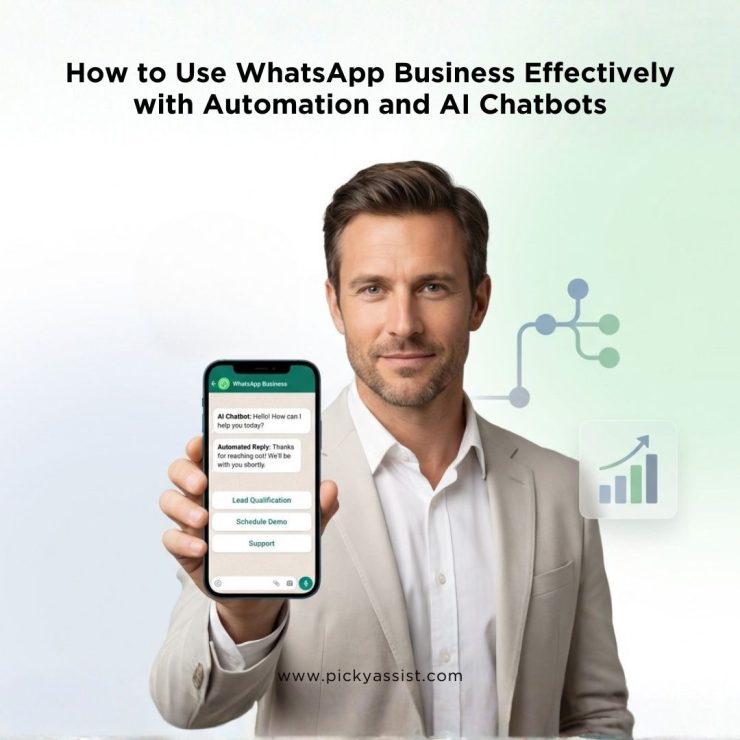
WhatsApp has evolved from a simple messaging app into one of the most powerful business communication channels globally. With over 2.7 billion active users and open rates exceeding 95%, it has become a primary touchpoint for customer interactions. However, many businesses still struggle to scale conversations manually, leading to delayed responses, lost leads, and inconsistent experiences. Understanding how to use WhatsApp Business effectively is no longer about just replying faster, it’s about building structured, automated, and intelligent conversations.
By combining WhatsApp Business with automation and AI chatbots, companies can handle high volumes of inquiries, qualify leads in real time, and guide customers seamlessly from first contact to purchase, all while reducing operational costs and improving customer satisfaction.
Why Automation Is Critical to Use WhatsApp Business at Scale?
Manual messaging works only up to a point. Once a business starts receiving hundreds or thousands of inquiries per day, response quality and speed decline sharply. Studies show that businesses responding within five minutes are 21 times more likely to convert a lead compared to slower responses.
Automation solves this by:
- Instantly responding to customer queries 24/7
- Reducing human workload by up to 60%
- Ensuring consistent brand messaging
- Eliminating missed or forgotten follow-ups
When businesses learn how to use WhatsApp Business effectively, automation becomes the foundation that enables scale without compromising customer experience.
Key Automation Features Every Business Should Enable
To fully leverage WhatsApp Business, companies must go beyond basic auto-replies and deploy advanced automation features.
Automated Greeting and Away Messages
Instant greeting messages reduce bounce rates and reassure users that their inquiry is being handled. Away messages ensure no lead is lost outside business hours.
Quick Replies and Saved Responses
For recurring queries, quick replies improve agent efficiency and maintain response consistency, reducing handling time by 40%.
Conversation Routing and Agent Assignment
Automation can route chats based on user intent, language, or location, ensuring faster resolution and better customer satisfaction.
How to Use WhatsApp Business Effectively with Chatbots?
Chatbots transform WhatsApp from a reactive support channel into a proactive sales and engagement engine. Instead of waiting for agents to respond, chatbots guide users through structured conversations.
Key ways chatbots improve WhatsApp Business performance include:
Automated Lead Qualification
Chatbots can ask qualifying questions such as budget, location, or intent within seconds. This ensures that sales teams only engage with high-intent leads, increasing close rates by 30%.
Product Discovery and Recommendations
By integrating catalogs and logic flows, chatbots can recommend products based on user preferences. This shortens the decision cycle and increases average order value by 40%.
Instant Support for Common Queries
Around 70% of customer questions are repetitive, pricing, availability, timings, policies. Chatbots handle these instantly, freeing agents to focus on complex issues.
This is where businesses truly understand how to use WhatsApp Business effectively, not as a chat inbox, but as an automated conversation system.
Using WhatsApp Automation Across the Sales Funnel
WhatsApp automation is effective across every stage of the customer journey.
Top of Funnel: Lead Capture and Engagement
Click-to-WhatsApp ads, website widgets, and QR codes drive inbound leads, while chatbots capture intent and contact details instantly.
Middle of Funnel: Nurturing and Education
Automated follow-ups, FAQs, and product comparisons keep prospects engaged without overwhelming sales teams.
Bottom of Funnel: Conversion and Payment
Automated reminders, offers, and payment links help close deals faster, reducing drop-offs at the decision stage.
Businesses that understand how to use WhatsApp Business effectively treat it as a full-funnel channel, not just a support tool.
Automation Use Cases That Drive Measurable Results
To move beyond theory, here are proven automation use cases delivering real ROI:
- Welcome & Opt-in Flows: Automatically greet users and capture consent within seconds
- Appointment Booking: Reduce no-shows by up to 35% with automated confirmations and reminders
- Abandoned Lead Follow-ups: Recover up to 25% of lost leads using timed WhatsApp nudges
- Broadcast + Chatbot Combo: Send targeted offers and let chatbots handle replies, creating a closed-loop sales flow
Businesses that master how to use WhatsApp Business effectively combine outbound broadcasts with inbound chatbot automation for maximum conversion impact.
Integrating WhatsApp Automation with Sales and CRM Systems
Automation becomes exponentially more powerful when WhatsApp is connected to CRM software, payment, and analytics tools.
With proper integration, businesses can:
- Sync leads directly into CRM pipelines
- Trigger automated follow-ups based on deal stage
- Track conversation-to-conversion ratios
- Measure ROI at a campaign level
Data shows companies using integrated WhatsApp automation see 25% faster sales cycles compared to disconnected systems. This integration layer is a critical but often overlooked aspect of how to use WhatsApp Business effectively.
Measuring Performance and Optimizing WhatsApp Automation
Automation should be continuously monitored and optimized using data.
Key metrics to track include:
- Response time
- Conversation completion rate
- Lead-to-conversion ratio
- Drop-off points in chatbot flows
By refining flows based on these insights, businesses can improve efficiency and conversion rates over time.
Compliance, Trust, and Customer Experience Considerations
Automation must be implemented responsibly. WhatsApp has strict policies around opt-ins, messaging frequency, and template usage. Over-automation or spammy messaging can damage trust and reduce engagement.
Best practices include:
- Using explicit user opt-ins
- Personalizing messages with dynamic variables
- Keeping conversations contextual, not promotional-heavy
- Offering easy human handover when needed
When done correctly, automation enhances trust instead of eroding it, an essential principle in learning how to use WhatsApp Business effectively.
Conclusion
WhatsApp is no longer just a messaging platform, it is a full-funnel business channel. Businesses that rely solely on manual replies will struggle to scale, while those leveraging automation and chatbots gain a decisive competitive advantage.
Understanding how to use WhatsApp Business effectively means building intelligent, data-driven conversations that respond instantly, qualify leads automatically, and guide customers toward action. With the right automation strategy, WhatsApp can reduce costs, increase conversions, and deliver measurable business growth, without sacrificing customer experience.
Add comment