
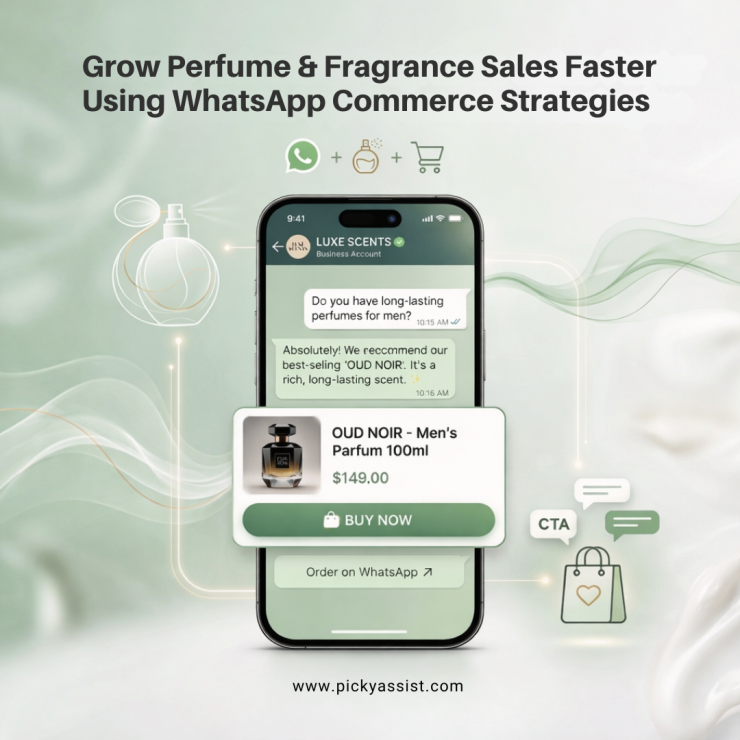
The perfume and fragrance industry is one of the most emotionally driven consumer markets in the world, yet it has historically depended on physical retail, sensory experiences, and human consultation to close sales. As consumer behavior shifts toward mobile-first interactions, fragrance brands are being forced to rethink how discovery, education, and conversion happen in a digital environment.
Traditional ecommerce alone struggles to replicate the trust and personalization required for fragrance purchases. This is where WhatsApp Commerce is emerging as a powerful channel that combines real-time conversation, guided selling, and seamless transactions. By enabling one-to-one engagement at scale, WhatsApp is helping fragrance brands bridge the gap between physical consultation and digital convenience while improving conversions, retention, and customer lifetime value.
The Digital Evolution of the Perfume and Fragrance Industry
The fragrance industry has evolved rapidly over the last decade, driven by globalization, changing consumer preferences, and innovation across product formulation and branding. The modern perfume industry is no longer limited to luxury boutiques or department stores. It now spans mass-market brands, niche artisanal labels, industrial fragrances used in home and personal care products, and digitally native fragrance startups. This expansion has reshaped the fragrance and perfume market, making it more competitive and fragmented than ever before.
According to recent fragrance market research, more than 70 percent of fragrance buyers now conduct online research before making a purchase decision. This includes reading reviews, understanding scent notes, comparing prices, and learning about longevity and formulation. The global fragrance industry continues to grow steadily, supported by rising disposable incomes and strong demand in Asia-Pacific and the Middle East. At the same time, the global perfume market is projected to grow at over 66 percent CAGR, with the luxury perfume market outperforming other segments due to premiumization and gifting trends.
Despite this growth, digital channels face a fundamental challenge: fragrance is not a visually driven product. This limitation has pushed brands to adopt conversational interfaces that allow them to explain, recommend, and reassure customers in real time. WhatsApp Commerce has become a natural solution because it mirrors how people already communicate and make decisions.
Why WhatsApp Commerce Fits the Perfume and Fragrance Industry?
WhatsApp Commerce works exceptionally well for the perfume and fragrance industry because fragrance buying is consultative rather than transactional. Consumers rarely purchase a perfume without context. They want to understand how it smells, when it should be worn, how long it lasts, and whether it aligns with their personality or lifestyle. In physical stores, this role is played by trained sales advisors. On WhatsApp, this experience is replicated through guided conversations powered by automation and AI.
Data from perfume market research shows that conversational commerce channels can increase conversion rates by up to 45 percent compared to traditional ecommerce flows. This uplift is particularly strong in fragrance because customers feel more confident when their questions are answered instantly. WhatsApp allows brands to showcase catalogs, share videos, explain notes, and recommend alternatives in a single conversation. For brands operating in the perfume market, this reduces friction and shortens the decision-making cycle significantly.
WhatsApp also supports high engagement rates, with open rates exceeding 90 percent, far outperforming email and paid media. This makes it a valuable channel not only for acquisition but also for retention, cross-selling, and repeat purchases.
How WhatsApp Commerce Enhances Product Discovery?
One of the biggest advantages of WhatsApp Commerce for fragrance brands lies in its ability to educate customers effectively. The production of perfume involves complex processes, from sourcing raw materials to blending compounds and aging formulations. Consumers may not understand these technical aspects, but they care deeply about outcomes such as scent profile, longevity, and skin compatibility.
Through WhatsApp, brands can explain the science behind perfume manufacturing, the role of a perfume compound manufacturer, and the difference between eau de parfum and eau de toilette in a conversational manner. This approach builds trust and positions the brand as an authority in the perfume cosmetics world.
WhatsApp also allows brands to explain the nuances of flavors and fragrances, helping customers differentiate between citrus, woody, oriental, and gourmand profiles. This level of education is difficult to achieve through static product pages alone. Over time, this leads to better-informed customers, fewer returns, and higher satisfaction.
WhatsApp Commerce Across the Fragrance Supply Chain
The benefits of WhatsApp Commerce extend beyond D2C brands to the broader ecosystem of perfume manufacturing companies and suppliers. Perfume fragrance manufacturers use WhatsApp to engage distributors, retailers, and private-label clients more efficiently. It enables faster communication, sample coordination, and order confirmations, especially in export-driven markets.
For perfume bottle manufacturers and custom perfume bottles manufacturers, WhatsApp serves as a visual communication tool. Design mockups, packaging options, and customization details can be shared instantly, reducing delays and misunderstandings. This improves operational efficiency across the fragrance market, where speed and precision are critical.
In the B2B segment, WhatsApp Commerce also supports lead qualification and relationship management, making it easier for manufacturers to scale without increasing sales overhead.
Driving Sales and Retention Through WhatsApp Automation
WhatsApp Commerce is not just about conversations; it is about automation at scale. WhatsApp automation platforms like Picky Assist enable fragrance brands to automate key touchpoints while maintaining a personalized experience. This includes abandoned cart reminders, replenishment prompts, new launch announcements, and loyalty communications.
According to industry benchmarks, automated WhatsApp follow-ups can recover up to 30 percent of abandoned carts in the perfume market. For repeat purchases, timely reminders based on usage cycles significantly improve retention. This is particularly effective in the luxury perfume market, where customer lifetime value is high and brand relationships matter.
Automation also allows brands to segment audiences based on preferences, purchase history, and engagement behavior. This ensures that messaging remains relevant and non-intrusive, preserving brand equity.
The Role of Technology in Scaling WhatsApp Commerce
Advancements in perfume technology are reshaping how fragrances are developed and marketed. AI-driven scent analysis, digital formulation tools, and data-led insights are becoming more common across the global perfume market. WhatsApp Commerce acts as the interface that connects these innovations to consumers.
Chatbots powered by AI can analyze user inputs and recommend fragrances with high accuracy. Over time, these systems improve through learning, delivering increasingly refined suggestions. This convergence of technology and conversation is redefining customer expectations in the fragrance and perfume market.
Market Insights and Measurable Impact
Independent fragrance market research indicates that brands using conversational commerce experience higher engagement, faster purchase decisions, and improved brand recall. In the global fragrance industry, WhatsApp Commerce is particularly effective in emerging markets where messaging apps dominate digital communication.
From a cost perspective, WhatsApp Commerce reduces dependency on paid acquisition channels by driving organic engagement and referrals. This improves overall marketing ROI while strengthening direct customer relationships.
How Picky Assist Powers WhatsApp Commerce for Fragrance Brands?
Picky Assist enables fragrance businesses to deploy WhatsApp Commerce without technical complexity while maintaining enterprise-grade control. This is particularly impactful for brands operating in the perfume cosmetics world, where customer lifetime value depends heavily on retention and repeat purchases.
Key capabilities include:
- No-code chatbot builders for scent discovery and FAQs
- WhatsApp catalogs for showcasing collections
- Automated broadcasts for launches and offers
- CRM and segmentation for repeat targeting
- Integration with ecommerce, payments, and logistics
To Conclude
WhatsApp Commerce has become a strategic growth channel for brands operating in the perfume and fragrance industry. As consumer expectations shift toward immediacy, personalization, and trust-driven engagement, WhatsApp offers a unique combination of scale and intimacy.
By leveraging automation, conversational AI, and platforms like Picky Assist, fragrance brands can replicate the in-store experience digitally while driving measurable business outcomes. In an increasingly competitive fragrance market, those who adopt WhatsApp Commerce early will set the benchmark for customer experience, loyalty, and long-term growth.
FAQs on Perfume and Fragrance Industry
1. How is WhatsApp used in the perfume and fragrance industry?
WhatsApp is used for guided fragrance discovery, personalized recommendations, order management, customer support, and automated follow-ups, replicating in-store consultation digitally.
2. Can WhatsApp increase perfume sales?
Yes. Brands report up to 45% higher conversion rates due to real-time interaction, reduced friction, and personalized engagement compared to traditional ecommerce.
3. Is WhatsApp Commerce suitable for luxury perfume brands?
Absolutely. Luxury brands use WhatsApp for private consultations, exclusive launches, VIP access, and relationship-driven selling without compromising brand prestige.
4. How do manufacturers benefit from WhatsApp Commerce?
Manufacturers use WhatsApp for B2B lead generation, distributor onboarding, sample coordination, and faster communication across the supply chain.
Add comment