
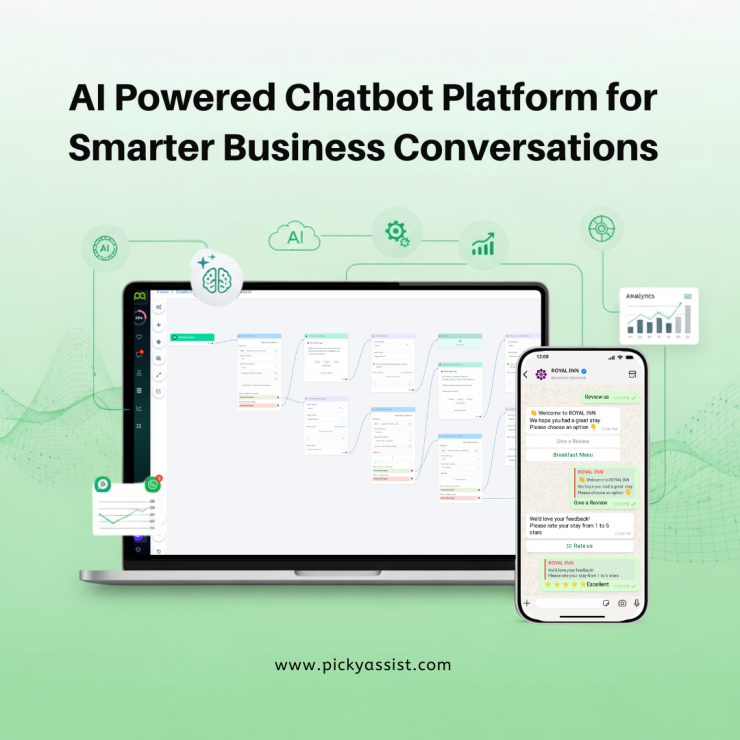
Customer expectations have permanently shifted. Businesses are now required to respond instantly, personalize every interaction, and remain available 24/7 across channels. An AI powered chatbot platform has therefore evolved from a support enhancement tool into a mission-critical automation layer for marketing, sales, and customer experience.
Among the platforms enabling this transformation is Picky Assist, which provides a no code chatbot builder and advanced AI capabilities, including chatbot deployment on WhatsApp.
This guide explores how an AI powered chatbot platform works, how no code development simplifies adoption, and how businesses can build AI powered chatbots for scalable growth.
What is an AI Powered Chatbot Platform?
An AI powered chatbot platform is a software ecosystem that allows organizations to design, deploy, and manage conversational bots driven by artificial intelligence.
Unlike basic scripted bots, an AI powered chatbot can:
- Understand natural language queries
- Interpret intent and context
- Respond dynamically
- Learn from interactions
- Automate complex workflows
Modern AI driven chatbots integrate Natural Language Processing (NLP), machine learning, and large language models to create fluid, human-like conversations.
How an AI Powered Chatbot Platform Works?
An AI powered bot operates through a structured yet intelligent process:
- A user initiates a message via WhatsApp, website, or app.
- The platform’s NLP engine analyzes the text.
- Intent and contextual entities are identified.
- The system generates or selects an appropriate response.
- Backend integrations trigger workflows if required (CRM update, ticket creation, lead scoring).
When implemented as a chatbot with OpenAI, the system can deliver advanced contextual conversations, intelligent summarization, and dynamic response generation.
AI Powered Chatbot on WhatsApp
WhatsApp has become one of the most dominant communication channels for businesses globally. Deploying an AI powered chatbot on WhatsApp allows brands to automate conversations where customers are already active.
With Picky Assist, businesses can implement:
- Automated lead capture
- Intelligent FAQs
- Appointment scheduling
- Order tracking
- Customer service workflows
- Payment reminders
- Feedback collection
A no code WhatsApp chatbot eliminates the need for programming expertise, allowing teams to design automation flows visually.
No Code Chatbot Builder: Build Without Programming
One of the biggest barriers to chatbot adoption used to be technical complexity. Today, a no code chatbot builder removes that friction.
Using a no code bot builder, businesses can:
- Create conversation flows using drag-and-drop interfaces
- Set triggers and automation rules
- Connect CRM and backend systems
- Deploy bots across channels
- Monitor analytics in real time
A no code chatbot platform enables marketing, operations, and support teams to build AI powered chatbots without programming knowledge. This significantly reduces deployment time and cost.
Core Capabilities of an AI Powered Chatbot Platform
1. Intelligent Conversation Engine
AI powered conversation bots understand intent rather than relying solely on keyword matching.
2. Contextual Memory
Advanced AI powered bots retain conversation history to respond contextually.
3. CRM & Data Integration
Cloud-based integrations enable real-time updates to lead and customer records.
4. Omnichannel Deployment
Deploy across WhatsApp, website chat, SMS, and social platforms.
5. Automation Workflows
Trigger backend actions such as sending emails, assigning agents, or updating sales stages.
AI Powered Virtual Assistant vs AI Powered Bot
An AI powered bot generally handles defined tasks such as FAQs or form collection. An AI powered virtual assistant goes further by:
- Managing multi-step conversations
- Handling contextual decision trees
- Integrating across sales, service, and marketing systems
- Providing recommendations based on behavior
Platforms like Picky Assist combine automation logic with AI-driven chat to create business-grade virtual assistants.
AI Powered Chatbot vs Rule-Based Chatbot
| Capability | AI Powered Chatbot | Rule-Based Bot |
| Intent Recognition | Advanced NLP | Keyword dependent |
| Adaptability | Learns over time | Static scripts |
| Personalization | High | Limited |
| Workflow Automation | Dynamic | Linear |
| Conversational Depth | Contextual | Predefined responses |
AI driven chatbots outperform rule-based bots in complex customer journeys and sales qualification scenarios.
Use Cases Across Industries
E-commerce
- Cart recovery
- Product recommendations
- Order tracking
Education
- Admission enquiries
- Course information
- Student onboarding
Healthcare
- Appointment booking
- Prescription reminders
- Patient FAQs
Real Estate
- Property listings
- Lead qualification
- Site visit scheduling
SaaS & Services
- Demo booking
- Lead scoring
- Customer onboarding
An AI powered chatbot platform adapts to industry-specific workflows.
Benefits of Using an AI Powered Chatbot Platform
1. 24/7 Availability
Customers receive instant support without human intervention.
2. Cost Efficiency
Reduces dependency on large support teams.
3. Improved Conversion Rates
Automated qualification ensures sales teams focus on high-intent leads.
4. Enhanced Customer Experience
Personalized and contextual responses improve engagement.
5. Scalability
Handle thousands of simultaneous conversations effortlessly.
How to Build an AI Powered Chatbot with Picky Assist
Set Up Your Account & Channel Integration
Start by:
- Creating your account on the platform.
- Connecting your communication channel:
- WhatsApp Business API
- Website chat widget
- Other supported messaging channels
- WhatsApp Business API
If you are building a no code WhatsApp chatbot, ensure your WhatsApp Business API is verified and connected inside the dashboard.
Once connected, your chatbot can send and receive real-time messages.
Access the No Code Chatbot Builder
Navigate to the visual chatbot flow builder inside the platform.
This is where you:
- Drag and drop message blocks
- Add decision nodes
- Configure triggers
- Set conditions
- Design automation paths
This no code bot builder eliminates the need for programming logic.
Define the Chatbot Objective
Before designing flows, clearly define your automation goal.
Examples:
- Lead generation
- Demo booking
- Customer support
- Order tracking
- Feedback collection
For example, if building an AI powered bot for lead generation:
- Ask qualification questions
- Capture name, email, phone
- Store responses
- Trigger CRM update
- Notify sales team
Your objective shapes the conversation architecture.
Design the Conversation Flow
Inside the visual builder:
1. Add Welcome Message
Create an engaging opening message that explains what the bot can help with.
Example:
“Hi 👋 I’m your virtual assistant. How can I help you today?”
2. Add Interactive Options
Use:
- Quick reply buttons
- List messages
- Conditional branching
- Keyword triggers
3. Configure Intent-Based Paths
Instead of only static replies, configure AI powered conversation bots by mapping:
- Pricing enquiries
- Product questions
- Support requests
- Demo bookings
This allows structured automation while maintaining flexibility.
Enable AI Capabilities
To convert your workflow into an AI powered chatbot:
- Train intent variations (multiple ways users may ask the same question)
- Enable contextual response handling
- Connect knowledge base content
- Configure fallback intelligence
If using chatbot with OpenAI integration, you can:
- Generate dynamic responses
- Summarize conversations
- Provide intelligent answers beyond predefined flows
- Handle open-ended queries
This transforms your bot from rule-based automation into AI driven chatbots.
Configure Data Capture & CRM Integration
One major advantage of the platform is structured data capture.
You can:
- Store user responses in custom fields
- Push data into CRM automatically
- Assign leads to sales agents
- Trigger internal notifications
- Send automated email alerts
This converts your AI powered chatbot platform into a centralized automation engine.
Add Automation Rules & Workflows
Enhance the chatbot by adding:
- Auto-tagging of users
- Lead scoring logic
- Follow-up reminders
- Time-based triggers
- Conditional routing
Example automation:
User requests pricing → Bot captures details → CRM updated → Sales notified → Follow-up message sent after 24 hours.
This is where AI powered bots generate measurable ROI.
Configure Human Handover
Even advanced AI powered virtual assistant systems need human intervention in some scenarios.
Set rules for:
- Escalation triggers
- Agent assignment
- Live chat takeover
- Priority routing
This ensures a seamless customer experience.
Test Before Going Live
Testing is critical.
Simulate:
- All user paths
- Invalid inputs
- Intent variations
- CRM data flow
- Notification triggers
Ensure fallback responses are intelligent and not repetitive. Testing improves chatbot performance significantly
Deploy and Monitor Performance
Once validated:
- Activate the chatbot
- Monitor conversation analytics
- Track completion rates
- Measure lead conversions
- Optimize drop-off points
Continuous optimization enhances AI powered chatbot efficiency over time.
Using Picky Assist, businesses can:
- Design chat flows visually
- Integrate CRM and sales tools
- Deploy AI powered bots on WhatsApp
- Automate marketing campaigns
- Track performance metrics
- Enable AI-powered response generation
Its no code chatbot platform ensures non-technical teams can manage automation independently.
Key Features to Look for in an AI Powered Chatbot Platform
When selecting a platform, evaluate:
- Advanced NLP capabilities
- AI model integration (including chatbot with OpenAI options)
- No code chatbot builder interface
- WhatsApp automation support
- Workflow automation engine
- CRM and API integrations
- Real-time analytics
- Role-based access control
Choosing the right AI powered chatbot platform determines long-term automation success.
Security and Compliance on AI Powered Chatbot Platform
Enterprise-grade AI powered chatbot platforms must provide:
- End-to-end encryption
- Secure API integrations
- Role-based permissions
- Audit logs
- Compliance with data protection standards
Security becomes especially critical when automating conversations on WhatsApp.
The Future of AI Powered Chatbot Platforms
Emerging innovations include:
- Predictive sales bots
- Emotion-aware AI
- Voice-integrated bots
- AI-powered lead scoring
- Autonomous workflow execution
AI powered conversation bots are evolving into intelligent automation systems that support entire customer lifecycles.
To Conclude
An AI powered chatbot platform is now a strategic automation asset, not merely a support enhancement.
By combining:
- AI powered conversation bots
- No code chatbot builder tools
- WhatsApp automation capabilities
- CRM integration
- Intelligent analytics
Businesses can streamline communication, reduce operational friction, and increase conversion efficiency.
Platforms like Picky Assist enable organizations to build AI powered chatbots without programming, deploy them on WhatsApp, and scale engagement intelligently.
Companies that adopt AI driven chatbots today gain a measurable competitive advantage in responsiveness, personalization, and operational efficiency.
Frequently Asked Questions on AI powered chatbot platform
1. What is an AI powered chatbot platform?
An AI powered chatbot platform is a system that enables businesses to create and manage intelligent conversational bots using artificial intelligence technologies.
2. Can I build AI powered chatbot platform without programming?
Yes. A no code chatbot builder allows teams to design and deploy bots without coding expertise.
3. Does Picky Assist support WhatsApp chatbot automation?
Yes. Picky Assist enables deployment of AI powered bots on WhatsApp with automation workflows.
4. What is the difference between AI powered chabot platform and rule-based bots?
AI powered bots use NLP and machine learning to understand context and intent, while rule-based bots rely on predefined scripts.
5. What is a no code WhatsApp chatbot?
A no code WhatsApp chatbot allows businesses to automate WhatsApp conversations using visual builders without writing code.
6. How secure are AI powered chatbot platforms?
Enterprise-grade platforms provide encryption, controlled access, and secure API integrations to protect user data.
7. Can AI powered chatbot platform integrate with CRM systems?
Yes. Most advanced AI powered chatbot platforms integrate with CRM and backend systems for seamless data flow.
Add comment