
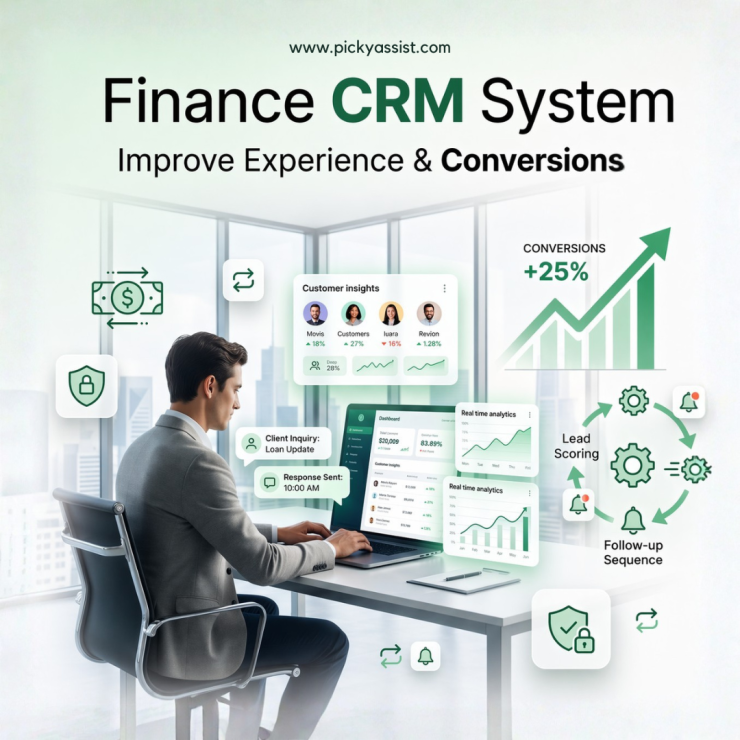
Financial institutions operate in one of the most complex, high-trust environments in the business world. Whether you manage a bank, NBFC, lending company, or advisory firm, your success depends on how effectively you build relationships, manage communication, and stay compliant, without slowing down operations. That’s exactly where a CRM for financial institutions becomes essential.
However, not all CRM systems are designed with the realities of finance in mind. Many are generic, rigid, or lack the communication intelligence required for modern customer engagement. This guide breaks down what actually matters, how to evaluate your options, and where a solution like Picky Assist fits into the picture.
What is a CRM for Financial Institutions?
A CRM for financial institutions is a specialized system that helps organizations manage customer relationships, communication, and lifecycle interactions while aligning with industry-specific requirements such as compliance, documentation, and data sensitivity.
Unlike general-purpose CRMs, a financial institution CRM focuses on:
- Structured lead and customer lifecycle tracking
- Secure and trackable communication
- Automated engagement workflows
- Integration with financial tools and systems
- Documentation and audit trails
More importantly, it ensures that every interaction, from onboarding to servicing; is consistent, timely, and recorded.
Why Traditional CRM Systems Fall Short in Finance?
Many organizations initially adopt generic CRM tools. Over time, limitations begin to surface.
1. Communication Silos
Finance businesses rely heavily on messaging platforms like WhatsApp and email. Traditional CRMs often fail to unify these channels into one interface.
2. Lack of Automation for Engagement
Without automation, teams manually follow up with leads, reminders, and document requests. This leads to delays and missed opportunities.
3. Poor Visibility Across Teams
Sales, operations, and support teams often work in disconnected systems, leading to fragmented customer data.
4. Limited Workflow Customization
Financial processes such as loan processing or policy approvals require structured flows that many generic CRMs cannot support efficiently.
As a result, organizations begin searching for a financial CRM software that better aligns with their workflows.
Features to Look for in a Financial CRM System
Choosing the right system requires focusing on capabilities that directly impact operations and growth.
1. Omnichannel Communication Integration
A modern CRM for finance must support multiple communication channels within one platform. This includes:
- WhatsApp Business API
- SMS
- Website chat
Picky Assist stands out here by enabling centralized communication management, ensuring that all conversations are logged and accessible.
2. Workflow Automation for Financial Processes
Automation is not just about saving time, it’s about reducing human error and ensuring consistency.
Key automation use cases include:
- Lead qualification flows
- Document collection workflows
- Appointment scheduling
- Payment reminders
- Renewal notifications
A well-designed CRM in finance allows you to trigger actions based on user behavior or lifecycle stages.
3. Lead and Customer Lifecycle Management
Financial institutions deal with long sales cycles. Therefore, tracking every stage is critical.
A robust system should allow:
- Lead scoring
- Pipeline tracking
- Stage-wise automation
- Custom deal flows
This is especially useful for businesses looking for a CRM for finance brokers, where managing multiple client journeys simultaneously is common.
4. Data Centralization and Visibility
A good CRM should eliminate data silos.
With Picky Assist, teams can:
- View complete conversation history
- Track customer interactions across channels
- Access lead data in real-time
This level of visibility improves collaboration across departments.
5. Compliance-Friendly Communication Tracking
While Picky Assist is not a compliance management system, it helps support compliance by:
- Maintaining communication logs
- Ensuring structured messaging workflows
- Providing traceability for interactions
For financial businesses, this adds a layer of accountability and audit readiness.
6. Integration Capabilities
A strong financial CRM systems solution should integrate with:
- Core banking systems
- Loan management tools
- Accounting software
- Marketing platforms
Picky Assist integrates well with existing systems, acting as a communication and automation layer rather than replacing core infrastructure.
How Picky Assist Fits into Financial CRM Needs?
Picky Assist is not a traditional CRM. Instead, it functions as a communication-first CRM layer that enhances how financial institutions interact with customers.
Here’s where it delivers real value:
Unified Communication Hub
Manage WhatsApp, SMS, email, and chat in one shared inbox.
Automation Engine
Create workflows that handle repetitive tasks like follow-ups, onboarding, and reminders.
Real-Time Engagement
Respond instantly using automated chatbots or team-based messaging.
CRM Integration Support
Enhance your existing CRM instead of replacing it entirely.
Scalable for Different Financial Segments
Whether you are a lender, advisor, or broker, the platform adapts to your workflows.
Use Cases Across Financial Institutions
To understand the practical value, let’s explore real-world applications.
1. Loan and Lending Companies
- Capture leads via website or ads
- Automatically initiate WhatsApp conversations
- Collect KYC documents via chat
- Send reminders for incomplete applications
2. Insurance Advisors and Brokers
For businesses looking for a CRM for financial services, engagement is everything.
- Send policy updates and renewal reminders
- Automate follow-ups for leads
- Track conversations for each client
3. Wealth Management Firms
- Schedule consultations
- Share investment updates
- Maintain communication history
4. NBFCs and Microfinance Institutions
- Automate repayment reminders
- Engage customers through preferred channels
- Track communication for collections
A well-implemented financial management CRM improves both recovery rates and customer satisfaction.
Example of CRM in Banking: Personal Loan Lead Management
Scenario
A retail bank wants to improve how it captures, nurtures, and converts personal loan inquiries coming from its website and digital campaigns.
Step-by-Step Use Case Flow
1. Lead Capture
A potential customer fills out a personal loan inquiry form on the bank’s website.
- The CRM instantly captures the lead details
- The lead is automatically assigned to the appropriate branch or relationship manager
- A new contact profile is created in the system
2. Instant Customer Engagement
As soon as the lead is captured:
- The customer receives an automated WhatsApp message confirming their request
- Basic loan eligibility questions are triggered through an automated chat flow
- The system begins collecting additional details like income range, employment type, and loan amount
This is where a communication-focused platform like Picky Assist adds strong value by enabling real-time engagement.
3. Lead Qualification and Routing
Based on the responses:
- The CRM categorizes the lead (high intent, medium, or low)
- High-intent leads are prioritized and assigned to senior agents
- Low-intent leads enter a nurturing workflow
This ensures efficient resource allocation.
4. Document Collection
The CRM initiates a structured workflow:
- The customer receives a secure link or chat prompt to upload documents
- Required documents may include ID proof, salary slips, and bank statements
- The system tracks which documents are pending
Automated reminders are sent if the customer delays submission.
5. Follow-Up Automation
Instead of manual chasing:
- The CRM schedules follow-ups via WhatsApp
- Automated reminders are sent for incomplete applications
- Relationship managers get alerts for high-priority leads
This prevents drop-offs during the application process.
6. Loan Processing Coordination
Once documents are complete:
- The CRM updates the application stage
- Internal teams (verification, underwriting) are notified
- Status updates are shared with the customer automatically
This improves transparency and reduces inbound queries.
7. Approval and Disbursement Communication
- The customer receives approval updates instantly
- Loan terms and next steps are shared
- Disbursement confirmation is sent once completed
All communication is logged in the CRM for future reference.
8. Post-Disbursement Engagement
The CRM continues to add value even after conversion:
- EMI reminders are automated
- Cross-sell offers (credit cards, insurance) are triggered based on profile
- Customer support interactions are tracked in one place
Key Outcomes of This CRM Use Case
- Faster response time to new leads
- Higher loan conversion rates
- Reduced manual workload for staff
- Better customer experience through timely updates
- Complete visibility of the customer journey
Why This Matters
In banking, delays and poor communication often lead to lost opportunities. A well-implemented CRM, especially one enhanced with automation and omnichannel messaging like Picky Assist, ensures that every lead is engaged, every step is tracked, and every customer interaction is optimized.
Benefits of Implementing a Financial CRM System
Adopting the right system can transform operations.
Improved Customer Experience
Customers receive faster responses and consistent communication.
Higher Conversion Rates
Automated follow-ups ensure no lead is neglected.
Operational Efficiency
Teams spend less time on manual tasks and more on strategic work.
Better Data Insights
Centralized data helps identify patterns and improve decision-making.
Scalable Growth
Systems like Picky Assist grow with your business.
How to Choose the Right CRM for Financial Institutions?
Making the right decision requires a structured approach.
Step 1: Define Your Workflow Requirements
Understand your sales, onboarding, and servicing processes.
Step 2: Evaluate Communication Needs
If messaging is central to your business, prioritize platforms with strong communication capabilities.
Step 3: Check Integration Flexibility
Ensure the CRM works with your existing tools.
Step 4: Assess Automation Capabilities
Look for systems that can automate real operational tasks, not just marketing.
Step 5: Consider Scalability
Your CRM should support growth without requiring a complete overhaul.
Common Mistakes to Avoid
Even experienced teams make avoidable errors when selecting a CRM.
Choosing Based on Brand Name Alone
A popular CRM may not fit your specific needs.
Ignoring Communication Capabilities
In finance, engagement is critical. A CRM without strong communication features creates bottlenecks.
Overlooking User Adoption
Complex systems often fail because teams don’t use them effectively.
Not Planning for Integration
Switching systems frequently creates disruption and data loss.
Future Trends in CRM for the Finance Industry
The CRM for the finance industry is evolving rapidly.
AI-Powered Engagement
Chatbots and automation are becoming standard for customer interaction.
Conversational CRM Models
Messaging platforms are replacing traditional email-heavy workflows.
Hyper-Personalization
CRMs are leveraging data to deliver more relevant communication.
API-First Architecture
Flexible integration is becoming a priority for modern systems. Picky Assist aligns well with these trends by focusing on communication-driven CRM workflows.
Conclusion
A CRM for financial institutions is no longer optional, it’s a foundational system that directly impacts growth, efficiency, and customer experience.
However, the real advantage comes from choosing a solution that fits how your business actually operates.
Picky Assist offers a practical, communication-focused approach. Instead of forcing you to replace your existing systems, it enhances them by improving how you engage, automate, and manage customer interactions.
For financial institutions that rely heavily on messaging, follow-ups, and structured workflows, this approach delivers immediate and measurable value.
FAQs on CRM for Financial Institutions
1. What is the main purpose of a CRM for financial institutions?
It helps manage customer relationships, track interactions, automate workflows, and centralize communication while supporting operational efficiency.
2. How is a financial CRM different from a regular CRM?
A financial CRM is tailored for industry-specific workflows such as loan processing, policy management, and compliance-friendly communication tracking.
3. Can Picky Assist replace my existing CRM?
No. Picky Assist is designed to enhance your existing CRM by adding communication and automation capabilities.
4. Is CRM useful for small financial businesses?
Yes. Even small firms benefit from improved organization, automation, and better customer engagement.
5. What channels should a CRM for finance support?
Ideally, it should support WhatsApp, SMS, email, and live chat for complete communication coverage.
6. How does CRM improve lead conversion in finance?
By automating follow-ups, tracking interactions, and ensuring timely engagement with prospects.
7. Is automation important in financial CRM systems?
Yes. Automation reduces manual work, ensures consistency, and speeds up processes like onboarding and reminders.
8. What should I prioritize when choosing a CRM for financial services?
Focus on communication capabilities, workflow automation, integration flexibility, and ease of use.


Add comment