
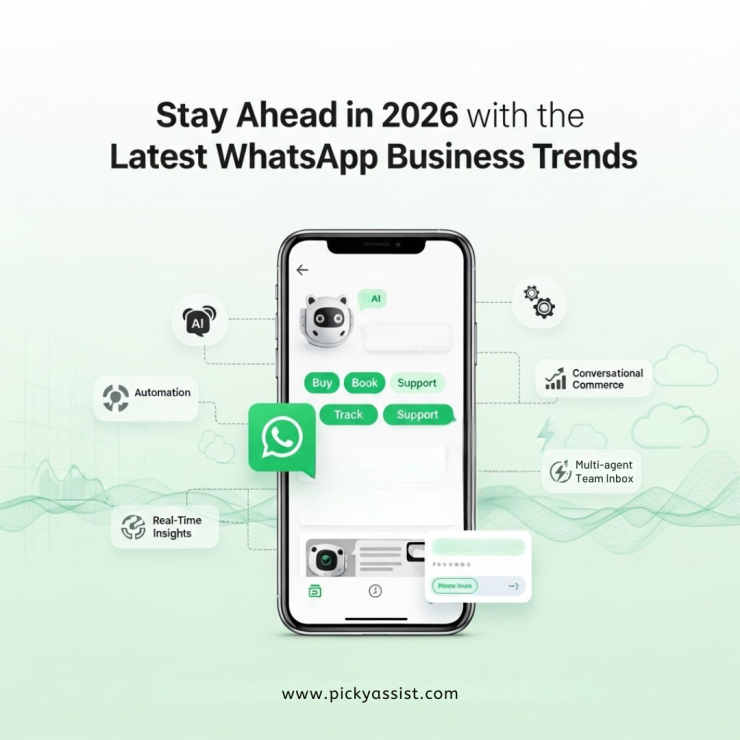
WhatsApp trends in 2026 clearly show that the platform has moved far beyond personal messaging. Businesses now rely on WhatsApp as a core communication channel that supports marketing, sales, customer support, and internal operations. Companies that treat WhatsApp as an optional tool struggle to meet customer expectations in a chat-first world.
In 2026, WhatsApp functions as an AI-driven conversational commerce platform. Picky Assist is such a platform that lets businesses manage full customer journeys inside a single chat, from first interaction to payment and post-purchase support. This shift explains why WhatsApp marketing continues to outperform email, SMS, and traditional landing pages.
Let’s find out the most important WhatsApp trends in 2026 and how these trends affect real business growth.
Why Has WhatsApp Become a Core Business Platform in 2026?
Customer behavior has changed dramatically over the last few years. People now expect instant responses, personalized communication, and frictionless buying experiences. WhatsApp meets all these expectations in one place.
Open rates on WhatsApp remain significantly higher than email. Response rates also exceed most digital channels. The 26–35 age group dominates WhatsApp usage, and this group prefers fast, intuitive, and conversational interactions.
Because of this shift, businesses now approach WhatsApp strategically. They combine automation, AI, analytics, and compliance to build scalable communication systems.
1. Conversational Commerce Dominates WhatsApp Trends in 2026
Conversational commerce stands at the center of WhatsApp trends in 2026. Customers no longer want to browse websites, fill forms, or wait for callbacks. They prefer to discover products, ask questions, and complete purchases inside a WhatsApp conversation.
WhatsApp product catalogs allow businesses to showcase offerings directly in chat. In-chat carts simplify product selection without redirects. Integrated payments, including UPI, complete the buying process instantly.
This approach reduces friction, shortens the sales cycle, and increases conversion rates. Businesses now manage the entire sales journey within WhatsApp, which makes conversational commerce a major growth driver in 2026.
2. AI-Driven Conversations Replace Static WhatsApp Chatbots
Early WhatsApp chatbots relied on rigid rule-based flows that often frustrated users. In 2026, businesses will use AI-powered conversational assistants that understand intent, context, and sentiment.
These AI assistants answer complex customer questions accurately. It qualify leads automatically using conversation data. They route chats to the correct sales or support team without delays. They also operate 24/7 while maintaining a natural conversational tone. AI now enables human-like conversations at scale. This shift improves response quality, customer satisfaction, and operational efficiency across industries.
3. WhatsApp Automation Covers the Entire Customer Lifecycle
WhatsApp automation in 2026 extends far beyond promotional messaging. Businesses now automate complete customer journeys using WhatsApp as the primary interface.
Automation begins with lead capture from websites and click-to-WhatsApp ads. Instant welcome messages engage users immediately. Automated follow-up funnels prevent missed opportunities. Order updates, invoices, and payment confirmations flow automatically. Post-purchase support and re-engagement campaigns keep customers active. This lifecycle-based automation reduces manual work while maintaining consistent communication. Teams focus on high-value interactions instead of repetitive tasks.
4. CRM-Integrated WhatsApp Personalization Becomes Essential
Generic WhatsApp broadcasts lose effectiveness in 2026. Customers now expect contextual and personalized communication that reflects their history and preferences.
CRM integration enables advanced WhatsApp personalization. Businesses use customer data to trigger behavior-based messages. Campaigns adapt based on browsing activity, purchase history, and engagement patterns. Conversations remain visible across teams, which prevents repetition and confusion. This level of personalization increases engagement rates and strengthens long-term customer relationships.
5. Interactive WhatsApp Messages Drive Higher Conversions
Long text messages no longer hold attention. Businesses now use interactive WhatsApp message formats that simplify decision-making and guide users clearly.
Quick reply buttons reduce typing effort. Call-to-action buttons speed up responses. List messages organize options clearly. Rich media, including images, PDFs, videos, and product carousels, improves understanding and engagement. These interactive formats reduce friction, shorten response time, and improve conversion outcomes across sales and support use cases.
6. Data-Driven WhatsApp Marketing Becomes the Standard
WhatsApp marketing in 2026 relies heavily on analytics. Businesses no longer guess what works. They track performance using real-time dashboards.
Key metrics include first response time, read rates, reply rates, campaign performance, agent productivity, and conversion influence. These insights help teams refine messaging strategies continuously. Data-driven optimization ensures that WhatsApp marketing delivers measurable ROI instead of vanity metrics.
7. Compliance-First WhatsApp Business API Usage Is Mandatory
As WhatsApp usage grows, compliance becomes non-negotiable. Businesses now move away from unofficial tools and adopt the official WhatsApp Business API. API-based messaging ensures policy compliance, secure data handling, template approval, and scalability. This approach protects accounts from bans and builds customer trust. Regulated industries especially treat compliance as a competitive advantage rather than a limitation.
8. Click-to-WhatsApp Ads Outperform Traditional Landing Pages
Click-to-WhatsApp ads play a major role in WhatsApp trends in 2026. These ads open a direct chat from Facebook and Instagram, eliminating landing page friction. Businesses qualify leads instantly through conversation. Sales teams respond faster. Customers receive immediate answers. This approach shortens the sales cycle and improves conversion rates significantly.
9. Video-Driven WhatsApp Marketing Gains Momentum
Video content drives engagement across digital platforms, and WhatsApp is no exception. Short-form and interactive video messages now play a key role in product discovery and education. Businesses use videos to demonstrate products, explain features, and build trust. In-chat video shopping experiences increase clarity and reduce hesitation during purchase decisions.
Privacy, Consent, and Trust Shape WhatsApp Marketing in 2026
Customers expect transparency and control over communication. Businesses must follow clear opt-in practices, respect consent, and protect customer data. Brands that prioritize privacy build stronger trust and long-term loyalty. Compliance also improves message engagement and reduces opt-outs.
Frequently Asked Questions About WhatsApp Trends in 2026
Is WhatsApp marketing still effective in 2026?
Yes, WhatsApp marketing remains highly effective in 2026 due to high open rates, instant engagement, and conversational interactions.
Do small businesses need WhatsApp Business API?
Small businesses can start with the WhatsApp Business app, but growing businesses benefit from API features like automation and CRM integration.
Are WhatsApp bulk messages allowed in 2026?
WhatsApp allows bulk messages only with user opt-in and approved templates to ensure compliance and trust.
Can WhatsApp replace websites for sales?
WhatsApp can handle full sales cycles, but businesses often use it alongside websites for maximum reach.
What industries benefit most from WhatsApp marketing?
Ecommerce, education, healthcare, real estate, travel, and financial services see strong results from WhatsApp marketing.
Conclusion: The Future of WhatsApp Marketing in 2026
WhatsApp trends in 2026 make one thing very clear for businesses across industries. WhatsApp has evolved into a central, chat-first growth platform that connects marketing, sales, customer support, and operations in one continuous experience. Businesses no longer use WhatsApp only to send messages. They now use it to manage complete customer journeys.
In 2026, successful brands treat WhatsApp as a strategic business channel rather than an add-on tool. They invest in AI-driven conversations, lifecycle automation, CRM-integrated personalization, and compliance-first WhatsApp Business API solutions. This approach allows them to respond faster, communicate better, and convert customers more efficiently.
Customer expectations continue to shift toward instant, conversational engagement. Buyers want answers in real time. They want personalized recommendations. They want to browse products, ask questions, and complete purchases without leaving a chat. WhatsApp enables all of this through conversational commerce, interactive messages, in-chat payments, and rich media experiences.
Businesses that adopt WhatsApp marketing trends in 2026 gain a clear competitive advantage. It reduce response times. They shorten sales cycles. Improve customer satisfaction. They also build stronger trust by respecting privacy, consent, and data security.
On the other hand, businesses that delay adoption face increasing challenges. They struggle with slower response times, fragmented customer data, lower engagement, and missed revenue opportunities. In a world where customers expect immediate and meaningful conversations, outdated communication models no longer work.
The future of WhatsApp marketing depends on intelligent automation, responsible personalization, and measurable outcomes. Companies must automate workflows without losing the human touch. They must personalize messages without becoming intrusive. They must track performance based on real business impact rather than message volume.


Add comment