
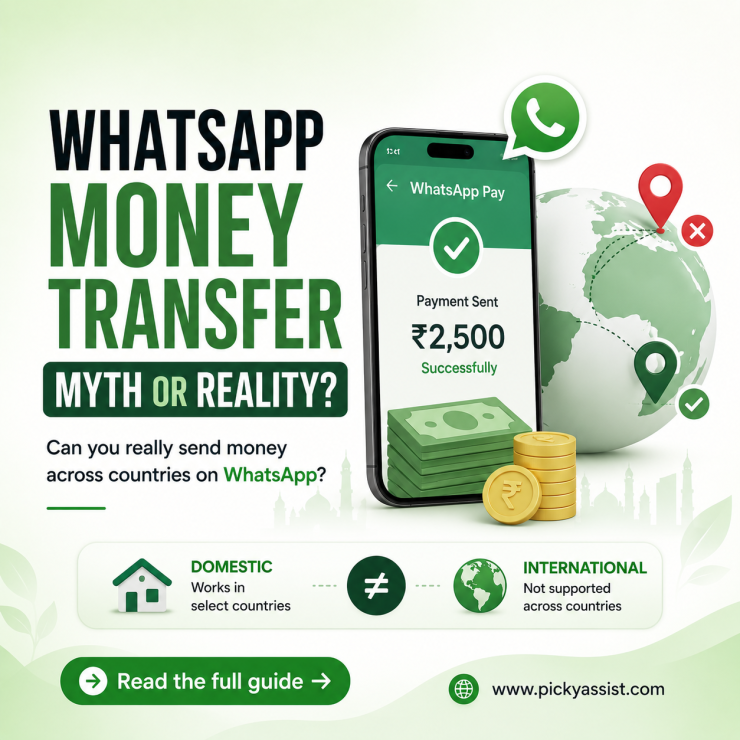
WhatsApp money transfer, known officially as WhatsApp Pay, is a domestic payment feature. It works through UPI in India, Meta Pay in Brazil, and Stripe in Singapore and none of these connect to each other. As of 2026, WhatsApp Pay does not support sending money from one country to another; a lot of content circulating online claims otherwise, and it’s simply out of date or wrong.
The last point matters because people repeat this WhatsApp Pay myth more than any other. Search for “WhatsApp money transfer,” and you’ll find older articles claiming WhatsApp supports international transfers. They aren’t, and if you’re trying to send money abroad based on that assumption, you’ll hit a wall at the confirmation screen, not before.
What WhatsApp Pay Actually Is?
WhatsApp Pay lets a user send money to a contact directly inside a chat, without leaving the app. It isn’t WhatsApp’s own payment rail. It’s a thin layer on top of each country’s existing banking infrastructure. In India, that means UPI (Unified Payments Interface); in Brazil, it means Meta Pay, integrated with local card networks and banks; in Singapore, it runs through Stripe. Each implementation is a separate, regionally regulated product, not one global system.
That’s why you can’t send a payment via WhatsApp Pay from India (Mumbai) to someone using WhatsApp Pay in Brazil. Different payment rails power these systems, different central bank rules govern them, and neither system supports cross-border money transfers.
Can You Send Money Internationally on WhatsApp?
No, not natively, not yet. This is worth stating plainly because so much existing content blurs the line between “WhatsApp Pay works well domestically” and “WhatsApp Pay works for remittances,” which are two different claims. Payments and CX platforms covering WhatsApp’s rollout consistently confirm that WhatsApp does not currently support cross-border P2P transfers. Meta has only piloted early exploratory work on stablecoin-based cross-border micropayments, and it has not launched anything for general users.
If you are an Indian user hoping to send rupees to a relative in another country through WhatsApp UPI, that transaction isn’t possible on the platform today. The same is true in reverse. WhatsApp Pay’s UPI implementation is explicitly scoped to domestic INR transfers.
WhatsApp Pay by Country: What’s Actually Live?
| Country | Payment rail | What it supports | Fees for P2P |
|---|---|---|---|
| Country | Payment rail | What it supports | Fees for P2P |
| India | UPI | Domestic bank-to-bank transfers, QR payments to businesses | Free |
| Brazil | Meta Pay | Domestic transfers and in-chat purchases | Free for P2P; merchant fees apply |
| Singapore | Stripe | Domestic payments, business checkout | Varies by transaction type |
| All other countries (US, UK, most of Europe, etc.) | Not available | No, native WhatsApp Pay Works. Third-party payment links only works in these locations | N/A |
Transaction limits also vary by country and bank rather than being fixed platform-wide: India commonly enforces per-transaction and daily caps set by individual banks under UPI rules, and Brazil applies its own per-transaction and monthly limits. Neither is a WhatsApp-set number, both come from the underlying financial regulator.
Where the “No Fees” Claim Falls Apart?
It’s true that peer-to-peer transfers on WhatsApp Pay are generally free where the feature is available. But that’s a narrower claim than “WhatsApp Pay has no fees,” which is how it often gets repeated. Business payments, a customer paying a merchant through WhatsApp, can carry processing fees set by the payment gateway or acquiring bank, the same as any card or UPI transactions outside the app. WhatsApp isn’t charging a platform fee, but the payment rail underneath it isn’t free for every transaction type.
Security: What’s Actually in Place?
Every WhatsApp Pay transaction requires authentication at the payment-rail level; a UPI PIN in India, card or bank authorization in Brazil and Singapore, separate from WhatsApp’s own end-to-end message encryption. People often conflate the two. Message encryption protects the conversation, while banks or payment partners authenticate and process the transaction, not WhatsApp itself.
If You Actually Need to Send Money Internationally?
Since WhatsApp Pay doesn’t do this, the practical options remain what they were before WhatsApp Pay existed: bank wire transfers, dedicated remittance services, or fintech transfer apps that specialize in cross-border pricing and exchange-rate transparency. None of these run inside a WhatsApp chat, but for actual international remittance, that’s the honest current state, not a workaround to route through WhatsApp Pay.
Where This Leaves Businesses on WhatsApp?
For businesses, the more relevant point isn’t remittance, it’s that WhatsApp Pay’s domestic-only scope shapes how payment requests should be handled inside customer conversations. A business in India can request UPI payment directly in-chat; a business serving customers across multiple countries generally can’t rely on WhatsApp Pay as a universal checkout method and needs a payment link or gateway integration instead.
This is where WhatsApp automation platforms like Picky Assist come in on the messaging side, sending payment reminders, order confirmations, or payment links through approved templates, rather than replacing the payment rail itself, since Picky Assist automates the conversation around a transaction, not the transaction infrastructure.
FAQs on WhatsApp Money Transfer
No. WhatsApp Pay in India runs on UPI, which is scoped to domestic INR transfers only. It cannot be used to send money abroad.
Peer-to-peer transfers are generally free where WhatsApp Pay is available. Business payments can carry processing fees set by the payment gateway or bank, separate from WhatsApp itself.
India (via UPI), Brazil (via Meta Pay), and Singapore (via Stripe) are the only markets with official, native WhatsApp Pay support as of 2026.
Meta has explored early, limited pilots involving stable coin-based cross-border micro-payments, but there is no general international transfer feature live for users today.
No. Message encryption protects the conversation; payment authentication (UPI PIN, card authorization) happens separately at the bank or payment-partner level.
Bank wire transfers and dedicated international remittance or fintech transfer services remain the standard options, since none of these currently operate inside WhatsApp itself.





Add comment