
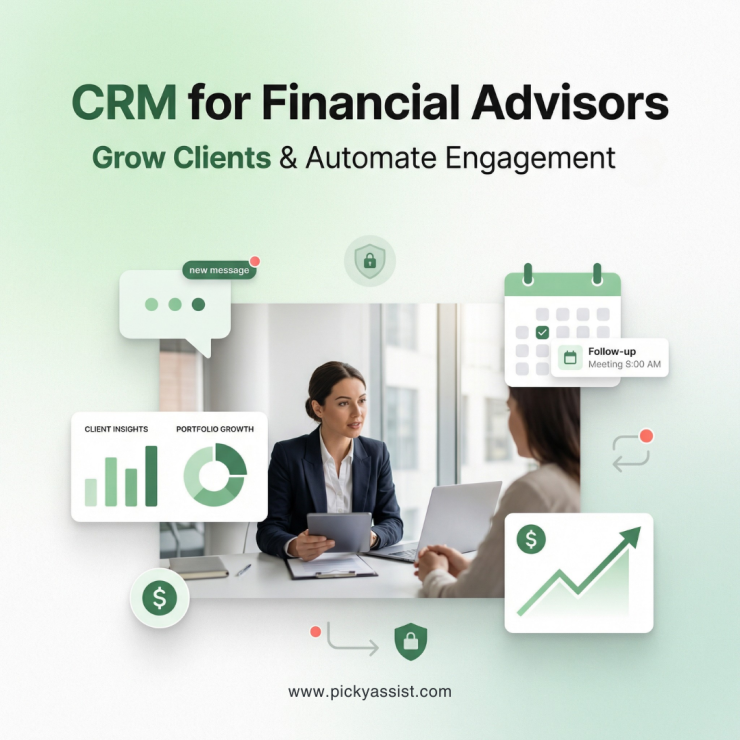
Financial advisory is built on trust, timing, and consistent communication. Every interaction; from the first consultation to ongoing portfolio discussions, shapes long-term client relationships and revenue. However, most advisors still manage these interactions across emails, calls, spreadsheets, and messaging apps. As client volumes grow, this approach becomes difficult to scale. This is where a CRM for financial advisors becomes essential.
A well-implemented CRM does more than organize contacts. It helps advisors manage client relationships, automate follow-ups, track engagement, and deliver a more structured and professional experience.
In this guide, we’ll break down how CRM fits into financial advisory workflows, what features matter most, how to evaluate options, and how Picky Assist aligns with real-world advisory needs.
What is CRM for Financial Advisors?
A CRM system for financial advisors is software designed to manage client interactions, track communication history, and streamline engagement processes.
Unlike generic CRM tools, a financial planning CRM must support long-term relationships, recurring interactions, and personalized communication.
For example, a client may inquire about investment planning, schedule a consultation, review options over multiple discussions, and only commit after careful consideration. Even after onboarding, ongoing engagement is required for portfolio updates, reviews, and cross-selling opportunities.
A CRM ensures that every step of this journey is structured, trackable, and consistent.
Why do Financial Advisors need CRM?
Financial advisors operate in a high-trust, high-consideration environment. Clients don’t make instant decisions. Instead, they evaluate options, ask questions, and build confidence over time.
Without a structured system, several issues arise.
Leads may come from multiple channels; website forms, referrals, WhatsApp, or email, and can easily get lost. Response times may vary depending on availability, which affects first impressions. Follow-ups may be inconsistent, especially when handled manually. Over time, these gaps reduce conversion rates and weaken client relationships.
A well-designed financial management software for advisors addresses these challenges by introducing structure, automation, and visibility into the entire client lifecycle.
Key Challenges Financial Advisors Face and How CRM Solves Them?
Fragmented Communication
Advisors often manage conversations across email, phone, and messaging apps. This creates scattered communication and lack of visibility. A CRM centralizes all interactions, into a shared inbox, ensuring that every conversation is tracked and accessible.
Delayed Responses
Clients expect timely responses, especially when discussing investments or financial planning. CRM systems enable instant acknowledgments, automated replies, and lead assignment, helping improve response speed.
Inconsistent Follow-Ups
Follow-ups are critical in financial advisory. However, manual tracking often leads to missed opportunities. CRM automation ensures that follow-ups happen consistently, based on predefined timelines or client behavior.
Long Decision Cycles
Clients take time to evaluate financial decisions. A CRM for investment advisors helps manage these extended journeys by tracking engagement and scheduling reminders.
Lack of Visibility into Client Pipeline
Without a clear system, it becomes difficult to track where each client stands. CRM provides pipeline visibility, allowing advisors to prioritize effectively and forecast revenue more accurately.
What Makes the Best CRM for Financial Advisors?
Not all CRM tools are suitable for advisory workflows. The best CRM for financial advisors must align with how advisors communicate, nurture, and retain clients.
Centralized Communication
A CRM should bring together all communication channels, including email and messaging platforms, into one unified interface.
Client Segmentation
Advisors need to categorize clients based on financial goals, investment preferences, risk profiles, and lifecycle stages. This enables more targeted communication.
Automation Capabilities
Automation helps reduce manual effort. Features such as automated follow-ups, reminders, and engagement workflows are essential.
Pipeline Management
A clear view of leads, prospects, and active clients helps advisors manage their workload and focus on high-value opportunities.
Personalization
Financial advisory is highly personalized. A CRM should make it easy to track client preferences and tailor communication accordingly.
How Picky Assist Fits as a CRM for Financial Advisors?
Picky Assist offers a conversational CRM approach that aligns well with advisory workflows, especially in environments where communication plays a central role.
Centralized Communication Hub
Advisors can manage interactions across channels such as WhatsApp and website chat from a single platform. This ensures no conversation is missed.
Automated Engagement
Picky Assist allows advisors to automate responses, follow-ups, and reminders. This is particularly useful for nurturing leads and maintaining consistent client communication.
Conversation-Driven Workflow
Unlike traditional systems that rely heavily on static data, Picky Assist supports ongoing conversations, which is critical in advisory services
Workflow Customization
Advisors can create workflows tailored to different services, such as wealth management, insurance advisory, or investment planning.
Practical Use Cases for Financial Advisors
Lead Capture and Qualification
When a potential client submits an inquiry, the CRM captures the lead, sends an instant response, and assigns it to the advisor. Follow-ups are triggered automatically.
Consultation Scheduling and Follow-Up
After an initial consultation, CRM ensures timely follow-ups, reminders, and continued engagement.
Ongoing Client Communication
Advisors can use CRM to send updates, reminders, and personalized messages, ensuring continuous engagement.
Re-Engagement Campaigns
Inactive clients can be re-engaged through automated campaigns, improving retention and lifetime value .
Comparing CRM Options for Financial Advisors
When exploring options, advisors often search for:
- best CRM software for financial advisors
- top CRM for financial advisors
- CRM solutions for financial advisors
However, the right choice depends on workflow alignment.
Traditional CRM Systems
These provide strong reporting and structured pipelines but may lack flexibility in communication.
Free CRM Tools
Options like best free CRM software for financial advisors can be useful initially. However, they often lack automation and scalability.
Conversational CRM Platforms
These are better suited for advisors who rely on messaging and ongoing client communication.
Is a Free CRM Enough?
Many advisors start with a free CRM for financial advisors, but limitations quickly become apparent.
Free tools often lack:
- Advanced automation
- Integration with communication channels
- Custom workflows
As your client base grows, investing in a robust financial planning CRM software becomes necessary.
How to Choose the Right CRM?
Choosing the right CRM for advisors requires clarity on your workflow.
Start by mapping how leads come in and how you engage with clients. Identify bottlenecks such as delayed responses or missed follow-ups.
Evaluate CRM options based on communication capabilities, automation features, and ease of use.
Ensure the system integrates with your existing tools and can scale with your business.
Common Mistakes to Avoid
Choosing a CRM based only on price is a common mistake. A low-cost tool that does not fit your workflow can result in lost opportunities. Ignoring automation is another issue. Manual processes limit scalability. Lack of proper onboarding can reduce adoption, even if the tool is powerful. Overcomplicating the setup can also create confusion. Start simple and scale gradually.
The Role of CRM in Modern Financial Advisory
The role of CRM in financial advisory is evolving.
Clients expect faster responses, personalized communication, and seamless engagement. Advisors who adopt structured systems can meet these expectations more effectively.
CRM is no longer just a tool, it is a key driver of growth, efficiency, and client satisfaction.
Conclusion
A well-implemented CRM for financial advisors helps streamline client management, improve engagement, and increase conversions.
It brings structure to your processes, ensures consistent communication, and enables you to scale your advisory practice without losing personalization.
For advisors who rely heavily on conversations and ongoing client engagement, a conversational CRM like Picky Assist offers a practical and scalable solution.
FAQs on CRM for Financial Advisors
1. What is CRM for financial advisors?
It is software that helps advisors manage client relationships, track interactions, and automate communication to improve efficiency and conversions.
2. Why do financial advisors need CRM?
CRM helps manage leads, improve response time, ensure consistent follow-ups, and enhance client relationships.
3. What features should a financial planning CRM include?
It should include communication tracking, automation, client segmentation, pipeline management, and personalization.
4. Is there a free CRM for financial advisors?
Yes, free CRM tools are available, but they often come with limitations in automation and scalability.
5. How does CRM improve client relationships?
CRM ensures timely communication, personalized engagement, and consistent follow-ups, which build trust and improve retention.
6. What is the best CRM for financial advisors?
The best CRM is one that aligns with your workflow, supports communication channels, and offers automation and scalability.
7. Can CRM integrate with messaging platforms?
Yes, modern CRM systems, including conversational platforms, support messaging integrations for better client communication.
8. How do I choose the right CRM for my advisory business?
Evaluate based on communication needs, automation capabilities, ease of use, integration, and scalability.

Add comment