
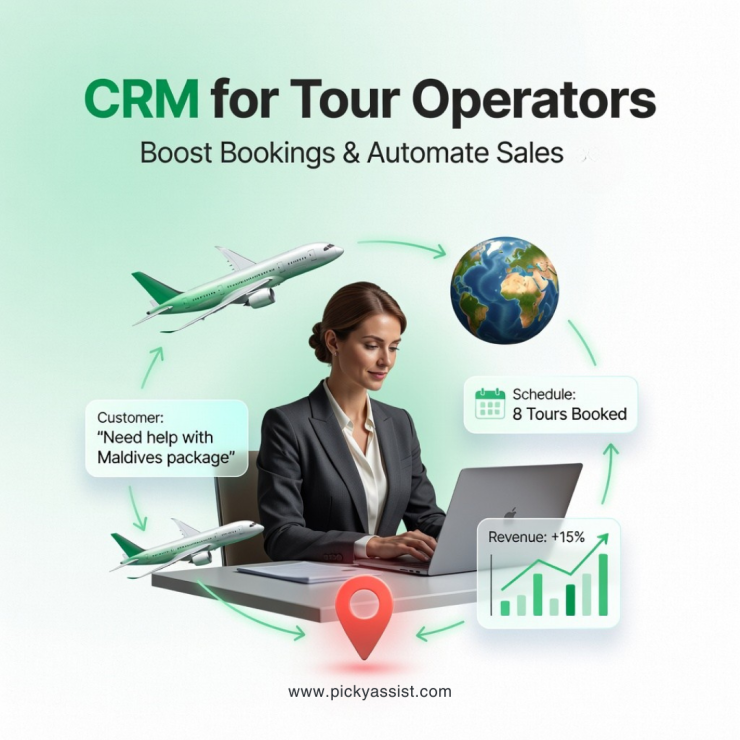
Tour operators today operate in a highly competitive and experience-driven market. Selling a tour is no longer just about offering a package, it involves managing multiple conversations, nurturing leads over time, and delivering personalized communication at every stage of the journey. From the first inquiry to post-trip engagement, every interaction plays a role in whether a customer books, returns, or refers others. This is exactly why a well-implemented CRM for tour operators has become essential rather than optional.
Instead of managing scattered data across spreadsheets, WhatsApp chats, emails, and manual reminders, a CRM centralizes your operations into a structured system. It allows you to capture leads efficiently, respond faster, automate repetitive tasks, and ultimately convert more inquiries into confirmed bookings. This guide takes a deeper look at how CRM works specifically for tour operators, what makes it different from generic CRM tools, and how solutions like Picky Assist align with real-world travel workflows.
What is CRM in the Travel Industry?
To understand its role clearly, it helps to start with the basics. CRM in the travel industry refers to software that helps travel businesses manage customer relationships, track interactions, automate communication, and improve sales outcomes.
However, in the context of tour operations, CRM goes far beyond simple contact storage. A tour business deals with complex customer journeys that include multiple inquiries, itinerary discussions, budget considerations, and long decision-making timelines. This means the CRM must act as a dynamic system that supports ongoing conversations rather than just static data.
For example, a customer might inquire about a Bali trip, ask multiple questions over WhatsApp, compare pricing, request customization, and only book after several days. A CRM ensures that every step of this interaction is tracked, organized, and acted upon systematically.
In practical terms, a CRM becomes the central system that connects your sales, communication, and customer experience processes into one unified workflow.
Why Tour Operators Specifically Need CRM?
Tour operators face a very different sales dynamic compared to industries like retail or eCommerce. Purchases are rarely instant. Instead, customers take time to research, compare options, and build trust before committing.
Because of this, managing relationships becomes more important than just managing transactions.
Without a structured CRM system, several issues start to emerge. Leads may come in from different channels such as WhatsApp, Instagram, or website forms, but without centralization, some of them are easily missed. Response delays become common, and in a competitive market, even a small delay can result in losing a potential booking.
In addition, follow-ups often become inconsistent. One customer may receive timely updates, while another might be forgotten entirely. Over time, this lack of consistency directly impacts conversion rates.
A well-implemented CRM for tourism addresses these issues by organizing the entire customer journey. It ensures that every inquiry is captured, every conversation is tracked, and every follow-up is executed at the right time.
Key Challenges Faced by Tour Operators and How CRM Solves Them
Fragmented Communication
Inquiries come from multiple channels like websites, calls, and messaging apps, making conversations hard to manage. A CRM centralizes all interactions into one system for better visibility and control.
Slow Response Time
Travel inquiries are time-sensitive, and delays can cost bookings. CRM enables instant responses, automated replies, and quick lead assignment to improve speed.
Long Decision Cycles
Customers take time to compare and decide. CRM helps track interactions, schedule follow-ups, and keep leads engaged throughout the journey.
Manual Follow-Ups
Relying on manual tracking leads to missed or inconsistent follow-ups. CRM automates this process to ensure timely and structured engagement.
Lack of Data Visibility
Without insights, it’s hard to optimize performance. CRM provides analytics on lead sources, conversions, and drop-offs for better decision-making.
What Makes a CRM Ideal for Tour Operators?
Built for Travel Workflows
The right CRM should match how inquiries come in, how conversations progress, and how bookings are finalized, not just generic sales processes.
Omnichannel Communication
Customers interact across platforms like WhatsApp, websites, and social media, and these are linked inside a shared inbox accessible to all your team members, so that no chats are missed. A CRM should unify these channels for seamless communication.
Lead Management & Segmentation
Organizing leads by destination, budget, travel dates, and preferences enables more relevant and targeted communication.
Automation for Efficiency
Automated responses, follow-ups, and reminders reduce manual effort and ensure consistent engagement at scale.
Pipeline Visibility
Clear tracking of each lead stage, from inquiry to booking; helps teams prioritize and forecast more effectively.
Personalization at Scale
Travel decisions are personal, so a CRM should help tailor communication based on customer preferences and behavior.
How Picky Assist Fits as a CRM for Tour Operators?
Picky Assist positions itself as a conversational CRM, which is particularly relevant for tour operators. Unlike traditional systems that focus heavily on static data and pipelines, Picky Assist is built around managing real-time customer conversations.
One of its strongest advantages is centralized communication. Tour operators can handle inquiries from WhatsApp, website chat, and other platforms within a single interface. This eliminates the need to switch between multiple tools and ensures that no conversation is lost.
Automation is another area where it aligns well with travel workflows. Tour operators can set up automated responses for new inquiries, create structured follow-up sequences, and send reminders for pending bookings. This not only saves time but also ensures consistency across all customer interactions.
The concept of conversational selling is particularly important here. Travel bookings often involve back-and-forth discussions, and Picky Assist supports this by enabling smooth, continuous communication rather than rigid ticket-based interactions.
Additionally, the platform allows workflow customization. Whether you are handling domestic tours, international packages, or group travel, you can design processes that match your specific business model. This flexibility makes it a practical option for businesses looking for a scalable CRM for tours and travels.
Practical Use Cases of CRM in Action
To understand the real impact of tourism CRM, it helps to look at how it functions in everyday scenarios.
Consider a situation where a customer submits an inquiry through your website. Instead of manually checking emails or forms, the CRM automatically captures the lead, sends an instant acknowledgment, and assigns it to a sales representative. At the same time, a follow-up sequence is initiated, ensuring that the lead is nurtured even if the team is busy.
In another scenario, a customer reaches out via WhatsApp asking about tour packages. The CRM tracks the entire conversation, allows the team to respond quickly using predefined templates, and tags the lead based on interest. Over the next few days, automated reminders and personalized messages help move the customer closer to booking.
Post-trip engagement is another area where CRM adds value. Instead of losing contact after the booking is completed, the system can trigger feedback requests, send seasonal offers, and re-engage past customers. This transforms one-time buyers into repeat customers.
Comparing CRM Options for Travel Businesses
When businesses start exploring options, they often come across terms like best CRM for travel agencies. However, the right choice depends more on operational fit than on popularity.
Traditional CRM tools are strong in reporting and structured pipelines but often fall short when it comes to managing real-time conversations. They are not designed for the fast-paced, inquiry-driven nature of travel sales.
Free tools, including options often searched as best free CRM for travel agencies, can be useful at an early stage. However, they typically lack advanced automation, deep integrations, and scalability, which limits their effectiveness as the business grows.
Conversational CRM systems, on the other hand, are designed to handle messaging-first interactions. They are particularly effective for businesses that rely heavily on platforms like WhatsApp and need to manage high volumes of inquiries efficiently.
Is a Free CRM Enough for Tour Operators?
Many tour operators initially considered a free CRM for travel agencies to minimize costs. While this can work for very small teams or early-stage businesses, it often becomes a limitation as operations expand.
Free tools usually lack the depth required for automation, omnichannel communication, and workflow customization. As inquiry volumes increase, these limitations start affecting response times, follow-up consistency, and overall efficiency.
Investing in a scalable CRM software for tour operators is not just about adding features, it is about enabling growth without operational friction.
How to Choose the Best CRM for Your Tour Business?
Choosing the right CRM requires a clear understanding of your own processes. Start by mapping how leads currently flow into your business, how your team responds, and where delays or inefficiencies occur.
Once you have this clarity, it becomes easier to identify the features that truly matter. Communication channels, automation capabilities, and reporting tools should align with your daily operations rather than being selected based on trends.
Ease of use is another critical factor. Even the most advanced system will fail if your team finds it difficult to adopt. A good CRM should feel intuitive and integrate naturally into your workflow.
Integration capabilities should also be evaluated carefully. The CRM must work seamlessly with your website, messaging platforms, and marketing tools to avoid data silos.
Finally, scalability should be a key consideration. Your CRM should support your growth over time, not restrict it.
Common Mistakes to Avoid
One of the most common mistakes is choosing a CRM based solely on price. While cost is important, selecting a tool that does not fit your workflow often leads to lost opportunities and inefficiencies.
Another mistake is ignoring automation. Manual processes may seem manageable initially, but they quickly become unsustainable as the business grows.
Lack of proper training is also a frequent issue. Even a well-designed CRM requires onboarding and consistent usage to deliver results.
Overcomplicating the setup is another pitfall. It is better to start with a simple structure and gradually build more advanced workflows as your team becomes comfortable with the system.
The Next Phase of CRM in the Travel and Tourism Industry
The CRM in the travel and tourism industry is evolving rapidly, driven by changing customer expectations and advancements in technology.
Personalization is becoming more sophisticated, with systems using data to tailor recommendations and communication. Chat-based booking journeys are becoming the norm, especially with the rise of messaging platforms. Predictive analytics is helping businesses anticipate customer behavior and optimize their strategies.
Automation is also becoming more intelligent, allowing businesses to engage customers proactively rather than reactively.
Tour operators who adopt these trends early, especially through conversational and automation-focused systems, will be better positioned to compete and grow.
Conclusion
A modern CRM for tour operators is not just a tool, it is a foundational system that supports every stage of your business, from lead capture to customer retention.
It enables you to respond faster, manage conversations more effectively, automate repetitive tasks, and build stronger relationships with your customers. While there are many options available, the key is to choose a CRM that aligns with how your business actually operates.
For tour operators who rely heavily on messaging platforms and inquiry-driven sales, a Picky Assist, the conversational CRM offers a practical and scalable solution that fits naturally into their workflow.
FAQs on CRM for Tour Operators
1. What is a CRM in the tourism industry?
CRM in the tourism industry refers to software that helps travel businesses manage customer interactions, track leads, automate communication, and improve booking conversions.
2. Why do tour operators need CRM software?
Tour operators deal with multiple inquiries, long decision cycles, and personalized communication. CRM helps organize these processes and improves efficiency.
3. What features should a tour CRM include?
It should include:
- Omnichannel communication
- Lead management
- Automation
- Pipeline tracking
- Customer segmentation
4. Is there a free CRM software for travel agents?
Yes, there are free options available. However, they usually come with limitations in automation, scalability, and integrations.
5. How does CRM improve travel bookings?
CRM improves response time, ensures consistent follow-ups, and helps personalize communication, all of which increase conversion rates.
6. What is the difference between travel CRM and regular CRM?
Travel CRM is tailored for inquiry-based sales, itinerary handling, and customer communication, while regular CRM focuses more on generic sales pipelines.
7. Can CRM integrate with WhatsApp for tour operators?
Yes, modern CRMs like Picky Assist support WhatsApp integration, allowing businesses to manage conversations and automate responses.
8. How do I choose the best CRM for travel companies?
Evaluate based on:
- Your communication channels
- Automation needs
- Ease of use
- Scalability
- Integration capabilities
Add comment