
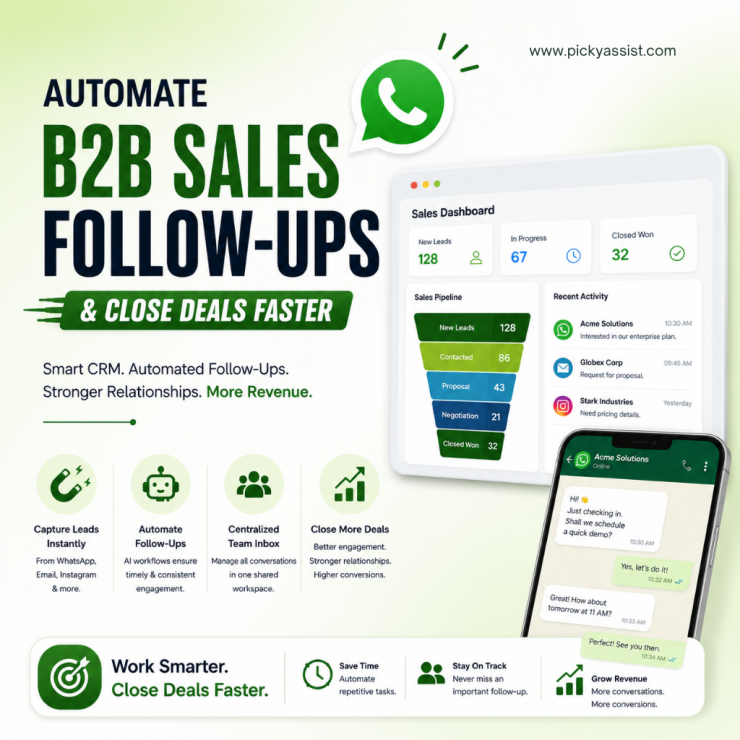
Most businesses do not lose deals because of poor products.They lose opportunities because follow-ups are delayed, conversations get scattered, and sales teams operate without visibility. However a B2B CRM software can solve most troubles!
- A lead comes through WhatsApp.
- Another inquiry arrives through Instagram.
- A proposal request lands in email.
Meanwhile, the sales team updates spreadsheets manually while customer conversations remain disconnected across platforms. CRM platforms do far more than store contacts. Businesses now rely on them to automate engagement, improve customer experience, and support sales growth across multiple channels.
What is B2B CRM Software?
B2B CRM software helps businesses manage relationships with other businesses throughout the sales and customer lifecycle. Unlike B2C transactions, B2B sales usually involve:
- longer decision-making cycles
- multiple stakeholders
- repeated follow-ups
- customized proposals
- relationship-driven communication
Because of this, businesses require systems that can organize:
- leads
- conversations
- customer data
- sales pipelines
- reminders
- team collaboration
- automated communication
A CRM systems should help businesses move prospects from inquiry to conversion while reducing operational friction along the way.
Why Traditional CRM Tools No Longer Work for Many Businesses?
Many older CRM platforms were built primarily for data storage and pipeline tracking. However, modern sales operations revolve around conversations. Customers now expect businesses to respond instantly across channels like:
- Website chat
- Facebook Messenger
The problem is that many companies still manage these conversations separately. As businesses scale, this creates serious operational issues:
- missed follow-ups
- duplicate communication
- poor response time
- inconsistent customer experience
- lost sales visibility
Sales teams spend more time searching for context than actually engaging prospects. This is where conversational CRM platforms are changing how businesses manage customer engagement.
The Shift Toward Conversational B2B CRM
The next generation of B2B CRM platforms focuses heavily on communication automation and centralized engagement. Instead of treating conversations as secondary activities, conversational CRMs place customer interactions at the center of the workflow. This matters because modern buyers prefer messaging-based communication over traditional sales processes.
Businesses now need systems that can:
- capture leads instantly
- automate replies
- route conversations
- nurture prospects automatically
- help teams collaborate in real time
Platforms like Picky Assist are built around this operational shift by combining CRM functionality with conversational automation.
How Picky Assist Supports Modern B2B Business Operations?
Picky Assist helps businesses manage customer communication, automate engagement, and streamline sales workflows from one connected platform. Instead of using separate tools for messaging, follow-ups, and customer management, businesses can centralize operations across channels like WhatsApp, Instagram, email, Facebook Messenger, and website chat. The platform supports modern B2B workflows through:
- shared team inbox management
- no-code AI chatbot automation
- automated follow-ups and reminders
- lead nurturing workflows
- conversational sales funnels
- broadcast messaging campaigns
- third-party workflow integrations
Picky Assist also helps teams collaborate better by keeping customer conversations organized and accessible in one workspace. This improves response consistency while reducing missed follow-ups and communication gaps. For businesses managing high inquiry volumes, the platform helps automate repetitive customer interactions without losing the personal touch that B2B communication often requires.
Why CRM for B2B Sales Requires Automation?
A strong CRM for B2B sales should actively help businesses improve conversion efficiency. Modern sales performance depends heavily on:
- response speed
- consistency
- timing
- lead nurturing
Businesses lose opportunities when follow-ups happen too late. For example:
- a lead requesting a demo may never receive a callback
- proposal discussions may remain unresolved
- warm prospects may go cold due to inconsistent engagement
Automation helps businesses maintain continuity throughout the sales cycle. With the right CRM infrastructure, businesses can:
- automate reminders
- trigger lead journeys
- schedule follow-ups
- send personalized broadcasts
- route conversations automatically
This creates a more scalable sales process.
Best CRM for B2B Small Business: What Actually Matters?
The best CRM for B2B small business operations is not necessarily the platform with the most features. Small and growing businesses usually need:
- simplicity
- fast onboarding
- automation
- communication visibility
- scalability
Overly complex enterprise software often creates adoption problems for smaller teams. Instead, businesses should prioritize platforms that:
- centralize communication
- reduce manual work
- automate repetitive tasks
- improve lead visibility
- support collaboration
Picky Assist is particularly relevant for businesses that rely heavily on customer communication through WhatsApp and other messaging channels.
Common Signs Your Business Needs Better B2B CRM Software!
Many businesses continue using disconnected workflows until operational inefficiencies become impossible to ignore. Here are some common indicators that a CRM upgrade may be necessary.
Leads Frequently Go Cold
If inquiries regularly remain unanswered or follow-ups are inconsistent, businesses likely need better automation and visibility.
Teams Use Multiple Disconnected Platforms
When conversations happen separately across WhatsApp, email, spreadsheets, and chat systems, operational complexity increases rapidly.
Manual Follow-Ups Consume Too Much Time
Sales teams should focus on relationship-building instead of repetitive administrative work.
Customer Communication Lacks Consistency
Customers expect continuity regardless of which team member responds. A centralized CRM system helps maintain communication quality.
How to Choose the Best B2B CRM for Your Business?
The best B2B CRM depends heavily on operational needs rather than feature quantity alone. Before selecting a CRM, businesses should evaluate:
- communication channels used most frequently
- sales process complexity
- automation requirements
- collaboration workflows
- scalability goals
- customer support needs
Businesses should also consider whether the CRM supports conversational engagement effectively. Today, communication speed often influences conversion rates directly.
Why Communication-Centric CRM Platforms Are Growing Faster?
The CRM industry is evolving toward automation-first ecosystems. Businesses increasingly prefer platforms that combine:
- communication
- customer engagement
- chatbot automation
- workflow management
- lead nurturing
- shared collaboration
inside one operational framework. This is why conversational CRM systems continue gaining traction across industries. Companies no longer want separate tools for:
- support
- sales
- messaging
- automation
- lead tracking
They want connected workflows that reduce operational friction.
Conclusion
Modern B2B CRM software is no longer just about storing customer information. Businesses now require systems that can:
- centralize conversations
- automate engagement
- improve response time
- support collaboration
- scale communication efficiently
As customer expectations continue evolving, businesses that rely heavily on manual communication processes may struggle to maintain consistency. Picky Assist helps businesses combine conversational automation, omnichannel communication, AI chatbot workflows, and collaborative engagement inside one connected platform. For businesses looking to improve operational efficiency while strengthening customer engagement, communication-driven CRM infrastructure is becoming increasingly important.
FAQs on B2B CRM Software
1. What is B2B CRM software?
B2B CRM software helps businesses manage relationships, communication, leads, follow-ups, and sales workflows when selling products or services to other businesses.
2. How is B2B CRM different from B2C CRM?
B2B CRM focuses on longer sales cycles, multiple stakeholders, relationship management, and repeated follow-ups, while B2C CRM often supports shorter and faster customer journeys.
3. Why is automation important in CRM for B2B sales?
Automation helps businesses reduce manual work, improve follow-up consistency, respond faster to leads, and maintain better customer engagement throughout the sales cycle.
4. What features should businesses look for in B2B CRM systems?
Businesses should prioritize:
- omnichannel communication
- workflow automation
- AI chatbot support
- shared team inboxes
- lead management
- reporting visibility
- integration flexibility
5. Can small businesses benefit from B2B CRM software?
Yes. Small businesses often benefit significantly because CRM automation reduces operational workload while improving customer communication consistency.
6. How does WhatsApp integration help B2B businesses?
WhatsApp integration helps businesses manage lead conversations, send reminders, automate responses, and improve customer engagement through a widely used communication channel.
7. Why are conversational CRM platforms becoming popular?
Businesses increasingly prefer conversational CRM systems because customer engagement now happens primarily through messaging platforms instead of traditional communication channels.
8. How does Picky Assist support B2B communication workflows?
Picky Assist helps businesses automate customer communication, manage multi-channel conversations, create chatbot workflows, send broadcast campaigns, and centralize customer engagement through its collaborative platform.
Add comment