
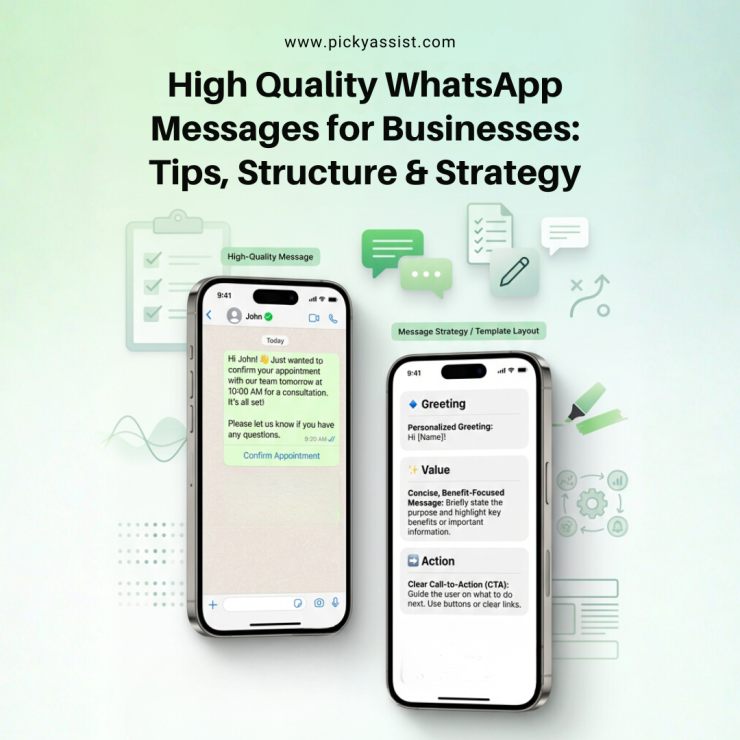
Digital commerce has set a new standard for how brands engage customers, nurture interactions, and drive conversions. Yet not all platforms or messages perform equally. WhatsApp Business is one of the clearest examples of how modern communication channels can make customer contact faster, richer, and more commercially effective. Many brands misunderstand what high quality WhatsApp messages actually mean, often equating them with polished templates or correct grammar.
In practice, WhatsApp evaluates message quality primarily by measuring recipient feedback and interaction signals (for example: blocks, reports and other negative feedback). These signals determine a phone number’s quality rating and influence messaging capacity, template status, and other platform privileges.
If your brand requires predictable deliverability, faster template approvals, or higher messaging limits, understanding WhatsApp’s operational definition of high quality WhatsApp messages is essential. The sections below explain that definition precisely and translate Meta’s guidance into an actionable playbook for enterprise teams and marketing operators.
What Counts as High Quality WhatsApp Messages?
High quality WhatsApp messages are business-initiated conversations that, as a set, are well received by recipients and therefore produce favorable interaction signals. In practical terms that means messages and messaging programs that deliver low rates of blocks and reports, healthy engagement, and clear user value. Meta exposes quality information at the phone-number and template level and classifies quality into tiers (Green/High, Yellow/Medium, Red/Low). These tiers directly affect messaging limits and template behavior.
A business message program should therefore satisfy these practical criteria:
- Expected. Recipients should have opted in and should recognise the business and the reason for the message. (Opt-in hygiene reduces surprise messages, a main driver of complaints.)
- Timed with contextual intent. Messages should be connected to a recent user action, lifecycle stage, or time-bound event (e.g., a recent purchase, a browsed product, shipment status, or a subscription renew).
- Relevant to the user’s recent signal. Relevance means the content aligns with browsing, purchase, usage, or other signals that indicate genuine interest.
- Clear and low friction. Messages should communicate purpose fast, present an unambiguous CTA, and avoid unnecessary copy, phishing-like patterns, or spammy language.
- Policy-aligned. Messaging must follow WhatsApp Business and Commerce policies. Non-compliant content risks template rejection, account actions, or changes to quality state.
- Low user friction in outcomes. Low block/report/mute rates and reasonable read and reply behavior, these real-world signals determine whether a program stays in the High quality tier.
Why Message Quality Controls Your Entire WhatsApp Strategy?
WhatsApp’s quality controls are not cosmetic, they gate functionality. Phone numbers and templates with low quality can be restricted, have throttled delivery, or be subject to messaging limits. Conversely, accounts that maintain sustained high quality and open a high volume of quality conversations can gain higher messaging tiers and broader capabilities.
WhatsApp prioritises user experience, brands that fail to maintain consistently High quality WhatsApp messages face structural consequences:
- Message delivery throttles
- Template rejections or slowed approval cycles
- Reduced messaging limits
- Higher conversation costs due to negative sentiment
- Lower organic visibility in WhatsApp Business Search
- Risk of phone number flags or restriction
Conversely, brands that maintain strong quality across 1,000+ conversations over 30 consecutive days unlock:
- High throughput outbound messaging
- Instant template approvals
- Eligibility for advanced features
- No-friction delivery during peak campaigns
- Strong CTRs and conversion lifts across the funnel
The Structural Components of a High Quality WhatsApp Message
Think of WhatsApp’s quality evaluation as a multi-layered scoring model. A message must pass all layers to earn High quality:
1. Expectation Layer: Opt-In Hygiene
Compliant opt-ins and clear user expectations reduce surprise messages, the leading cause of complaint signals. Ensure opt-in points state message category and provide an easy opt-out. Facebook
2. Timing Layer: Recency & User Action
Messages should align closely with recent user behavior or lifecycle events (purchase, browsing, delivery, expiry). Messages that lack a clear temporal link are more likely to be perceived as irrelevant.
3. Relevance Layer: Meaningful Personalisation
Personalisation should be contextual (product, transaction, geography, service usage). Superficial name tokens alone are not sufficient to preserve quality.
4. Clarity Layer: Structure & CTA Design
State the purpose in the first line. Use one clear CTA. Avoid spammy copy, excessive emojis, or false urgency, such constructs increase negative feedback and template rejections. Facebook for Developers
5. Sentiment Layer: Real-World User Behaviour
Meta measures recent recipient feedback (blocks, reports, complaints) and interaction patterns to determine template and phone number quality. Sentiment outcomes trump intent or copy quality if recipients respond negatively.
How to Improve Your WhatsApp Quality Rating — The Advanced Framework
General advice is common; the approach below mirrors Meta’s published tips and proven BSP best practices:
1. Map Message Categories to Customer Lifecycle Stages
Design templates for acquisition, onboarding, activation, usage, expansion, recovery, and support, don’t mix stages in a single template.
2. Implement Frequency Governance
There’s no public “hard” frequency cap from Meta, but high-density campaigns and multiple messages within short windows increase complaint risk. Use segmentation and throttling controls.
3. Run a 7-Day Template Audit When Quality Shifts
When quality drops, newly added or newly used templates are the usual culprits. Audit templates added in the last 7 days (template-level quality is available in WhatsApp Manager).
4. Build an Experimentation Model
A/B test CTA placement, message timing, personalization depth, and audience slices. Measure sentiment (blocks/reports), CTRs, and read rates and iterate.
5. Maintain Policy Alignment
Strictly follow WhatsApp Business and Commerce policies. Non-compliance can cause template removals or account actions.
How to Send High Quality WhatsApp Messages?
1. Strategy
Define a channel value proposition, message categories, and explicit opt-in flows mapped to each category.
2. Structure
Every message must instantly answer: What is it about? Why now? What should the user do next? Remove any sentence that does not serve one of those three purposes.
3. Personalisation
Use behavioural, value, predictive, and lifecycle personalisation rather than superficial tokens.
4. Delivery Control
Respect frequency governance, monitor negative events in real time, and adapt based on sentiment.
5. Continuous Governance
Use WhatsApp Manager and BSP dashboards to track 30-day quality history, template-level quality, drop triggers, block spikes, and engagement decay. Shift content strategy when sentiment shifts.
The Business Impact of High Quality WhatsApp Messages
Brands that master message quality see measurable improvements:
- More consistent message delivery and throughput.
- Faster template approvals and fewer rejections.
- Lower block and report rates; higher CTRs and conversion completion.
- Longer retention on WhatsApp and a larger, healthier subscriber base.
- Improved ability to scale messaging tiers and access advanced features when consistent quality thresholds (e.g., sustained quality across large conversation volume) are demonstrated.
Quality is not merely a creative goal, it is the operational mechanism that unlocks WhatsApp’s capabilities for your business.
Final Thoughts
In WhatsApp’s ecosystem, message quality is the protocol that determines whether a brand can reliably use one of the world’s most intimate communication channels. Businesses that internalise the operational definition of high quality WhatsApp messages, expectation (opt-in), timing, relevance, clarity, sentiment, and policy alignment, consistently outperform peers in conversions, engagement, and long-term channel economics.
For teams that need an integrated execution layer, Picky Assist is a WhatsApp BSP that helps businesses scale quality messaging with CRM integration, automated AI chatbots, broadcasters, funnels, catalogs, and no-code builders, all designed to support compliance-aware, sentiment-preserving messaging programs.



Add comment