
Founders rarely ask about the difference between sales and marketing out of curiosity. They ask because the budget is tight, and every rupee spent on ads, tools, or hiring has to pay off. Fund the wrong function and you either fill a pipeline nobody can close or hire reps with no leads to call.
Knowing where marketing stops and sales starts shows you where the next investment belongs. This guide defines each function, compares them side by side, and helps you decide which to strengthen first.
What is Marketing?
Marketing is the work of understanding a market, shaping an offer that fits it, and earning attention and trust before anyone is ready to buy. It covers research, positioning, pricing, promotion, and distribution, and it continues after a purchase through feedback and retention. Its main output is demand: people who know your brand and believe you can solve their problem.
What is Sales?
Sales is the process of turning an interested prospect into a paying customer through direct conversation. Sales teams qualify needs, answer objections, negotiate terms, and close deals, then keep the relationship healthy for repeat business. Its main output is revenue, and it works one buyer at a time.
What is the Difference Between Sales and Marketing?
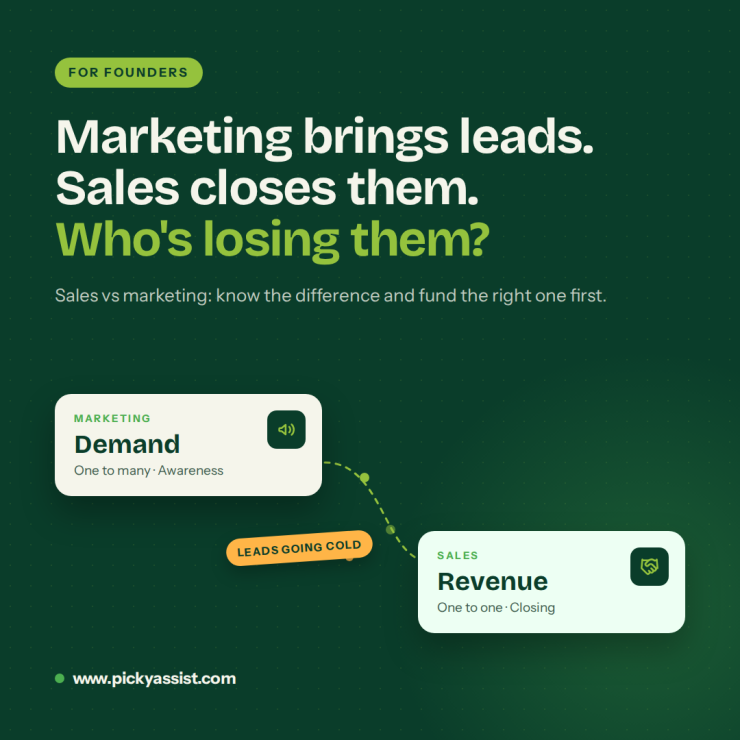
Marketing creates awareness and demand across a broad audience. Sales converts individual prospects who show buying intent into paying customers. Marketing works before a buyer is ready to talk, and sales takes over once they are.
Marketing vs Selling: The Difference in Detail
People use the two words as synonyms, but they describe different ways of running a business. The difference between marketing & selling starts with where you begin. Selling starts with the product you already have. Marketing starts with the customer’s needs in the market.
Two Mindsets: Inside Out vs Outside In
A selling mindset asks, “We built this. Who will buy it?” The company decides what to produce, then pushes it toward buyers. A marketing mindset asks, “What do buyers need, and how do we serve it profitably?” It studies the market first, then shapes the product, price, and message around what it finds.
Selling looks inside out. Marketing looks outside in. A new product with no proven demand needs marketing insight first. A proven product with waiting buyers needs selling strength.
| Factor | Selling | Marketing |
|---|---|---|
| Starting point | The product you already have | The customer need in the market |
| Focus | Moving the product | Solving a customer problem |
| Time horizon | Short term, tied to monthly targets | Long term, tied to brand and loyalty |
| Main goal | Sales volume and closed deals | Profit through customer value |
| Customer contact | Direct, one to one | Broad, one to many |
| Typical output | A closed deal | Qualified demand and brand trust |
5 Types of Selling
- Aggressive selling: The rep pushes for a one-shot purchase. It can close quick deals but rarely builds repeat business.
- Consultative selling: The rep acts as an advisor and puts the relationship ahead of the immediate sale.
- Need-oriented selling: The rep watches and listens closely, then asks questions to uncover what the buyer needs.
- Product-oriented selling: The rep explains features and benefits, often with demos, until the buyer is satisfied.
- Competition-oriented selling: The rep stays one step ahead of rival offers and pushes hard to win the deal.
For most software and service businesses, consultative and need-oriented selling work best. Buyers compare options before they speak to anyone, so they respond to advice more than pressure.
5 Types of Marketing
- Relationship marketing: It strengthens bonds with existing customers to build loyalty.
- Word of mouth: Satisfied customers recommend you to friends and colleagues. Disappointed ones do the opposite.
- Digital marketing: It reaches buyers online through search, social media, email, and messaging channels.
- Paid advertising: It buys attention through TV, radio, print, and online ads.
- Cause marketing: It links a brand to a social cause or issue.
Why Both Matter?
Selling builds direct relationships, gives you honest feedback in live conversations, and creates repeat business. Marketing builds awareness, reaches many people quickly, and feeds the pipeline that sellers work.
A founder who only sells depends on constant outbound effort. A founder who only markets collects interest without closing it. That is why the difference between marketing & sales as departments matters less than how well they connect.
Inbound vs Outbound: Where the Two Overlap
The difference between inbound and outbound sales is who starts the conversation.
- Inbound sales: The prospect reaches out after a blog post, ad, or WhatsApp message. Marketing warms the lead, and sales responds quickly.
- Outbound sales: A rep starts contact through calls, emails, or messages to a target list. Marketing supports content and acc
- ount research.
Most growing companies run both, so the two teams share more work than job titles suggest.
A Practical Example for Sales and Marketing Scenario
Picture a startup selling appointment software to clinics. Marketing publishes guides and runs ads, and enquiries arrive steadily. Sales calls each one, but many leads lack budget or decision-making authority. Without a shared definition of a qualified lead, marketing celebrates volume while sales complains about quality.
Then both teams agree on criteria: clinic size, timeline, and decision-maker. Marketing tunes its targeting, and sales works only qualified leads. The difference between sales and marketing stays, but the friction goes.
How Should Marketing Hand Leads to Sales?
Clear handoffs turn the difference between sales and marketing into an advantage. Five habits help:
- Define a qualified lead together. Write down the criteria both teams accept.
- Set a response-time rule. Agree how fast sales contacts a new lead.
- Keep one shared record. Both teams should see the same customer history.
- Send feedback back. Sales tells marketing which leads closed and which stalled.
- Review shared numbers. Track lead quality and conversion together.
Picky Assist supports this handoff. Chatbots ask qualifying questions on WhatsApp and other channels, and automation workflows route qualified leads to the right rep. Campaign automation keeps nurturing leads who aren’t ready yet. Conversations land in Conversational CRM, where the team collaborates on one record, and integrations connect your forms, ads, and other tools.
Which Should Founders Invest In First?
Let the gap decide:
- Few enquiries: Strengthen marketing.
- Plenty of enquiries, few closed deals: Fix the sales process.
- Leads going cold between the two: Fix the handoff before spending more on either.
Conclusion
The difference between sales and marketing comes down to timing and scope. Marketing builds demand across a market, and sales converts individual buyers. Identify your gap, whether it is too few leads, weak conversion, or a leaky handoff, and fund that first. Shared definitions, one CRM, and automated follow-up help you lose fewer leads in between.
To run WhatsApp campaigns, chatbot qualification, and CRM follow-up from one place, explore Picky Assist.
FAQs on Sales and Marketing
Marketing builds awareness and generates leads across a broad audience. Sales converts individual prospects into paying customers through direct conversations.
Selling is one activity focused on completing a purchase. Marketing is broader, covering research, positioning, pricing, promotion, and customer experience.
Marketing usually comes first by creating awareness and interest. Sales enters once a prospect shows buying intent.
Early-stage founders often do. As lead volume grows, separate ownership prevents follow-ups from slipping.
Inbound sales respond to prospects who contact you first. Outbound sales start with your team reaching out to a target list.
Marketing tracks qualified leads, cost per lead, and channel conversion. Sales tracks response time, win rate, sales cycle, and revenue.
They agree on what a qualified lead is, share one CRM, and pass feedback both ways so targeting and pitches improve.
A shared CRM, chatbots for lead qualification, and automation workflows help. Picky Assist combines these with WhatsApp campaigns and team collaboration.
Add comment