
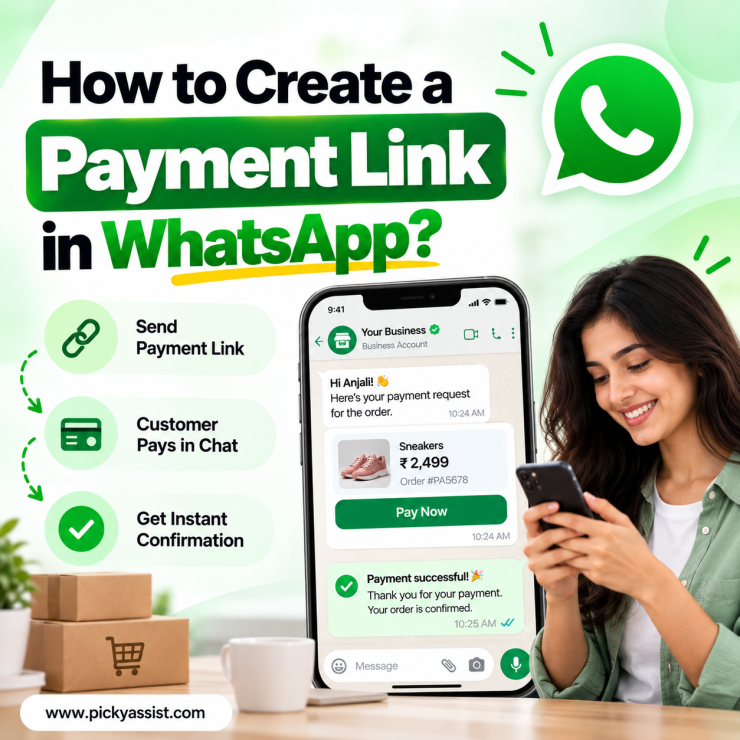
If you’ve compared payment gateways for your business, you’ve likely run into the same frustration: setup fees, redirect pages that lose customers halfway through checkout, and integration work that takes weeks. A WhatsApp automated payment collection link solves a different problem entirely allowing customers to pay you inside the same chat where they’re already asking questions, without ever leaving the app. Before you evaluate which tool to build this on, it helps to understand exactly how the process works and where the real cost savings come from.
What is WhatsApp Pay?
WhatsApp Pay is a payment feature that lets businesses request and receive payments directly inside a WhatsApp conversation. There’s no redirect to a browser, no separate app to download, and no complicated checkout flow.
A customer receives a payment request, taps to review it, and completes the transaction without ever leaving the chat. For a business, that means fewer steps between “customer wants to buy” and “payment received.”
How Does a WhatsApp Payment Link Actually Work?
Creating and using a WhatsApp payment link generally follows five steps:
- The business sends a payment request through a WhatsApp Business Solution Provider like Picky Assist.
- The customer receives a detailed payment request on WhatsApp, showing the amount and what it’s for.
- The customer reviews and completes the payment securely, inside WhatsApp itself.
- The business gets instant confirmation the moment payment clears.
- The business ships the product or delivers the service right after confirmation.
What makes this useful at scale is automation. Once set up, this entire flow runs without manual intervention; a business can process a handful of payments a day or scale to thousands, using the same setup. That’s a meaningful difference from manually sending payment gateway links one customer at a time.
WhatsApp Payment vs. Traditional Payment Systems
The biggest reason businesses look into a WhatsApp business payment option is friction. Traditional systems ask a customer to leave the conversation, visit a website, and often create an account before they can pay. Each extra step is a chance to lose the sale.
| Factor | Traditional Payment Systems | WhatsApp Payment |
|---|---|---|
| Payment completion speed | Slower, due to redirects and manual input | Instant, no redirection needed |
| Customer drop-off risk | High, from multiple steps and friction | Low, payment happens in the same chat |
| Confirmation | Often delayed or manual | Instant and automatic |
| Automation | Usually requires manual follow-up | Fully automated, handles multiple transactions |
| Technical setup | Needs website or gateway integration | Minimal, set up through a provider like Picky Assist |
| Scalability | Limited by manual processes | Scales from a few payments to millions |
The pattern across nearly every row is the same: WhatsApp payment removes the steps that cause abandoned carts and delayed confirmations.
Picky Assist for Automated WhatsApp Payment Collection and Sending Reminders?
Setting up WhatsApp API payment directly with Meta isn’t built for non-technical teams. A Business Solution Provider like Picky Assist handles that complexity so you don’t have to.
How does Picky Assist help in payment collection?
- No integration code to write or maintain
- No direct handling of Meta’s API infrastructure
- No separate tool for tracking payment status, it’s built into the same platform
Why payment links work better inside an existing automation platform:
| Business need | How Picky Assist handles it |
|---|---|
| Collect payment during a chatbot conversation | Payment link sits inside the checkout flow itself, no handoff to a separate tool |
| Confirm payment without manual checking | CRM updates automatically the moment payment clears |
| Recover incomplete payments | Automatic follow-up message sent if a customer opens the request but doesn’t pay |
| Manage payments across a team | Works within shared WhatsApp numbers and team collaboration tools already in use |
| Scale without adding headcount | Same setup handles a few payments a day or high daily volume |
How does this help your customers and not just your team!
- No third-party checkout page to open mid-conversation
- No re-explaining the order after being redirected elsewhere
- The full journey — question, quote, payment, confirmation — stays in one chat
- Fewer steps between interest and payment means fewer abandoned sales
Making the Right Choice for Your Business
Deciding how to accept a WhatsApp business payment comes down to three questions: how many payments you process, how much manual work your team can realistically manage, and whether losing customers to a clunky checkout flow is costing you more than a proper setup would.
If you’re processing a low volume of payments occasionally, a manual link might work for now. But for any business handling regular transaction volume, an automated setup that lets customers send money via WhatsApp directly, with instant confirmation and CRM tracking, removes the manual work and the drop-off risk at the same time.
If you’re already running conversations, catalogs, or support through WhatsApp, exploring how Picky Assist can add payment requests into that same workflow is worth a closer look.
Frequently Asked Questions on WhatsApp Payment
It’s a payment request sent directly inside a WhatsApp chat that lets a customer complete payment without leaving the app.
Using a WhatsApp Business Solution Provider like Picky Assist, a business sends a payment request through the platform, which the customer receives and completes inside the chat.
Yes, payments are processed securely within WhatsApp’s infrastructure, and businesses receive instant confirmation once a transaction completes.
Yes, once configured, payment requests can be sent, confirmed, and tracked automatically without manual follow-up for each customer.
Not if you use a provider like Picky Assist, which handles the API setup so businesses can send payment requests without custom development.
A regular gateway link usually redirects the customer to a website; a WhatsApp payment link keeps the entire transaction inside the chat.
Only businesses set up with WhatsApp Pay through an approved provider can send and receive payment requests this way.
Yes, the process is built to scale from a handful of daily payments to large volumes without added manual work.

Add comment