
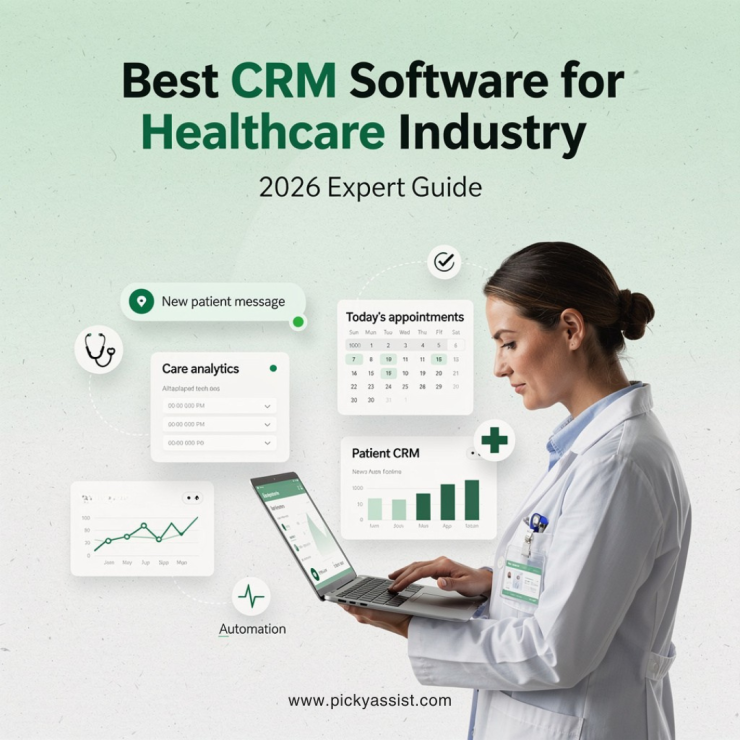
Healthcare organizations today operate in a high-pressure environment where patient expectations, regulatory requirements, and operational efficiency all intersect. As a result, adopting the best CRM software for healthcare industry use is not optional; it’s a strategic necessity. However, choosing the right system is not straightforward. Many platforms claim to be the best healthcare CRM software, but only a few truly align with how healthcare providers communicate, manage patient journeys, and automate engagement at scale. This guide breaks down what actually matters, how to evaluate options, and where software CRM solutions like Picky Assist fit in, especially for organizations prioritizing patient communication, automation, and real-time engagement.
What is CRM in Healthcare?
A healthcare CRM is a system designed to manage interactions between healthcare providers and patients across the entire lifecycle, from first inquiry to post-treatment follow-up.
Unlike generic CRMs, healthcare CRM systems must address:
- Patient communication workflows
- Appointment coordination
- Compliance considerations
- Multi-channel engagement (WhatsApp, SMS, email, etc.)
- Data centralization across departments
In practical terms, CRM in the medical field is about improving how providers acquire, engage, and retain patients while reducing manual workload.
Why Healthcare Needs a Specialized CRM Software?
Healthcare is fundamentally different from retail or SaaS. Patients don’t behave like customers, they require timely, personalized, and sensitive communication.
Here’s where CRM and healthcare intersect meaningfully:
1. Patient Experience Is a Competitive Advantage
Patients now expect instant responses, reminders, and easy access to information. A strong healthcare CRM platform ensures consistent engagement.
2. High Volume of Enquiries
Hospitals, clinics, and diagnostic centers receive inquiries from multiple channels. Without automation, this leads to missed opportunities.
3. Operational Complexity
Managing appointments, follow-ups, and internal coordination requires structured workflows that generic CRMs often fail to provide.
4. Need for Automation
Manual handling of patient communication is inefficient. The best medical CRM software automates repetitive tasks without compromising personalization.
Features to Look for in the Best CRM for Healthcare
Not all CRM tools are built equally. When evaluating the best CRM for healthcare, focus on capabilities that directly impact patient engagement and operational efficiency.
Multi-Channel Communication
A strong healthcare CRM solution should integrate:
- SMS
- Website chat
This ensures patients can reach you on their preferred channel.
Automated Patient Engagement
Automation is critical in CRM for healthcare providers. Look for:
- Auto-replies for inquiries
- Appointment reminders
- Follow-up sequences
- Re-engagement campaigns
Lead Capture and Qualification
For hospitals and clinics running campaigns, a CRM should:
- Capture leads from ads and websites
- Automatically qualify inquiries
- Route conversations to the right team
Appointment Workflow Automation
Efficient medical CRM systems should allow:
- Booking confirmations
- Rescheduling options
- Reminder notifications
Centralized Patient Data
A unified dashboard is essential in any healthcare CRM platform, enabling teams to:
- View complete conversation history
- Track patient interactions
- Maintain continuity of care
Team Collaboration and Assignment
A scalable CRM for healthcare industry use must support:
- Chat assignment to departments (sales, support, admin)
- Internal notes and tagging
- Role-based access
Common Use Cases of Healthcare CRM Systems
To understand how these systems deliver value, consider real-world applications.
1. Patient Inquiry Management
A clinic receives inquiries via ads or website forms. Instead of manual responses, the CRM instantly replies with:
- Service details
- Doctor availability
- Location information
This is a core function of modern healthcare CRM products.
2. Appointment Booking Automation
With the right healthcare CRM software, patients can:
- Book appointments directly from chat
- Receive confirmation instantly
- Get automated reminders
This reduces no-shows significantly.
3. Follow-Up and Retention Campaigns
Retention is often overlooked. A CRM for healthcare marketing enables:
- Post-visit follow-ups
- Preventive care reminders
- Re-engagement campaigns for inactive patients
4. Lead Management for Specialty Clinics
For services like cosmetic procedures or diagnostics, medical CRM software helps:
- Track high-intent leads
- Send brochures and videos
- Schedule consultations
5. Internal Workflow Optimization
With a structured healthcare CRM system, teams can:
- Assign inquiries to relevant departments
- Track response times
- Improve coordination
Challenges with Traditional Healthcare CRM Platforms
Despite the availability of many tools, several limitations persist.
Generic CRM Limitations
Most traditional CRM platforms:
- Are not built for real-time communication
- Lack WhatsApp integration
- Require heavy customization
This creates friction for healthcare providers.
Lack of Automation Depth
Some systems offer basic automation but fail to:
- Personalize responses
- Handle complex workflows
- Scale across departments
Poor Patient Engagement Tools
Many healthcare CRM solutions still rely heavily on email, which is less effective compared to messaging platforms.
How Picky Assist fits in as a Healthcare CRM?
Picky Assist is not positioned as a traditional CRM with heavy dashboards and complexity. Instead, it focuses on what healthcare providers actually need most: communication automation and patient engagement.
1. Instant Patient Communication
Picky Assist enables healthcare providers to:
- Auto-reply to inquiries from ads or websites
- Share service details, videos, or brochures instantly
This significantly improves response time.
2. WhatsApp-Based Engagement
Unlike many healthcare CRM platforms, Picky Assist leverages WhatsApp effectively:
- Patients receive real-time responses
- Conversations feel natural and personal
- Engagement rates are significantly higher
3. Automated Appointment Workflows
Healthcare providers can:
- Confirm bookings automatically
- Send reminders before appointments
- Offer rescheduling options
This reduces manual coordination.
4. Smart Chat Routing
Picky Assist allows:
- Assigning conversations to the right team
- Routing based on inquiry type (consultation, support, billing)
This improves operational efficiency.
5. Lead Qualification and Conversion
For clinics running marketing campaigns, Picky Assist helps:
- Capture incoming leads
- Qualify them through automated responses
- Guide them toward booking
6. Centralized Conversation Management
Instead of scattered communication, teams get:
- A unified inbox
- Complete chat history
- Better visibility into patient interactions
Comparing Healthcare CRM Options: What Actually Matters
When evaluating the top healthcare CRM, avoid getting distracted by feature overload. Focus on practical value.
| Factors | What to Prioritize |
|---|---|
| Communication | Real-time, multi-channel engagement |
| Automation | Depth, flexibility, and ease of setup |
| Usability | Simple interface for non-technical teams |
| Integration | Ability to connect with existing workflows |
| Scalability | Works for both small clinics and large hospitals |
Picky Assist stands out particularly in communication and automation, which are often the most critical gaps in traditional systems.
How to Choose the Best CRM Software for the Healthcare Industry?
Choosing the right system depends on your operational priorities.
Step 1: Identify Your Primary Need
- Patient acquisition → Focus on lead management
- Engagement → Focus on communication automation
- Operations → Focus on workflow management
Step 2: Evaluate Communication Channels
If your patients primarily use WhatsApp or SMS, ensure your healthcare CRM platform supports it natively.
Step 3: Assess Automation Capabilities
Look for systems that go beyond simple triggers and enable:
- Personalized responses
- Multi-step workflows
- Conditional logic
Step 4: Consider Team Usability
A CRM is only effective if your team uses it. Prioritize:
- Simple UI
- Minimal training requirement
- Clear workflows
Step 5: Start with a Scalable Solution
Avoid over-engineered platforms. Choose a solution that:
- Solves immediate problems
- Scales as you grow
Future of CRM in Healthcare
The evolution of CRM software for the healthcare industry is moving toward:
- Conversational AI-driven engagement
- Hyper-personalized patient journeys
- Deeper integration with communication platforms
- Automation-first workflows
Healthcare providers that adopt these systems early gain a strong competitive advantage.
Conclusion
The search for the best CRM software for the healthcare industry should not be about finding the most feature-rich platform. Instead, it should focus on selecting a solution that aligns with how healthcare providers actually operate.
Modern healthcare demands:
- Faster response times
- Better patient engagement
- Efficient internal workflows
This is where communication-focused platforms like Picky Assist deliver real value. By combining automation with real-time messaging, it addresses one of the biggest gaps in traditional healthcare CRM systems, effective patient interaction.
If your priority is improving how you connect with patients while reducing manual effort, a solution like Picky Assist is worth serious consideration.
FAQs on the Best CRM Software for Healthcare Industry
1. What is the best CRM software for the healthcare industry?
The best CRM depends on your needs. If your priority is patient communication and automation, solutions like Picky Assist are highly effective. For complex enterprise needs, traditional CRM systems may be considered.
2. How is healthcare CRM different from regular CRM?
Healthcare CRM systems focus on patient engagement, appointment workflows, and compliance, unlike generic CRMs that prioritize sales pipelines.
3. Can CRM software help reduce patient no-shows?
Yes. Automated reminders and confirmations significantly reduce no-show rates, especially when delivered via WhatsApp or SMS.
4. Is WhatsApp integration important in healthcare CRM?
Yes. WhatsApp enables real-time, high-engagement communication, making it one of the most effective channels for patient interaction.
5. What features should I prioritize in a healthcare CRM platform?
Focus on communication, automation, appointment management, and ease of use rather than feature quantity.
6. Is CRM useful for small clinics?
Absolutely. Even small clinics benefit from automated responses, appointment reminders, and organized patient communication.
7. Can CRM help in healthcare marketing?
Yes. A CRM for healthcare marketing helps manage leads, run follow-ups, and improve conversion rates.
8. How does Picky Assist support healthcare providers?
Picky Assist helps automate patient communication, manage inquiries, streamline appointment workflows, and improve overall engagement through messaging platforms like WhatsApp.
Add comment