
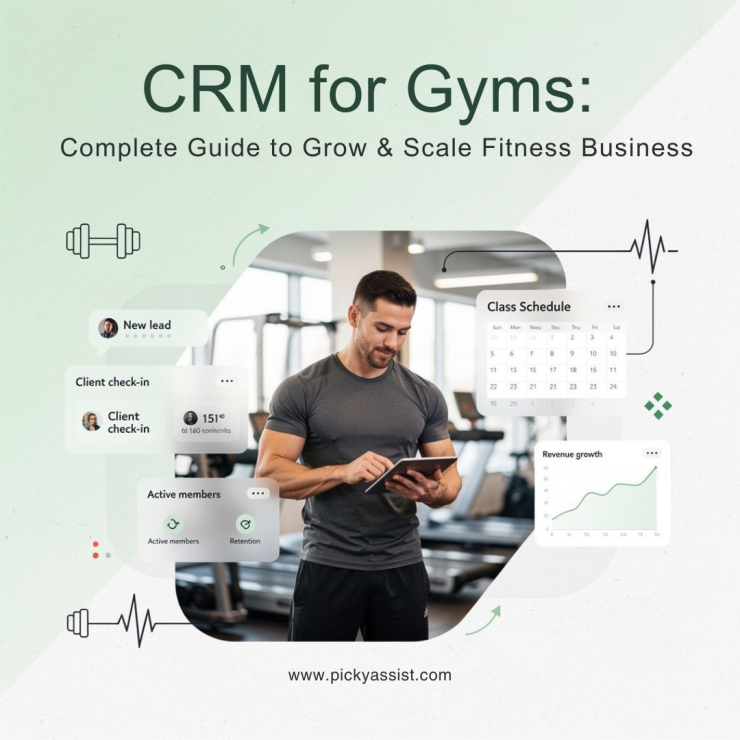
The fitness industry has evolved far beyond walk-in memberships and manual tracking. Today, growth depends on how effectively you capture leads, nurture relationships, manage memberships, and deliver personalized engagement at scale. This is exactly where a CRM for fitness industry becomes indispensable.
Whether you run a gym, a boutique fitness studio, or operate as a personal trainer, managing customer relationships manually leads to missed opportunities, inconsistent follow-ups, and revenue leakage. A well-implemented CRM system transforms how fitness businesses attract, convert, and retain clients, while reducing operational chaos.
In this guide, we’ll break down how a modern CRM works in the fitness space, what features actually matter, how to evaluate the right solution, and how tools like Picky Assist fit into real-world use cases.
What is a CRM for the Fitness Industry?
A CRM (Customer Relationship Management) system for the fitness industry is designed to help businesses manage interactions with prospects and members across their lifecycle; from first inquiry to long-term retention.
Unlike generic CRMs, a gym CRM system aligns with industry-specific workflows such as:
- Membership tracking
- Class scheduling and reminders
- Trainer-client interactions
- Automated follow-ups
- Payment tracking and renewals
- Engagement through messaging platforms
More importantly, it centralizes all customer data into a single system, enabling better decision-making and more consistent communication.
Why Fitness Businesses Can No Longer Operate Without a CRM
Fitness businesses operate in a highly competitive and retention-driven environment. Acquiring new members is expensive. Losing them due to poor engagement is even more costly.
Here’s where a CRM becomes a growth engine rather than just a tool.
1. Lead Response Speed Directly Impacts Conversions
When a potential member fills out a form or sends a message, delays in response reduce conversion probability. A CRM ensures:
- Instant lead capture
- Automated replies
- Structured follow-up sequences
2. Member Retention Requires Consistent Engagement
Fitness journeys are long-term. Members need reminders, motivation, and personalized interaction. A CRM helps:
- Track attendance patterns
- Trigger engagement messages
- Identify at-risk members
3. Manual Operations Create Bottlenecks
Without automation, teams spend time on repetitive tasks like:
- Scheduling follow-ups
- Sending reminders
- Managing spreadsheets
A fitness CRM software eliminates this inefficiency and allows teams to focus on growth.
Features to Look for in a Gym CRM System
Not all CRMs are built equally. Choosing the right one depends on how well it fits fitness-specific workflows.
Lead Management and Tracking
Your CRM should capture leads from:
- Website forms
- Social media
- Messaging platforms
- Walk-ins
It should also allow you to track where each lead comes from and how they progress.
Automated Follow-Ups
Follow-ups are where most conversions happen. A CRM should enable:
- Scheduled follow-up sequences
- Behavior-based triggers
- Personalized messaging
For example, if a lead doesn’t respond after 24 hours, the system should automatically send a reminder.
Membership Lifecycle Management
A strong gym CRM software helps manage:
- Membership start and end dates
- Renewal reminders
- Payment status
- Upgrade opportunities
Communication Automation (Especially Messaging Platforms)
Modern fitness businesses rely heavily on instant messaging. A CRM that integrates with platforms like WhatsApp can:
- Send class reminders
- Share workout tips
- Confirm bookings
- Handle inquiries automatically
This is where Picky Assist plays a critical role by enabling conversational automation at scale.
Trainer and Client Interaction Tracking
For businesses offering personal training, a CRM for personal trainers should:
- Track session history
- Store client preferences
- Enable personalized communication
Analytics and Reporting
Data should drive decisions. Your CRM must provide insights into:
- Lead conversion rates
- Member retention
- Revenue trends
- Campaign performance
Use Cases: How Different Fitness Businesses Use CRM
Gym Owners
A typical gym uses a gym CRM system to:
- Capture leads from ads and website
- Automate trial follow-ups
- Manage memberships
- Send renewal reminders
Fitness Studios (Yoga, Pilates, HIIT)
Studios often focus on class-based engagement. A best CRM for fitness studios supports:
- Class bookings
- Waitlists
- Attendance tracking
- Personalized engagement
Personal Trainers
A CRM for personal trainers helps:
- Track client progress
- Schedule sessions
- Maintain communication consistency
- Build long-term client relationships
Where Most Fitness Businesses Struggle Without a CRM
Understanding the pain points clarifies why CRM adoption matters.
Missed Leads
Leads come in at odd hours. Without automation, many go unanswered.
Inconsistent Follow-Ups
Staff may forget or delay follow-ups, leading to lost conversions.
Poor Member Retention
Without tracking engagement, it’s hard to identify members who are about to churn.
Lack of Visibility
Spreadsheets don’t provide real-time insights or actionable data.
How Picky Assist Fits Into the Fitness CRM Ecosystem?
Picky Assist is not positioned as a traditional all-in-one CRM. Instead, it focuses on a critical layer that most fitness businesses struggle with: conversational engagement and automation.
Here’s where it becomes highly relevant.
1. Automated Lead Engagement
When a lead comes in through WhatsApp or other channels, Picky Assist can:
- Instantly respond
- Qualify the lead
- Route it to the right team member
This reduces response time dramatically.
2. Follow-Up Automation That Actually Works
Instead of relying on manual reminders, businesses can set up:
- Multi-step follow-up sequences
- Behavior-based triggers
- Personalized messaging flows
3. Seamless Member Communication
Fitness businesses can automate:
- Class reminders
- Membership renewal notifications
- Promotional campaigns
This ensures consistent engagement without manual effort.
4. Integration-Friendly Approach
Picky Assist works alongside your existing fitness CRM software, enhancing communication rather than replacing your entire system. This makes it a practical choice for businesses that already use a CRM but struggle with engagement.
How to Choose the Best CRM for Gyms?
Selecting the best CRM for gyms is not about picking the most feature-rich tool. It’s about choosing what aligns with your operations.
Here’s a practical decision framework.
Step 1: Define Your Core Problem
Ask yourself:
- Are you losing leads?
- Is follow-up inconsistent?
- Is retention a challenge?
Your primary problem should guide your CRM choice.
Step 2: Evaluate Feature Relevance
Don’t get distracted by unnecessary features. Focus on:
- Lead management
- Automation
- Communication
- Reporting
Step 3: Check Integration Capabilities
Your CRM should integrate with:
- Messaging platforms
- Payment systems
- Booking tools
Step 4: Consider Scalability
Choose a system that grows with your business, especially if you plan to expand locations or services.
Step 5: Test Real Workflows
Before committing, simulate real scenarios like:
- Lead capture and follow-up
- Membership renewal
- Class booking
How to Get the Most Out of Your CRM?
A CRM is only as effective as how you use it.
Start with Lead Management
Set up:
- Lead capture channels
- Automated responses
- Follow-up workflows
Build Engagement Sequences
Create structured communication flows such as:
- Trial follow-up sequences
- Membership onboarding
- Retention campaigns
Train Your Team
Ensure your staff understands:
- How to use the CRM
- How to track interactions
- How to respond effectively
Monitor and Optimize
Continuously track:
- Conversion rates
- Engagement levels
- Drop-offs
Refine your workflows based on data.
Common Mistakes to Avoid
Overcomplicating the Setup
Start simple. Complex systems often fail due to poor adoption.
Ignoring Automation
Manual processes limit scalability. Automation is essential.
Not Using Data
A CRM without analytics is just a database.
Choosing Based on Price Alone
Cheap tools often lack critical capabilities, leading to higher long-term costs.
Trends of CRM in the Fitness Industry
The next phase of CRM evolution in fitness will focus on:
- AI-driven personalization
- Predictive analytics
- Conversational automation
- Omnichannel engagement
Fitness businesses that adopt these early will gain a significant competitive advantage.
Conclusion
A CRM for the fitness industry is no longer optional. It’s a foundational system for growth. From capturing leads to retaining members, every stage of the customer journey benefits from structured, automated, and data-driven processes.
However, choosing the right CRM is only part of the equation. The real impact comes from how effectively you implement and use it.
This is where tools like Picky Assist become valuable. By strengthening communication and automation, it fills a critical gap that many traditional CRMs leave unaddressed.
If your goal is to increase conversions, improve retention, and streamline operations, investing in the right CRM strategy is one of the most practical decisions you can make.
FAQs on CRM for the Fitness Industry
1. What is the best CRM for the fitness industry?
The best CRM depends on your business size and needs. Look for a system that supports lead management, automation, and communication. Integration with messaging tools is a major advantage.
2. How does a gym CRM system improve conversions?
It improves conversions by ensuring faster lead response, structured follow-ups, and consistent communication, which increases the chances of turning inquiries into paying members.
3. Can personal trainers benefit from CRM software?
Yes, a CRM for personal trainers helps manage client schedules, track progress, and maintain regular communication, leading to better client retention.
4. What features should I prioritize in fitness CRM software?
Focus on lead tracking, automation, communication tools, membership management, and analytics. Avoid unnecessary features that don’t align with your workflow.
5. Is CRM useful for small fitness studios?
Absolutely. Even small studios benefit from better lead management, automated engagement, and improved retention strategies.
6. How does automation help in gym CRM software?
Automation reduces manual effort by handling follow-ups, reminders, and engagement campaigns, ensuring no lead or member is neglected.
7. Can CRM integrate with WhatsApp for fitness businesses?
Yes, many modern systems integrate with WhatsApp. Tools like Picky Assist enable automated messaging, making communication faster and more effective.
8. How long does it take to implement a CRM in a fitness business?
Basic setup can take a few days, but optimizing workflows and training teams may take a few weeks for maximum effectiveness.
Add comment