
In hospitality, a guest can forget the room number, the lobby design, or even the price they paid but they rarely forget how your team made them feel throughout the experience. A delayed response to a booking inquiry, a missed follow-up after checkout, or inconsistent communication across channels can quietly reduce repeat bookings and damage guest trust. On the other hand, personalized engagement, fast support, and consistent communication create loyalty that drives long-term revenue. That shift is exactly why more hotels, resorts, travel operators, serviced apartments, and hospitality groups are investing in the best CRM for hospitality industry operations.
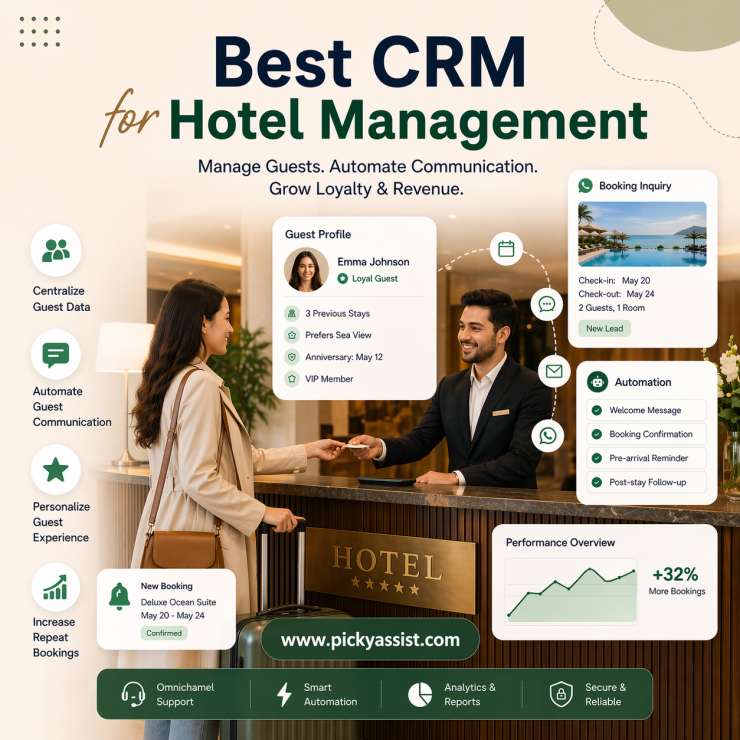
The right CRM does far more than store contact details. It helps hospitality businesses centralize guest conversations, automate communication, personalize engagement, improve response times, and create smoother guest journeys from inquiry to post-stay follow-up.
In this guide, we will break down what makes a hospitality CRM effective, what features actually matter, how hospitality businesses use CRM systems in real operations, and why communication-focused platforms like Picky Assist are becoming valuable for hospitality teams that want faster guest engagement and scalable automation.
Why is CRM important in the Hospitality Industry?
The hospitality industry operates in a high-touch environment where customer expectations are extremely dynamic. Guests expect:
- instant responses
- personalized communication
- smooth booking experiences
- proactive updates
- fast support across channels
At the same time, hospitality teams often struggle with fragmented systems. Guest conversations may be spread across:
- booking platforms
- phone calls
- website forms
- social media inquiries
Without centralized visibility, teams lose context quickly. That is where a dedicated CRM for hospitality industry workflows becomes critical. A hospitality-focused CRM helps businesses unify communication, guest history, and engagement data so teams can deliver consistent service at scale.
What makes the Best Hospitality CRM?
Not every CRM is designed for hospitality operations. A standard sales CRM may work for pipeline management, but hospitality businesses require stronger communication workflows, guest engagement tracking, and automation capabilities. The best hospitality CRM should support operational efficiency while improving the guest experience. Here are the capabilities that matter most.
Centralized Guest Profiles
Hospitality businesses handle repeat guests, seasonal travelers, corporate bookings, event inquiries, and loyalty members. A modern CRM should create unified guest profiles that include:
- booking history
- communication records
- preferences
- special requests
- stay frequency
- inquiry history
- guest feedback
This allows teams to personalize interactions instead of treating every guest like a first-time visitor. For example, if a returning guest previously requested airport pickup or early check-in, staff can proactively offer those services again. That level of personalization strengthens retention significantly.
Multi-Channel Guest Communication
Modern travelers do not communicate through one channel anymore. Some guests prefer WhatsApp. Others respond faster through email or website chat. Strong hospitality CRM software should help businesses manage communication across channels without forcing staff to switch between multiple tools. This is especially important for:
- hotels
- resorts
- travel agencies
- tour operators
- luxury stays
- boutique hospitality brands
Centralized communication reduces missed inquiries and improves response consistency.
Automation that improves Guest Experience
Automation should not feel robotic. In hospitality, automation works best when it improves timing and consistency while still feeling personal. Good hospitality CRM systems help automate:
- booking confirmations
- payment reminders
- check-in instructions
- welcome messages
- post-stay review requests
- upsell campaigns
- re-engagement campaigns
For example, a resort can automatically send spa upgrade offers to guests three days before arrival. That creates additional revenue opportunities without increasing manual workload.
Segmentation for Personalized Marketing
Guest segmentation is one of the most overlooked advantages of Customer Relationship Management in hospitality industry operations. Instead of sending generic campaigns to everyone, businesses can segment guests based on:
- stay frequency
- location
- booking type
- travel preferences
- spending behavior
- past interactions
This improves campaign relevance and increases engagement rates.
Fast Internal Coordination
Hospitality operations involve multiple departments. Front desk staff, reservation teams, marketing teams, and guest support teams often need access to the same guest information. A centralized CRM improves coordination and reduces communication gaps.
Common Challenges Hospitality Businesses Face Without CRM Systems
Many hospitality businesses still rely on disconnected spreadsheets or manual workflows. That creates operational friction that directly impacts guest experience.
Slow Inquiry Responses
Guests comparing hotels or resorts often contact multiple businesses simultaneously. Delayed responses can result in lost bookings. Fast response workflows matter enormously in hospitality sales cycles.
Inconsistent Guest Communication
Without centralized systems, guests may receive conflicting information from different departments. This damages trust quickly.
Weak Follow-Up Processes
Many businesses lose repeat booking opportunities simply because they fail to follow up after a guest’s stay. A CRM helps automate long-term engagement.
Poor Visibility Into Guest History
Without unified records, staff cannot personalize interactions effectively. This weakens the guest experience.
Benefits of CRM in Hospitality Industry Operations
The strongest hospitality brands focus heavily on relationship continuity. That is where the real value of CRM becomes visible. Here are some major benefits of CRM in hospitality industry environments.
Better Guest Retention
Personalized communication improves loyalty and repeat bookings. Returning guests are often more profitable than acquiring new customers repeatedly.
Faster Response Times
Centralized communication workflows help teams respond quickly across channels. This improves conversion rates for booking inquiries.
Improved Guest Satisfaction
When staff understand guest history and preferences, service quality improves naturally.
Stronger Upselling Opportunities
Hospitality businesses can promote:
- premium rooms
- dining experiences
- spa services
- event packages
- transportation services
based on guest behavior and booking patterns.
More Efficient Marketing Campaigns
Segmentation improves targeting accuracy and reduces irrelevant messaging.
CRM in Hotel Industry: Practical Use Cases
Understanding real operational use cases makes it easier to evaluate CRM systems properly. Here are some practical CRM in hotel industry examples that show how hospitality businesses use CRM platforms effectively.
Pre-Arrival Guest Engagement
Hotels can automate:
- booking confirmations
- welcome messages
- check-in instructions
- local travel recommendations
before guest arrival. This creates a smoother experience while reducing front desk workload.
WhatsApp-Based Guest Communication
Many guests now prefer messaging over phone calls. Hotels using WhatsApp workflows can manage:
- booking inquiries
- concierge requests
- check-in assistance
- support communication
through one centralized communication channel. This is where Picky Assist becomes highly relevant for hospitality businesses.
Loyalty Campaigns for Repeat Guests
A hotel can segment repeat visitors and send personalized offers during seasonal periods. This strengthens retention and increases repeat booking rates.
Feedback and Reputation Management
After checkout, automated review requests can encourage guests to leave feedback. This supports online reputation growth.
Why Communication Matters in Hospitality CRM Strategy?
Many hospitality businesses invest heavily in booking systems but overlook communication workflows. That creates major operational gaps. Guests expect quick responses across channels. If a potential guest sends an inquiry through WhatsApp and waits hours for a reply, the booking opportunity may disappear immediately. This is why communication-driven hospitality CRM solutions are becoming increasingly important.
How Picky Assist Supports Hospitality Businesses?
Picky Assist helps hospitality businesses streamline customer communication, automate engagement workflows, and manage conversations more efficiently across channels like WhatsApp. For hospitality businesses, communication speed and consistency directly affect booking conversions and guest satisfaction.
Picky Assist can support hospitality workflows through:
- centralized guest messaging
- WhatsApp automation
- automated guest communication flows
- broadcast messaging campaigns
- chatbot workflows
- lead and inquiry management
- customer engagement automation
For example:
A hotel can automate booking inquiry responses on WhatsApp, route guest conversations to the right team members, and send pre-arrival reminders automatically. Similarly, travel and hospitality businesses can use messaging automation for:
- tour confirmations
- itinerary updates
- payment reminders
- customer support communication
This makes Picky Assist particularly useful for hospitality brands that rely heavily on conversational engagement.
CRM in Hotel Management: What Features Matter Most?
When evaluating a CRM system in hotel industry operations, decision-makers should prioritize operational relevance over feature overload.
Here are the most important evaluation criteria.
Communication Integration
Can the CRM support messaging channels your guests actually use?
Automation Flexibility
Can workflows be customized for different guest journeys?
Ease of Use
Front desk and support teams need systems that are simple to operate during busy shifts.
Scalability
Can the platform support growing inquiry volumes and multiple properties?
Reporting Capabilities
Can leadership teams track engagement performance and guest communication metrics?
How to Choose the Best CRM for Hospitality Industry Operations?
Choosing the right CRM depends on operational priorities. A luxury resort may prioritize personalization workflows. A travel agency may focus more on inquiry automation. A hotel chain may require centralized communication management across locations. Before choosing a platform, hospitality businesses should evaluate:
- communication channels used by guests
- inquiry response workflows
- automation requirements
- guest retention strategies
- team collaboration needs
- integration requirements
The best systems align operational workflows with guest experience goals.
Customer Relationship Management in the Tourism and Hospitality Industry is Becoming Communication-Driven
Hospitality businesses are entering an era where communication responsiveness directly affects revenue outcomes.
Guests increasingly expect:
- instant replies
- personalized experiences
- seamless interactions
- mobile-first communication
This shift is changing how businesses approach Customer Relationship Management in hotel industry environments. The future of hospitality CRM is not only about storing guest data. It is about using communication intelligently to improve guest relationships continuously. So a conversational CRM is what matters and works the best.
Conclusion
The best CRM for hospitality industry businesses is not simply the platform with the longest feature list. It is the system that helps hospitality teams communicate better, respond faster, personalize experiences, and build stronger long-term guest relationships. As hospitality competition intensifies, businesses that create seamless guest engagement workflows will outperform those relying on fragmented communication systems.
For hospitality brands that want stronger guest communication workflows, automation capabilities, and scalable messaging engagement, Picky Assist offers practical solutions that align well with modern hospitality communication needs. The hospitality industry depends on relationships. A strong CRM helps businesses manage those relationships with consistency, personalization, and operational efficiency.
FAQs on CRM for hospitality industry
1. What is the best CRM for hospitality industry businesses?
The best CRM depends on the operational needs of the business. Hospitality companies should look for platforms that support guest communication management, automation workflows, centralized guest data, and multi-channel engagement. Businesses that rely heavily on messaging communication may benefit from platforms like Picky Assist that support conversational engagement workflows.
2. Why is CRM important in the hospitality industry?
CRM helps hospitality businesses improve guest relationships through personalized communication, centralized guest information, and automated engagement workflows. It also improves response times, guest retention, and operational coordination.
3. What are the benefits of CRM in hospitality industry operations?
Some major benefits include:
- improved guest retention
- faster inquiry handling
- better personalization
- stronger guest engagement
- improved upselling opportunities
- more organized communication workflows
4. How does CRM improve guest experience in hotels?
CRM systems help hotels personalize interactions based on guest history and preferences. They also improve communication consistency and automate important guest touchpoints like booking confirmations and post-stay follow-ups.
5. What features should hospitality CRM software include?
Important features include:
- guest profile management
- automation workflows
- multi-channel communication
- segmentation tools
- reporting dashboards
- messaging integrations
- team collaboration tools
6. Can WhatsApp integration help hospitality businesses?
Yes. Many guests prefer messaging platforms like WhatsApp for quick communication. WhatsApp integration can help hotels and hospitality businesses manage booking inquiries, support requests, reminders, and guest engagement more efficiently.
7. How is CRM used in hotel industry operations?
- guest communication
- booking follow-ups
- loyalty campaigns
- guest feedback management
- upselling services
- automated messaging workflows
8. What should hospitality businesses consider before choosing a CRM?
Businesses should evaluate:
- communication requirements
- automation capabilities
- integration flexibility
- scalability
- ease of use
- reporting functionality
- guest engagement workflows
Add comment