
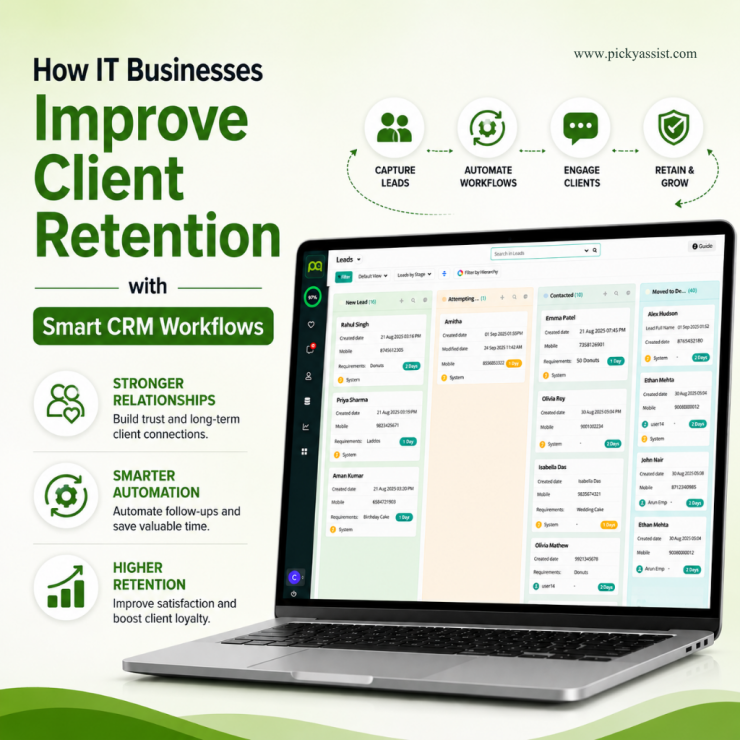
IT service providers operate in a highly demanding environment where clients expect fast communication, smooth project coordination, and reliable long-term support. At the same time, IT companies must manage leads, onboarding, renewals, support requests, and customer relationships without losing operational visibility. This is exactly why choosing the right CRM for IT service providers has become a strategic business decision rather than just a software upgrade.
Many IT businesses still rely on scattered spreadsheets, disconnected WhatsApp chats, and manual follow-ups. As customer volume grows, these gaps start affecting response times, sales conversions, and client management. A modern CRM helps centralize communication, automate workflows, and create a more scalable customer experience.
Platforms like Picky Assist combine CRM capabilities with conversational automation across WhatsApp, Instagram, email, and web chat.
Why Do IT Service Providers Need a Specialized CRM?
An IT business handles far more than customer records. Most IT companies simultaneously manage:
- New sales inquiries
- Technical consultations
- Support requests
- Project discussions
- Service renewals
- Multi-channel communication
- Team coordination
- Customer onboarding
- Ongoing account management
Without a centralized system, teams often lose visibility into customer interactions and project progress. For example, a sales executive may close a deal through WhatsApp, while the onboarding team communicates through email and the support team uses another platform entirely. As communication becomes fragmented, customers are forced to repeat information multiple times, leading to frustration and delays.
This is where a CRM for IT company operations becomes essential. Instead of isolated conversations and manual tracking, the entire customer journey becomes structured, visible, and easier to manage.
What Makes a CRM Valuable for IT Companies?
A CRM system, or Customer Relationship Management system, is software that helps businesses manage customer interactions, sales activities, communication workflows, and relationship history in a centralized platform. For IT service providers, a CRM acts as an operational command center. It helps teams:
- Track customer interactions
- Manage sales pipelines
- Automate communication
- Improve response times
- Collaborate across departments
- Maintain long-term customer relationships
Modern IT businesses are increasingly shifting toward conversational engagement and workflow automation. Clients no longer want slow communication cycles or delayed project updates. They expect real-time interaction. This is where conversational CRM platforms create a competitive advantage. An effective IT CRM system should support both customer acquisition and long-term relationship management while improving operational efficiency.
Centralized Communication
IT clients communicate through multiple channels. Some prefer WhatsApp for quick updates, while others rely on email or website inquiries. A CRM should consolidate these interactions into a unified inbox so teams can access complete customer history without switching platforms. Picky Assist helps businesses unify customer conversations across WhatsApp, Instagram, Facebook Messenger, email, and website chat into a single collaborative environment.
Lead Tracking and Qualification
Many IT businesses lose opportunities simply because follow-ups are delayed or inconsistent. A CRM software for IT company workflows should help teams:
- Capture incoming leads automatically
- Assign leads to sales representatives
- Trigger follow-up reminders
- Track deal stages
- Monitor conversion pipelines
This improves visibility while reducing manual dependency.
Faster Lead Response Times
Studies consistently show that businesses responding within minutes have significantly higher conversion rates compared to delayed follow-ups. With automated chatbots, IT companies can instantly acknowledge inquiries and maintain engagement even outside business hours.
Smarter Lead Routing
Not every inquiry belongs to the same department. An IT CRM software solution should intelligently route conversations based on intent. For example:
- Sales inquiries → Sales team
- Technical issues → Support team
- Existing customers → Account managers
This improves efficiency while reducing response delays.
Workflow Automation
Automation plays a major role in scaling IT operations.
Instead of manually sending onboarding messages, project updates, payment reminders, or support notifications, businesses can automate repetitive communication workflows. With Picky Assist, businesses can build automation flows that trigger based on customer actions, inquiry types, or CRM events. For example:
- Automatically send a WhatsApp welcome message after form submission
- Trigger onboarding sequences after deal closure
- Route technical inquiries to the support team
- Schedule automated follow-ups for inactive leads
This reduces operational bottlenecks while improving customer experience.
Better Team Collaboration
Centralized CRM platforms allow multiple departments to collaborate without losing visibility into customer history. This reduces duplicate communication and improves coordination.
Common Challenges IT Service Providers Face Without a CRM
Many IT companies realize operational problems only after growth begins creating internal friction. Here are some of the most common challenges businesses face without a centralized CRM for IT:
Missed Follow-Ups
Leads generated from ads, referrals, or website forms often remain unattended because teams rely on manual tracking. Delayed responses directly impact conversions.
Scattered Customer Conversations
When communication happens across personal WhatsApp numbers, emails, spreadsheets, and support tools, businesses lose context and accountability.
Inconsistent Customer Experience
Without structured communication workflows, different team members provide inconsistent responses, creating confusion for customers.
Limited Visibility Into Sales Pipelines
Managers struggle to understand:
- Which leads are active
- Which proposals are pending
- Which deals are stalled
- Which campaigns generate quality leads
A CRM solves this by centralizing pipeline management and reporting.
Difficulty Scaling Operations
As lead volume grows, manual coordination becomes unsustainable. Automation and centralized communication become necessary for operational scalability.
Why Is WhatsApp Becoming Important for IT Service Providers?
WhatsApp is no longer just a casual communication channel. For many IT businesses, it has become a primary communication medium for:
- Project updates
- Support coordination
- Client onboarding
- Meeting scheduling
- Proposal discussions
However, unmanaged WhatsApp communication creates operational chaos when conversations remain tied to personal devices. A structured CRM for IT service providers should allow businesses to manage WhatsApp communication professionally at scale. With Picky Assist, businesses can:
- Use WhatsApp Business API
- Manage team conversations collaboratively
- Automate replies and follow-ups
- Trigger notifications
- Run customer engagement campaigns
This creates a more organized communication infrastructure.
CRM for IT Company Growth: Beyond Sales Management
Many businesses mistakenly assume CRM platforms are only for sales teams. In reality, IT companies use CRM systems across multiple operational areas.
Customer Onboarding
Automated onboarding workflows improve customer experience while reducing manual effort.
Support Coordination
Customer conversations and support requests remain visible across teams.
Renewal Management
Recurring service businesses can automate renewal reminders and follow-up communication.
Marketing Automation
Businesses can nurture leads through personalized messaging campaigns and automated sequences.
Customer Retention
Consistent engagement improves long-term client relationships and retention rates.
How Picky Assist Supports IT Service Providers?
Picky Assist combines CRM functionality with conversational automation and multi-channel communication management. For IT service providers, this creates several operational advantages:
Unified Communication Management
Conversations from multiple channels are managed within one platform, and shared among teams. Admin can also set restrictions for access for specific teams or members if needed
Automation Workflows
Businesses can automate lead nurturing, onboarding, reminders, and customer engagement.
CRM and Messaging Integration
Instead of using separate systems for communication and customer management, businesses can centralize operations.
Scalable Customer Engagement
As customer volume grows, businesses can maintain responsiveness without proportionally increasing manual workload.
Conclusion
Managing customer relationships in the IT industry requires far more than contact storage and sales tracking. Modern IT businesses need centralized communication, automation, visibility, and scalable engagement systems that support both operational efficiency and customer experience.
A well-designed CRM for IT service providers helps businesses reduce communication gaps, improve follow-ups, automate workflows, and create stronger customer relationships across the entire lifecycle.
As customer expectations continue evolving toward faster and more conversational interactions, platforms like Picky Assist help IT companies modernize the way they engage, support, and grow their customer base through automation-driven communication and CRM workflows.
FAQs on CRM for IT Service Providers
1. What is a CRM for IT service providers?
A CRM for IT service providers is a customer relationship management platform designed to help IT businesses manage leads, customer communication, sales pipelines, onboarding, support coordination, and long-term customer relationships in a centralized system.
2. Why do IT companies need CRM software?
IT companies handle multiple customer interactions across sales, support, onboarding, and project management. CRM software helps organize these interactions, automate workflows, improve follow-ups, and increase operational visibility.
3. What features should an IT CRM system include?
An IT CRM system should include lead management, communication tracking, automation workflows, team collaboration tools, reporting, integrations, and omnichannel communication support such as WhatsApp and email.
4. How does WhatsApp integration help IT service providers?
WhatsApp integration helps IT companies manage customer conversations more efficiently, automate replies, provide faster support, and centralize communication within a professional business environment.
5. Can CRM software improve lead conversion for IT businesses?
Yes. CRM platforms improve lead conversion by enabling faster response times, automated follow-ups, structured pipeline management, and personalized communication workflows.
6. Is CRM only useful for sales teams?
No. IT businesses use CRM systems for customer onboarding, support management, marketing automation, renewal tracking, and customer retention in addition to sales management.
7. How does automation benefit IT service providers?
Automation reduces manual work by handling repetitive tasks such as welcome messages, reminders, lead nurturing, ticket routing, and follow-up communication, allowing teams to focus on higher-value activities.
8. How can Picky Assist support IT companies?
Picky Assist helps IT companies centralize communication, automate customer workflows, manage WhatsApp conversations collaboratively, and streamline lead engagement through CRM-integrated automation tools.


Add comment