
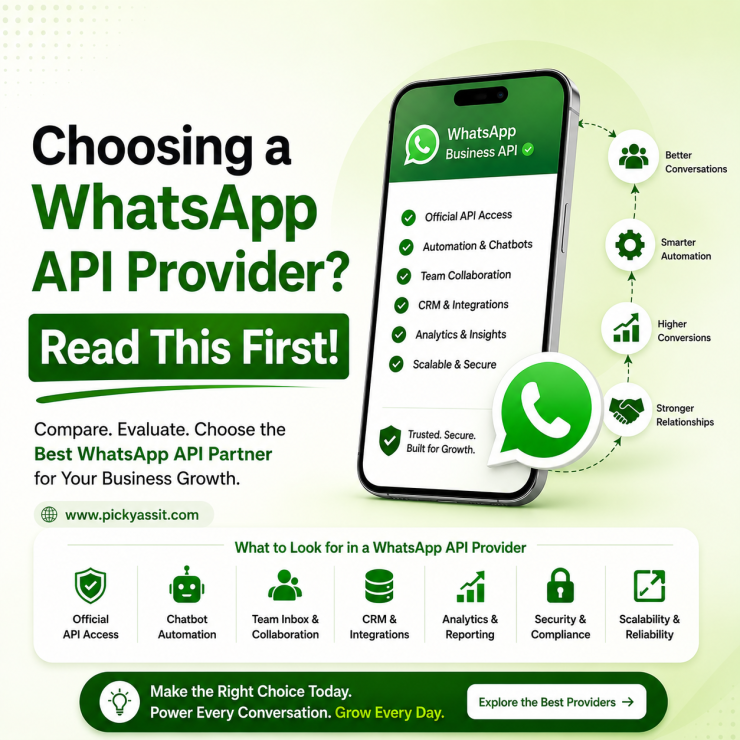
When customer conversations grow, managing everything manually through the WhatsApp Business App becomes challenging. Teams often face problems such as missed follow-ups, scattered customer information, slow responses, and limited visibility into sales conversations. This is where WhatsApp business API providers help businesses move from basic messaging to structured customer engagement.
A WhatsApp Business API platform enables companies to connect WhatsApp with automation tools, customer databases, chatbots, analytics, and internal workflows. Instead of treating every conversation as an isolated message, businesses can create a complete communication system that supports marketing, sales, and customer service.
For businesses looking to scale, choosing the right provider is not only about sending messages. It is about finding a platform that supports automation, customer experience, integrations, and long-term growth.
Picky Assist helps businesses achieve this through an all-in-one conversational platform that combines WhatsApp API access, CRM capabilities, automation workflows, chatbot building, and team collaboration.
What is WhatsApp Business API?
WhatsApp Business API is designed for companies that need to communicate with customers at scale. Unlike the regular WhatsApp Business App, the API allows businesses to connect WhatsApp with external software and automate customer interactions. With an API-powered system, businesses can:
- Send approved business messages
- Manage customer conversations
- Automate replies
- Build chatbot workflows
- Connect CRM systems
- Track customer journeys
- Support multiple agents
The API is especially useful for businesses handling hundreds or thousands of customer conversations every month.
Why Do Businesses Need WhatsApp Business API Providers?
Many companies start with WhatsApp because customers already prefer using it. However, growth creates operational challenges. A professional WhatsApp API provider helps businesses solve issues such as:
Managing High Message Volumes
When customer enquiries increase, manual replies become inefficient. Automation allows businesses to handle common questions instantly while allowing teams to focus on more valuable conversations.
Creating Faster Customer Experiences
Customers expect quick responses. Delays can result in lost sales opportunities. API-based platforms help businesses deliver timely responses through automated workflows and intelligent routing.
Connecting WhatsApp With Business Systems
Modern businesses rarely depend on one tool. They use CRMs, e-commerce platforms, support software, payment systems, and marketing tools. A strong platform enables WhatsApp integration with existing operations.
WhatsApp API Provider vs WhatsApp Business App
The WhatsApp Business App works well for small businesses managing limited conversations. However, growing companies require more advanced capabilities.
| WhatsApp Business App | WhatsApp API Platform |
|---|---|
| Designed for basic communication | Designed for scalable business communication |
| Limited automation | Advanced workflows |
| Fewer team management options | Multi-agent collaboration |
| Manual follow-ups | Automated customer journeys |
| Limited integrations | Connects with business systems |
A WhatsApp API solution helps businesses build a complete communication ecosystem.
Features to Look for in WhatsApp Business API Providers
Selecting the right provider requires looking beyond pricing. The best platform should support business growth through:
1. Official WhatsApp API Access
Businesses should choose providers that offer reliable access to the official WhatsApp Business Platform. This ensures better compliance, message delivery reliability, and scalability.
2. Chatbot Automation
A chatbot helps businesses respond instantly to common questions. With a no-code builder, teams can create automated flows without depending on developers.
Examples:
- Product enquiries
- Appointment scheduling
- Lead qualification
- Customer support
3. Customer Relationship Management
A connected customer management system helps businesses understand every interaction. A WhatsApp CRM approach allows companies to track customer history, conversations, and engagement.
4. Broadcasting and Campaign Management
Businesses can use automated WhatsApp broadcast for marketing campaigns to share updates, offers, reminders, and important information. However, successful campaigns depend on personalization and customer relevance.
5. Team Collaboration
Multiple employees often handle customer conversations. A shared inbox helps teams:
- Assign chats
- Monitor conversations
- Avoid duplicate responses
- Maintain service quality
Best 5 WhatsApp Business API Providers in India (2026)
India has become one of the largest markets for WhatsApp-based business communication. Several platforms now provide WhatsApp API solutions, but businesses should evaluate them based on automation, CRM capabilities, pricing, scalability, and integrations.
1. Picky Assist – Complete WhatsApp Automation Platform for Business Growth
Picky Assist is a WhatsApp API provider built for businesses that want more than messaging. The platform combines official WhatsApp API access with customer engagement tools, automation, chatbot workflows, and CRM functionality.
Instead of managing separate tools for marketing, sales, and support, businesses can manage customer communication from one connected ecosystem. Picky Assist enables businesses to:
- Build no-code chatbot workflows
- Automate customer interactions
- Manage conversations through Teambox
- Capture and organize leads
- Create automated follow-up journeys
- Connect with 3,000+ business applications
- Manage WhatsApp, Instagram, and email conversations
Pricing in India (June 2026)
- Free plan available
- API-only plan starts at ₹999/month
- Pro plan: ₹2,499/month
- Ultimate plan: ₹3,999/month
Additional features can be added based on business requirements.
Best For
Businesses that need a Complete All-in-one scalable conversational CRM platform combining communication, automation, and customer management. Picky Assist is especially suitable for companies that want to create a complete WhatsApp-driven customer journey rather than only send messages.
2. WATI
WATI focuses on helping businesses manage WhatsApp conversations through automation and team collaboration tools.
Key Features
- Shared inbox
- Broadcast campaigns
- Chatbot builder
- Customer support workflows
Best For
Startups and small businesses that need basic automation with WhatsApp communication.
3. Interakt
Interakt helps businesses combine WhatsApp communication with customer management features. It supports businesses with:
- Customer conversations
- Campaigns
- Automation
- CRM workflows
Best For
Indian SMBs looking for a simple WhatsApp communication system.
4. Zoko
Zoko focuses on helping e-commerce businesses sell through WhatsApp. It provides tools for:
- Product discovery
- Customer conversations
- Checkout workflows
- Commerce automation
Best For
Online brands that want to use WhatsApp as a sales channel.
5. Getgabs
Getgabs provides WhatsApp API solutions with tools for marketing, customer communication, and automation. It helps businesses manage campaigns, customer conversations, and sales interactions from a single platform.
Key Features
- WhatsApp API access
- Broadcast messaging
- Chatbot builder
- Shared inbox
- CRM capabilities
- Analytics
Best For
Small and medium businesses looking for a WhatsApp communication platform.
How to Choose the Right WhatsApp Business API Provider?
Choosing a WhatsApp API provider should depend on your business requirements, not just pricing. A platform that works for a small business may not support the needs of a growing enterprise. Before selecting a provider, consider the following:
Automation Capabilities
A good platform should reduce repetitive work. Look for features such as:
- Automated replies
- Chatbot workflows
- Lead qualification
- Customer notifications
- Follow-up sequences
Automation allows businesses to maintain consistent communication even outside working hours.
CRM and Customer Data Management
Customer conversations contain valuable business insights. A platform with WhatsApp CRM capabilities helps businesses understand customer preferences, previous interactions, and buying behaviour. This creates more personalized communication and improves customer retention.
Integration Options
Businesses already use multiple tools for operations. A reliable provider should connect with:
- CRM systems
- E-commerce platforms
- Payment tools
- Marketing platforms
- Internal applications
A strong CRM WhatsApp integration ensures customer conversations become part of the larger business workflow.
Scalability
A platform should support growth. As message volumes increase, businesses need:
- More agents
- More automation
- Better reporting
- Stronger workflow management
The right provider should grow with your business.
How Picky Assist Helps Businesses Beyond WhatsApp Messaging?
Many companies search for a CRM for WhatsApp because they want to organize conversations and improve customer management. Picky Assist helps businesses go beyond simple messaging by connecting communication with automation and customer lifecycle management.
The platform helps teams:
Capture Leads Automatically
Businesses can collect customer information through chatbot flows and automated conversations. This reduces manual data entry and ensures every enquiry enters the sales process.
Nurture Customers Through Automated Journeys
Not every customer is ready to buy immediately. Automated workflows help businesses send relevant updates, reminders, and follow-ups based on customer actions.
Improve Team Productivity
With a centralized inbox, teams can collaborate efficiently. Managers can monitor conversations, assign responsibilities, and improve response quality.
Build Connected Customer Experiences
Modern customers interact through multiple channels. Picky Assist helps businesses manage conversations across WhatsApp, Instagram, and email from one ecosystem.
WhatsApp Marketing and Customer Engagement in 2026
Customer communication has shifted from one-way promotions to interactive conversations. Businesses using WhatsApp marketing in India are increasingly focusing on personalized communication rather than sending generic messages. Successful WhatsApp campaigns usually include:
- Relevant offers
- Customer-specific updates
- Helpful information
- Timely reminders
When connected with customer data, businesses can create more meaningful interactions. A strong WhatsApp business CRM setup helps companies understand customer needs and deliver messages at the right stage of the journey.
Industries Benefiting From WhatsApp API Platforms
E-commerce
Online businesses use WhatsApp API solutions for:
- Order updates
- Product enquiries
- Customer support
- Repeat purchase campaigns
Real Estate
Real Estate companies use automated conversations to:
- Capture property enquiries
- Qualify prospects
- Schedule visits
Education
Educational institutions can manage:
- Course enquiries
- Admission communication
- Student support
Healthcare
Healthcare providers use WhatsApp automation for:
- Appointment reminders
- Patient communication
- Service updates
Travel
Travel companies can organize:
- Package enquiries
- Booking assistance
- Customer updates
Final Thoughts
The demand for WhatsApp communication platforms continues to grow as businesses look for faster, more personal, and more efficient ways to connect with customers.
The right WhatsApp business API providers help companies transform conversations into structured customer experiences through automation, CRM capabilities, and integrations.
Among the available solutions, Picky Assist stands out by combining WhatsApp API access with chatbot automation, customer management, lead nurturing, and multi-channel communication.
For businesses that want to build stronger customer relationships and scale communication efficiently, investing in the right platform can create a significant operational advantage.
FAQs on WhatsApp Business API providers in India
1. What are WhatsApp Business API providers?
WhatsApp Business API providers are platforms that help businesses access WhatsApp’s official API and connect it with tools such as CRM systems, chatbots, automation workflows, and customer support platforms.
They allow businesses to manage conversations at scale.
2. Why should businesses use WhatsApp Business API instead of the WhatsApp Business App?
The WhatsApp Business App is designed for smaller communication needs, while API solutions support larger teams, automation, integrations, analytics, and advanced customer management.
Businesses handling high volumes of customer conversations usually require API capabilities.
3. How does a WhatsApp API platform improve customer support?
A WhatsApp API platform helps businesses automate common questions, route conversations to teams, maintain customer history, and provide faster responses.
This creates a smoother support experience.
4. Can WhatsApp API providers help with marketing campaigns?
Yes. Businesses can use WhatsApp API platforms for campaigns, customer updates, reminders, and personalized communication.
However, effective WhatsApp marketing focuses on relevant conversations instead of sending unnecessary messages.
5. What features should I look for in a WhatsApp Business API provider?
Important features include:
- Official API access
- Chatbot automation
- CRM integration
- Shared inbox
- Analytics
- Team management
- Workflow automation
The right choice depends on your business size and goals.
6. Can WhatsApp API connect with CRM software?
Yes. Businesses can connect WhatsApp with CRM systems to manage customer data, conversations, sales activities, and follow-ups. This helps teams maintain a complete customer view.
7. Is Picky Assist suitable for businesses of all sizes?
Picky Assist supports businesses that need WhatsApp automation, customer communication management, and scalable workflows. It can help startups, growing businesses, and larger organizations organize customer engagement processes.
8. How does WhatsApp automation improve sales?
Automation helps businesses respond faster, qualify leads, send timely follow-ups, and maintain consistent communication. This improves the chances of converting interested customers into buyers.
Add comment