
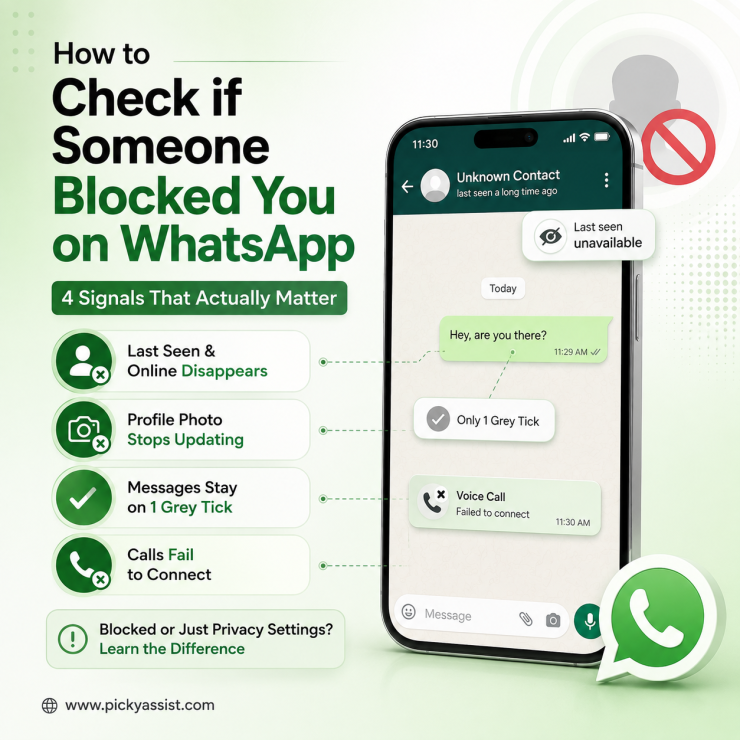
WhatsApp never sends a “you’ve been blocked” notification. You have to read the signal pattern, a missing “last seen,” a frozen profile photo, single grey ticks that never turn blue, and a failed call attempt, all showing up at the same time. One of these alone means nothing. All four together, on a chat that used to work normally, is about as close to confirmation as you’ll get without asking the person directly. I’ve had this question land in my inbox from two very different people: How to know if someone blocked me on WhatsApp? The signals are the same either way, but how you act on them shouldn’t be.
The 4 Signals That Actually Matter
Most articles list six or seven “signs.” In practice, only four are reliable enough to act on, and even then, only when they show up together.
- Last seen and online status disappear. If you could normally see “last seen today at 9:42 AM” or “online,” and it’s now just gone, that’s signal one. On its own, it also happens when someone tightens their privacy settings for everyone, not just you.
- Profile photo freezes. The photo you last saw stays exactly as-is, even if the person has visibly changed it elsewhere (LinkedIn, Instagram, a shared group where you can both see it). A frozen photo you can’t refresh is a stronger signal than a missing “last seen,” because privacy settings don’t usually cause this on their own.
- Messages stop past one grey tick. You send a message, it shows a single grey check (sent) but never a second check (delivered), no matter how long you wait. This is the single most diagnostic signal, because delivery status isn’t something the person can privacy-toggle, it’s a direct function of whether the message reached their device.
- Voice/video calls fail silently. The call doesn’t ring, doesn’t go to voicemail-style rejection, it just doesn’t connect, often failing within a second or two.
If you’re only seeing one of these, say, “last seen” disappeared but ticks still turn blue and calls connect you’re not blocked. You’re most likely looking at a privacy setting change, not a block.
Blocked vs. The Usual False Alarms
This is the part most guides skip, and it’s the part that actually saves people from a wrong conclusion.
| Scenario | Last seen | Profile photo | Message ticks | Calls | Group behavior |
|---|---|---|---|---|---|
| You’re blocked | Hidden | Frozen (old version) | Stuck at 1 grey tick | Fail to connect | Can’t add them to new groups |
| They changed privacy settings for everyone | Hidden | May still update | Still turns blue (2 ticks) | Still connects | Can add normally |
| Phone off / no signal / app uninstalled | Hidden temporarily | Frozen temporarily | Stuck at 1 tick temporarily | May fail | Can add normally |
| They deleted WhatsApp entirely | Hidden | Frozen | Stuck at 1 tick permanently | Fail | Can’t add (number invalid) |
| They deleted only your chat (not blocked) | Visible again once they reopen the app | Updates normally | Turns blue eventually | Connects | Can add normally |
The two columns that separate “blocked” from every other explanation are message ticks and calls. Privacy settings and a dead phone battery can explain a missing last-seen or a frozen photo. They can’t explain ticks that never move past one and calls that never connect, sustained over several days.
The Group Chat Test Underused, but Reliable
Try adding the person to a new WhatsApp group. If you get a message saying they couldn’t be added and need to be invited manually via a link, that’s consistent with a block, WhatsApp restricts group-add permissions for numbers that have blocked you. It’s not foolproof on its own (some users set “who can add me to groups” to “nobody” as a general privacy choice), but combined with the tick and call signals, it tightens the picture considerably.
Common Mistakes People Make Reading These Signals
- Judging off “last seen” alone. It’s the single weakest signal because it’s controlled by a privacy toggle that has nothing to do with blocking.
- Checking once and concluding immediately. A single grey tick can mean the phone was off for ten minutes. Give it 24–48 hours of consistent no-movement before drawing a conclusion.
- Creating a second number to “test” if they respond. This tells you whether that specific number is blocked, not whether you’re a welcome contact and it tends to escalate a personal situation rather than clarify it.
- Assuming a deleted chat means a block. If someone deletes your conversation but hasn’t blocked you, your messages still deliver fine and ticks still turn blue on their end once they reopen the thread.
Why does this Matter for Businesses and How is it Different?
For an individual, this is mostly a personal question. Undelivered WhatsApp messages can disrupt operations, reduce delivery rates, and lower campaign ROI. At scale, unresolved delivery issues can also negatively affect your WhatsApp Business Platform quality rating.
The catch: a business account often can’t manually check each contact’s “last seen” or send a test call to diagnose this one-by-one across hundreds or thousands of contacts. This is where message-level delivery status becomes the practical version of the tick-based signal above. At Picky Assist, our broadcaster tooling surfaces per-contact delivery and read status directly in the dashboard, so instead of guessing which contacts have gone unreachable, you can see it in the campaign report and clean your list accordingly.
FAQs on How to Know If Someone Blocked You on WhatsApp
No. WhatsApp doesn’t notify anyone when you view their profile, check last-seen status, or attempt to send a message. The block itself is invisible from both sides. There’s no confirmation screen for either party.
No. A single grey tick can mean the recipient’s phone is off, offline, or WhatsApp hasn’t connected yet. Only treat it as a strong signal if it persists for 24–48+ hours with no change.
No. If you’re blocked, you won’t see their status updates, and they won’t see yours, even if you were previously able to view each other’s stories.
No. Messages you already sent and received before the block stay in your chat history. Only new messages fail to deliver going forward.
No. Blocking is entirely controlled by the person who blocked you. No workaround or third-party tool bypasses this restriction; using them risks violating WhatsApp’s terms and your account.
Yes. Being removed from a shared group only affects that group, your direct messages to the person are unaffected. Being blocked affects all direct communication, regardless of shared groups.


Add comment