
A founder who sits through three vendor demos in five days. The first vendor sells a chatbot. The second sells an agent. The third sells “agentic” automation. By Friday, all three tools look alike on screen, yet the quotes differ by a wide margin. The overlap is real, and some of it is marketing. Let’s settle down the confusion between agentic AI vs AI agent question in plain language, place the AI chatbot on the same map, and see which one your business needs first and why!
AI Chatbot, Agent, or Agentic System
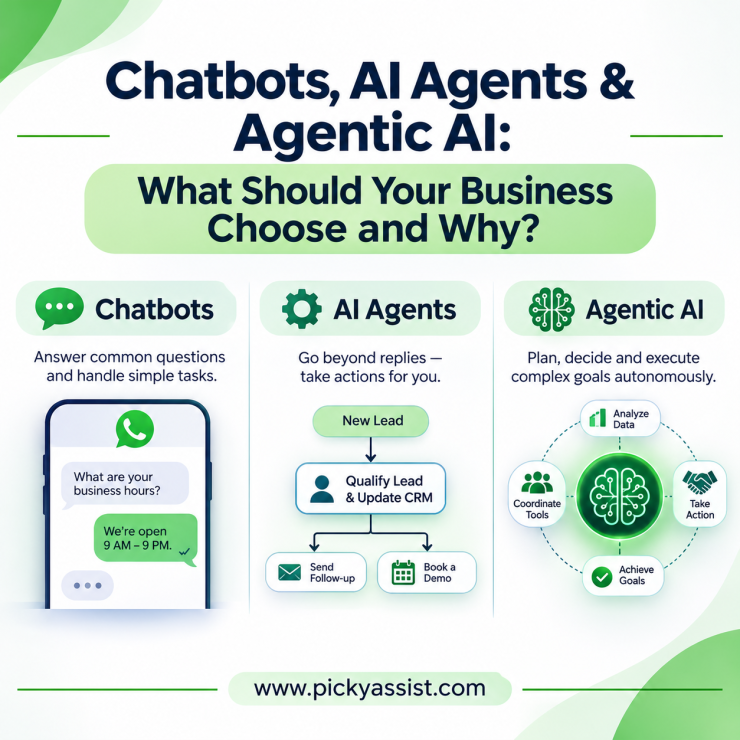
A chatbot answers questions inside conversation paths that you design. An AI agent takes a goal, picks its own steps, and uses tools such as your CRM or order system to finish a task. Agentic AI describes the wider approach, where one or more agents plan and run multi-step work with little prompting.
A simple way to remember it:
- Chatbot: replies to the customer.
- Agent: completes a task for the customer.
- Agentic system: manages a whole process from start to finish.
Vendors use these terms loosely. Treat these definitions as a working guide and not as an industry standard.
What is an AI Chatbot, and Where Does it Fit?
An AI chatbot reads a message and replies from a script, a flow, or a trained knowledge source. It is reactive. It waits for the customer to speak and answer inside a defined lane.
Rule-based AI chatbots like the ones offered by Picky Assist follow buttons and keywords. Also It uses language models to understand free text, but they still work within limits you set.
Chatbots shine on high-volume, low-variance questions like store hours, pricing, delivery areas, return policy. Their limit is action. A chatbot can tell a customer where the return form lives, but it cannot raise the return itself.
What is an Intelligent Agent in AI?
Intelligent agent in AI is any system that perceives its environment, makes decisions, and acts toward a goal. In business software, the idea narrows to three steps:
- Perceive: Read the customer’s message or a trigger, such as a new lead.
- Decide: Choose the next step toward the goal.
- Act: Use a connected tool to complete that step.
Let’s sort agents by how they decide. Reflex agents follow fixed rules. Goal-based agents pick actions that move toward a target, such as a booked appointment. Learning agents improve from feedback.
A knowledge based agent stores facts and rules, then reasons over them before it acts. In a business, that knowledge base is your catalogue, FAQs, price lists, policies and other set criterias. The agent answers from those sources instead of guessing, which keeps replies accurate.
Vendors often label customer-facing versions as intelligent virtual agents or an AI virtual agent. In practice, both labels point to conversational software that handles service requests across channels such as WhatsApp and voice.
Agentic AI vs AI Agent: Where the Real Difference Sits
The agentic AI vs AI agent distinction comes down to scope.
A single agent handles a defined task: check an order, qualify a lead, book a slot. Agentic AI covers systems that own an outcome across several steps, several tools, and often several agents working together. When the plan meets a surprise, such as a customer who misses an appointment, an agentic system decides what to do next instead of stopping.
Three differences show up in daily use:
- Scope: an agent finishes one task. An agentic system owns one outcome.
- Planning: an agent follows steps the builder broadly defined. An agentic system sets sub-goals and adjusts them.
- Oversight: more autonomy demands more guardrails, such as approval gates, activity logs, and clear handoff rules.
Side-by-Side Comparison between Chatbot, AI agent and Agentic AI Systems
| Factor | Chatbot | Agent | Agentic system |
|---|---|---|---|
| Factor | Chatbot | Agent | Agentic system |
| Core job | Answer questions | Finish one task | Own a multi-step outcome |
| Starts when | Customer sends a message | Message or trigger | A goal or business event |
| Decision making | Follows a flow or knowledge answer | Chooses steps within one task | Plans, adapts, coordinates |
| Tool use | Minimal | CRM, calendar, order system | Many tools, sometimes several agents |
| WhatsApp example | Shares store hours and catalogue link | Books a demo and updates the CRM | Qualifies a lead, schedules a visit, follows up, flags stalled deals |
| Human oversight | Review failed chats | Escalation rules and spot checks | Approval gates and audit logs |
| Setup effort | Low | Medium | High |
| Best first use | FAQs | Lead qualification, order status | Mature teams with clean data |
Understanding from Business Scenarios and Examples
Here is how the agentic AI vs AI agent choice plays out in real businesses.
A dental clinic needs a chatbot. Patients ask about timings, fees, and parking. A chatbot with a button menu answers these in seconds. Anything more advanced adds cost without adding value.
An apparel store needs an agent. A customer asks where an order is and wants to swap a size. The agent looks up the order, checks exchange eligibility, creates the exchange request, and tells the customer what happens next. If the order falls outside the return window, it hands the chat to a person.
A coaching institute needs an agentic system. Enquiries arrive from ads, Instagram, and WhatsApp. The system qualifies each enquiry, offers counsellor slots, books the call, and sends reminders. After a no-show, it follows up, updates the CRM, and alerts the counsellor when a lead turns warm. That workflow spans many steps, decisions, and tools, which is what the agentic label is meant for.
You may require a Chatbot, an AI agent or an Agentic system, which is completely based on the set of business requirements and workflows that actually runs for your business.
How to Choose Between Chatbots, Agentic AI and Agentic Systems in a Business?
Let’s ensure clarity. If you are a decision maker, ask these four questions before you settle the Chatbot vs Agentic AI vs AI agent choice.
- How repetitive is the work? Repeated questions favor a chatbot.
- Does the task require action in other systems? Booking, refunds, and record updates call for an agent.
- How many steps and decisions does the outcome involve? Long, branching processes point toward an agentic design.
- What happens when it is wrong? A wrong store-hours answer is minor. A wrong refund is not. High-risk actions need human approval.
Start with the lowest level that solves the problem. Many businesses begin with a chatbot, add agent behavior once their knowledge base is clean, and move toward agentic workflows when processes stabilize.
Where Picky Assist Helps Businesses?
Picky Assist is an Official Meta Partner for WhatsApp Business API, with chatbots, CRM, and AI agents customised for every industry.
Smart Replies: Instant Answers and No Repetitive chats with AI Chatbots
Smart Replies are AI chatbots that let your business answer every common question the moment it arrives, on WhatsApp, Facebook Messenger, Instagram or email. Upload your existing FAQ, build using drag-and-drop chatbot builders and connect them with no-code connectors. Picky Assist offers an entire no-code chatbot builder from which you can create AI chatbots that go live in a day, without manual setup for each question. Customers get fast replies that stay on topic across a conversation, so your team stops answering the same questions all day. When the bot cannot answer, it can pause replies and route the chat to a human agent in Teambox. The result is faster response times, lower support load, and a team that spends its time on conversations that need a person.
AI Employees: Where Enquiries Become Loyal, Satisfied Clients
AI Employees go beyond answering. They qualify leads, collect customer details, read documents and images, and save the structured data straight to your CRM, using 35+ built-in actions and your connected systems. You set what each one knows, what it can say, and when it hands over. When it does, your team gets a short summary instead of a full chat history. Automated follow-ups bring back customers who dropped off mid-conversation. The result is cleaner data, a sales team focused on ready-to-buy leads, and round-the-clock coverage with predictable costs, since you can cap conversations per customer.
Conclusion
The right choice depends on the job, not the label. Use a chatbot when customers need fast answers. Use an agent when the work requires action in your systems. Move toward agentic design only when a whole process, with its branches and follow-ups, justifies the extra setup and oversight. Keep humans in the loop wherever mistakes carry real cost.
The agentic AI vs AI agent debate matters less than starting with a narrow, well-defined use case and measuring it. If WhatsApp is where your customers already talk to you, explore Picky Assist’s Smart Replies and no-code builder to launch your first automated conversation and grow from there.
FAQs on AI Chatbot vs Agentic AI vs AI agent
A chatbot responds to messages inside conversation paths you design. An agent goes further: it works toward a goal and takes actions through connected tools, such as updating a CRM or booking a slot. The deciding question is whether the software only talks or also does.
Agentic AI refers to systems that plan and carry out multi-step work with limited human prompting. Instead of answering one request, the system pursues an outcome, adapts when something changes, and often coordinates several agents.
Yes. No-code builders let non-technical teams create chatbots and simple task flows. Start with common questions and one or two actions, such as lead capture or appointment booking, then expand after you review real conversations.
The knowledge base holds your approved facts: prices, policies, product details, and FAQs. Answering from it keeps the agent grounded in your business and reduces the chance of invented answers. Keeping that content current matters as much as the technology.
It needs WhatsApp Business API access through a Business Solution Provider, a clear knowledge source, connections to your CRM or other systems, and handoff rules for conversations that need a person. Approved message templates are also required for business-initiated messages.
No. It works best on repetitive requests and routine tasks, while people handle negotiation, complaints, sensitive cases, and high-value customers. Good setups pass context to the human so customers never repeat themselves.
Start with the chatbot layer, because it solves the most common problem quickly and cheaply. Add agent behavior when customers need actions, not just answers. The agentic AI vs AI agent question comes later, once your data is clean and your processes are stable.
Add comment