
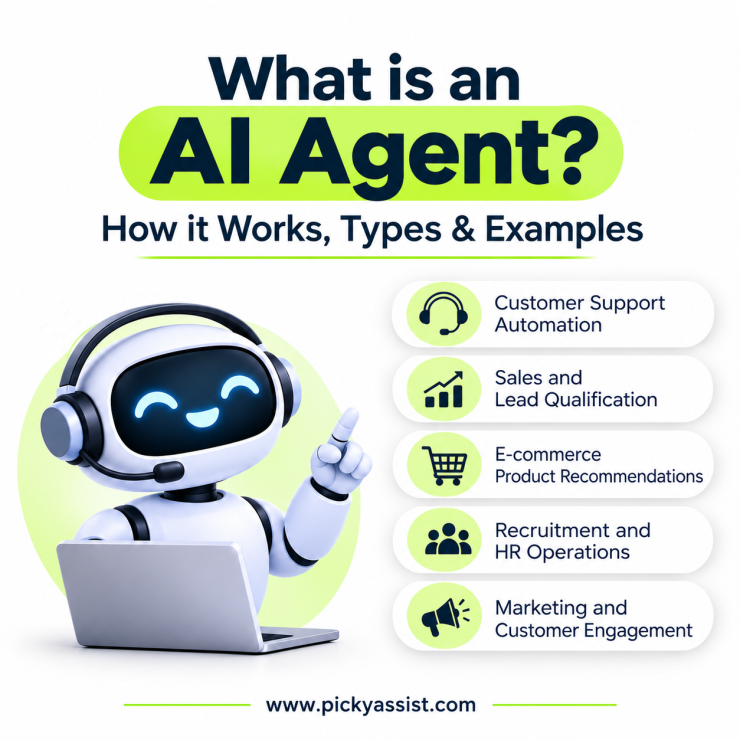
Imagine an automated system qualifying leads, answering customer questions, collecting contact details, and following up with interested prospects without requiring an employee to manage every conversation. An AI agent helps businesses with all these operations without the team being expanded. It can understand objectives, process information, make decisions, and perform tasks based on predefined instructions and available tools.
In 2026, businesses are increasingly exploring this technology to improve customer experiences, streamline operations, reduce repetitive work, and support growth without proportionally increasing their workforce. But what exactly are these systems, how do they work, and where can businesses use them? Let’s explore.
What is an AI Agent?
An AI agent is a software system that uses artificial intelligence to understand information, make decisions, and perform actions to achieve a specific goal with varying levels of human supervision.
Unlike traditional automation, which follows fixed instructions, an intelligent system can interpret different inputs and choose an appropriate response or action. For example, a conventional chatbot might respond to the question, “What are your business hours?” using a predefined answer.
An AI-powered agents can understand a more complex request, such as, “Can I schedule a consultation next Saturday afternoon?” It can identify the customer’s intention, ask for missing details, check available scheduling options through connected tools, and help complete the request. Traditional automation follows instructions. An AI agent understands a goal and determines the steps needed to achieve it.
What Are the Benefits of Hiring an AI Agent for Your Business?
An AI employee helps your business serve more customers, capture more leads, and reduce routine workload without constantly increasing your team size.
Here are six ways it can make a real business difference.
1. Convert More Enquiries into Customers
Respond to enquiries instantly, understand customer needs, recommend relevant products, and capture lead details. It results in fewer missed opportunities and more qualified leads.
2. Handle More Customers Without Hiring More Staff
Manage multiple routine conversations at once, answer FAQs, share order updates, and direct complex queries to your team. Handle higher customer volumes without increasing support costs at the same rate.
3. Follow Up with Leads Consistently
Identify interested prospects and send timely follow-ups so potential customers don’t get forgotten. Fewer lost leads and more chances to convert enquiries into sales.
4. Help Customers Make Faster Buying Decisions
Share product details, pricing, and relevant information to help customers choose the right solution. Faster responses and fewer delays in the buying process.
5. Give Your Team More Time to Focus on Sales
Automate routine tasks such as answering common questions, collecting customer details, and updating CRM records. Less administrative work and more time for closing deals and building customer relationships.
6. Capture Enquiries Beyond Business Hours
Respond to customers after hours, collect their requirements, and save requests for your team to follow up. Fewer missed after-hours enquiries and better customer engagement.
The bottom line: An AI employee helps your business increase its capacity, respond faster, and make better use of your existing team—while your employees stay focused on work that needs a human touch.
What does an AI Agent do exactly or How it Works?
Most modern systems combine an AI model, business information, instructions, memory, and connected tools. See how does an AI Agent work for your business processes.
- Perception: Receives information through text, voice messages, images, documents, or system events.
- Understanding: Interprets the request and identifies the user’s intention.
- Reasoning: Evaluates available information and determines the next appropriate step.
- Action: Uses connected tools, APIs, or business systems to perform the required task.
- Feedback: Reviews the outcome and determines whether another action or human intervention is necessary.
For example, when a customer asks about an order, the system can understand the request, retrieve relevant order information from an integrated system, and communicate the status.
This combination of understanding and action makes the technology useful for more than basic question-and-answer interactions.
What are the Different Types of AI Agents?
AI agents can be classified according to how they make decisions and interact with their environment. The following are five widely recognised categories in the traditional AI framework.
1. Simple Reflex Agents
These systems respond to specific conditions using predefined rules. They do not consider previous experiences or maintain extensive context.
Business example: Automatically sending a welcome message when a customer subscribes to a service.
Best for: Repetitive tasks with predictable inputs.
2. Model-Based Reflex Agents
These systems maintain an internal representation of their environment. They consider the current situation and relevant information from previous interactions.
Business example: A customer support chatbot that remembers the issue discussed earlier and avoids asking the same questions repeatedly.
Best for: Customer interactions that require context.
3. Goal-Based Agents
These systems work towards a defined objective and evaluate different actions before deciding what to do next.
Business example: A sales assistant that qualifies a prospect by asking about their budget, requirements, and purchase timeline before forwarding the lead to a salesperson.
Best for: Lead qualification, sales processes, and task completion.
4. Utility-Based Agents
These systems evaluate possible actions based on their expected usefulness and choose an option that best meets defined priorities.
Business example: An e-commerce assistant recommending products by considering a customer’s budget, preferences, delivery requirements, and product availability.
Best for: Personalised recommendations and decision support.
5. Learning Agents
These systems improve their performance using feedback and experience, depending on their design and training process.
Business example: A recommendation system that uses customer interactions and purchase patterns to improve future product suggestions.
Best for: Personalisation, forecasting, and continuously improving processes.
6. Knowledge-Based Agents
These Knowledge based AI Agent systems use a structured knowledge base containing facts, business rules, and stored information to answer questions, solve problems, and make informed decisions. They retrieve relevant knowledge and apply logical reasoning to respond to different situations.
Business example: A customer support assistant that accesses a company’s product documentation, pricing information, FAQs, and support policies to answer customer questions accurately.
Best for: Knowledge management, customer support, technical assistance, and information-based decision-making.
What Are the Core Components of an AI Agent?
An AI agent combines several components that allow it to understand instructions, process information, make decisions, and perform tasks. Each component plays a specific role in helping the system achieve its assigned objectives.
The four core components include:
1. Foundation Model (LLM or SLM)
The foundation model acts as the reasoning engine. It interprets user instructions, understands the context, processes information, and helps determine the next appropriate action. Large Language Models (LLMs) handle complex language-based tasks, while Small Language Models (SLMs) offer more lightweight alternatives for specific tasks and environments.
2. Tools and APIs
Tools and APIs allow an AI agent to interact with external applications and business systems. They extend its capabilities beyond generating text or answering questions. For example, an agent can connect with CRM platforms, databases, calendars, payment systems, and other software to retrieve information or perform specific actions.
3. Memory
Memory helps the system retain relevant information and maintain context across interactions. It generally includes two forms:
- Short-term memory: Maintains information from the current conversation or task so the system can understand follow-up instructions.
- Long-term memory: Stores useful information, preferences, and previous interactions for future reference, often through databases or vector search systems.
For example, a customer support assistant can use conversation history to avoid repeatedly asking customers for information they have already provided.
4. Planning and Orchestration Module
The planning and orchestration module determines how an agent approaches a task and coordinates the steps required to complete it. It helps break complex objectives into smaller actions, select appropriate tools, manage task sequences, and respond when an action fails or produces an unexpected result. For example, when a customer requests a product recommendation, the system may first understand their requirements, retrieve matching products, compare available options, and then present suitable recommendations.
Together, these components enable an AI agent to move beyond predefined responses and handle tasks that require understanding, reasoning, coordination, and action.
Business Examples of AI Agents in 2026
The practical value of this technology becomes clearer when applied to everyday business operations.
1. Customer Support Automation
A support system can answer frequently asked questions, understand customer complaints, retrieve relevant information, and route complicated issues to human representatives. For example, a healthcare provider can use an AI virtual agent to answer appointment-related questions, share preparation instructions, and direct sensitive enquiries to staff.
2. Sales and Lead Qualification
Sales teams receive enquiries from multiple channels, but not every prospect is ready to purchase. An intelligent sales assistant can ask qualifying questions, identify customer requirements, collect contact information, and prioritise promising leads.
This allows sales representatives to spend more time on meaningful conversations instead of manually filtering enquiries.
3. E-commerce Product Recommendations
Online shoppers often need help choosing between multiple products. An intelligent shopping assistant can understand their preferences, recommend suitable products, answer questions about specifications, and guide them towards checkout.
4. Recruitment and HR Operations
Recruitment teams handle repetitive activities such as collecting applications, screening basic candidate information, and scheduling interviews. Automated assistants can collect candidate details, ask initial screening questions, and coordinate interview scheduling, leaving final hiring decisions to recruiters.
5. Marketing and Customer Engagement
Businesses can use conversational automation to respond to enquiries, nurture prospects, send relevant follow-ups, and maintain customer engagement. For example, a prospective customer who enquires about a service but does not complete the purchase can receive a contextual follow-up based on their previous conversation.
AI Agent vs Traditional Chatbot: What’s the Difference?
Although both technologies support automated conversations, their capabilities differ.
| Comparison | Traditional Chatbot | AI Agent |
|---|---|---|
| Working method | Predefined rules | AI-driven decisions |
| Understanding | Limited to configured flows | Interprets natural language |
| Context | Usually limited | Can maintain conversation context |
| Actions | Executes predefined responses | Can use tools to perform tasks |
| Flexibility | Limited | Adapts to different requests |
| Best suited for | FAQs and simple workflows | Complex interactions and business tasks |
Traditional chatbots remain useful for predictable processes. More advanced systems are suitable when conversations require contextual understanding, decision-making, and multiple actions.
How Can Businesses Use AI Agent Through WhatsApp?
WhatsApp has become an important customer communication channel for businesses. Customers use it to ask questions, enquire about products, request support, and make purchasing decisions. This creates an opportunity to combine conversational automation with business workflows. With Picky Assist, businesses can explore AI-powered WhatsApp conversations that support:
- Automated customer responses: Answer enquiries using business-specific information.
- Lead qualification: Ask relevant questions and capture prospect details.
- Voice message understanding: Interpret customer voice messages and respond contextually.
- Automated follow-ups: Continue conversations using configured, context-aware follow-up sequences.
- Human handover: Transfer conversations to employees when personal assistance is required.
- CRM data collection: Extract customer information and save it as CRM attributes.
Picky Assist also supports interactive WhatsApp experiences through buttons, list menus, product carousels, images, and documents. Picky Assist These capabilities help businesses manage customer conversations from initial enquiry to follow-up without relying entirely on manual responses.
How to Choose the Right AI Agent for Your Business?
Before investing in automation, consider these five factors:
- Business objective: Identify whether you want to improve customer support, generate leads, automate sales, or streamline internal operations.
- Integration capabilities: Check whether the platform connects with your CRM, communication channels, and existing business applications.
- Knowledge accuracy: Ensure the system can use approved business information and follow clear response boundaries.
- Human supervision: Look for configurable escalation rules for sensitive requests and complex decisions.
- Cost and scalability: Evaluate usage-based pricing, interaction limits, integration costs, and the ability to handle increasing conversation volumes.
The best solution is not necessarily the most advanced one. It is the one that solves a genuine business problem reliably.
Conclusion
AI-powered automation is changing how businesses manage customer interactions and everyday operations. From customer support and sales qualification to recruitment and personalised recommendations, its applications extend across multiple departments.
An AI agent is particularly valuable when a task requires more than a predefined response. It can understand context, make decisions, use connected tools, and complete defined actions within business-approved boundaries.
For founders and growing businesses, the next step is to identify repetitive processes that consume valuable employee time and determine which ones can be automated effectively.
Explore Picky Assist to discover how AI-powered WhatsApp automation, conversational CRM, and intelligent customer engagement can help your business respond faster, manage leads better, and build stronger customer relationships.
Frequently Asked Questions on AI Agents
It is a software system that understands a task, makes decisions, and performs actions to achieve a particular goal. Unlike basic automation, it can interpret different requests and determine suitable next steps.
A traditional chatbot generally follows predefined conversation flows, whereas an AI-powered agent can interpret natural language, maintain context, make decisions, and use connected tools to complete tasks.
They are used for customer support, sales assistance, appointment scheduling, product recommendations, employee assistance, and other tasks that require natural-language interaction.
It is a system that uses a knowledge base containing facts, rules, and information to answer questions or make decisions. Businesses can use one to provide answers based on approved policies and product documentation.
Yes. Small businesses can use them to automate customer enquiries, qualify leads, provide product information, manage follow-ups, and reduce repetitive administrative work without building a large support team.
Yes. Businesses can deploy conversational systems through WhatsApp Business API integrations to respond to enquiries, collect customer information, qualify leads, send follow-ups, and transfer conversations to human employees.
They can be used responsibly when businesses establish clear permissions, approved knowledge sources, privacy controls, usage limits, and human escalation processes. Sensitive decisions and high-impact actions should have appropriate human oversight.
Add comment