
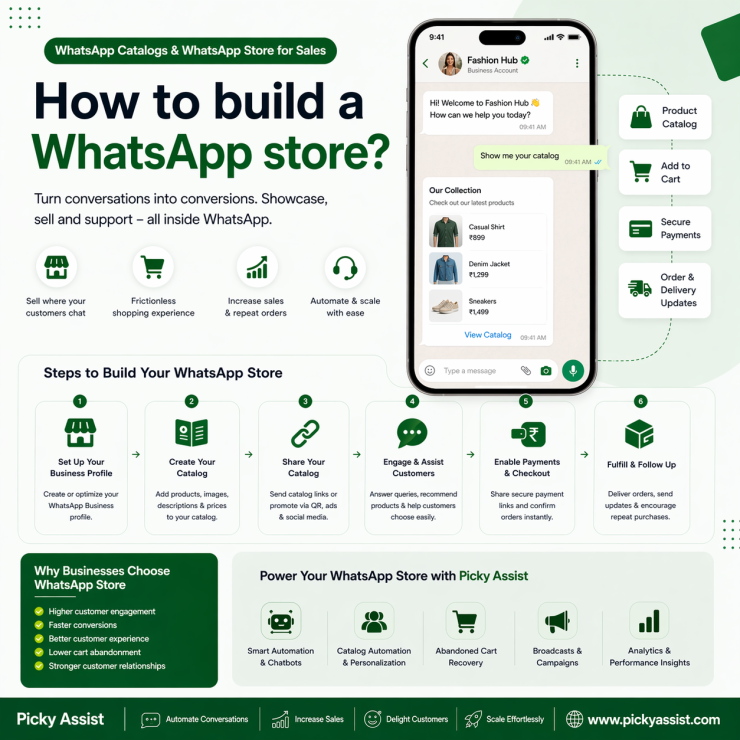
Online shopping is changing fast. Customers no longer want to jump between websites, apps, checkout pages, and support channels just to complete a purchase. They want faster answers, personalized recommendations, and a buying experience that feels simple from start to finish. That shift is driving the rise of WhatsApp shopping.
Instead of sending customers away to external storefronts, businesses can now showcase products, answer questions, recommend items, send payment links, and manage post-purchase support directly inside WhatsApp. For brands, this changes commerce completely. For customers, it removes friction.
From retail brands and D2C companies to grocery businesses and service providers, companies are increasingly building conversational buying experiences through WhatsApp to improve engagement and increase conversions.
In this guide, we will break down how WhatsApp shopping works, why businesses are investing in conversational commerce, how automation improves scalability, and how platforms like Picky Assist help businesses manage and grow commerce operations through WhatsApp.
What is WhatsApp Shopping?
WhatsApp shopping refers to the process of browsing, discovering, ordering, and interacting with businesses directly inside WhatsApp. Instead of forcing customers to visit a separate website, businesses can create a shopping experience within the messaging platform customers already use daily. A business can:
- showcase product catalogs
- recommend products
- answer customer questions
- send payment links
- manage orders
- automate follow-ups
all through chat-based interactions. This creates a much more conversational buying experience compared to traditional ecommerce journeys.
Why is WhatsApp Shopping Growing so Fast?
Consumer behavior has changed dramatically. People spend more time on messaging platforms than on many ecommerce apps. As a result, businesses are adapting to where customer attention already exists. Several factors are accelerating the growth of WhatsApp social commerce.
Customers Want Faster Buying Experiences
Traditional ecommerce flows often create unnecessary friction. A customer may:
- browse products
- leave the site
- abandon the cart
- forget to return
With conversational commerce, businesses can engage customers instantly and guide them toward purchase decisions in real time.
Messaging Feels More Personal
Unlike static websites, WhatsApp allows businesses to create two-way conversations. Customers can ask questions immediately before buying. That improves trust significantly.
Mobile Commerce Continues to Grow
WhatsApp is naturally mobile-first. Since most customers already use the app daily, shopping inside the platform feels seamless.
Higher Engagement Rates
Messages on WhatsApp often receive significantly higher open and response rates compared to email campaigns. This makes it highly effective for customer engagement and remarketing.
What is a WhatsApp Store?
A WhatsApp shop or WhatsApp store is essentially a digital storefront built within WhatsApp Business.
Businesses can display:
- product images
- descriptions
- pricing
- availability
- product categories
Customers can browse products directly in chat without leaving the app. This creates a streamlined shopping flow that reduces drop-offs. A properly structured WhatsApp business store helps businesses combine communication and commerce into one experience.
How a WhatsApp Ecommerce Store Works?
A WhatsApp ecommerce store typically follows a conversational buying journey. Here is how the process usually works.
Step 1: Product Discovery
Customers discover products through:
- ads
- QR codes
- website links
- social media campaigns
- WhatsApp broadcasts
Once they enter WhatsApp, businesses can share product catalogs instantly.
Step 2: Product Browsing
Customers browse products directly inside the chat.
A WhatsApp online store may include:
- categories
- featured products
- pricing details
- images
- descriptions
Step 3: Customer Interaction
Customers ask questions before buying.
For example:
- delivery timelines
- product availability
- sizing details
- recommendations
This is where conversational commerce becomes powerful.
Step 4: Add to Cart
Businesses can guide users toward a WhatsApp shopping cart experience where selected products are collected before checkout.
Step 5: Payment and Checkout
Businesses can send payment links directly within the conversation. Customers complete purchases without complicated navigation.
Step 6: Post-Purchase Engagement
After checkout, businesses can automate:
- order confirmations
- shipping updates
- reorder reminders
- support messages
This improves retention and customer satisfaction.
Why Are Businesses Building Ecommerce Stores on WhatsApp?
Businesses are realizing that conversational commerce reduces friction throughout the buying journey. An ecommerce store on WhatsApp helps brands create faster, more interactive shopping experiences. Here are some major benefits.
Reduced Cart Abandonment
Customers stay within the same conversation flow instead of moving across multiple platforms. This reduces drop-offs.
Better Customer Support
Businesses can answer customer concerns instantly. That improves buying confidence.
Personalized Product Recommendations
Businesses can recommend products based on:
- previous purchases
- browsing behavior
- customer preferences
Faster Decision-Making
Real-time conversations help customers buy faster.
Stronger Customer Relationships
Conversational interactions feel more personal than traditional ecommerce experiences.
Grocery Shopping on WhatsApp is Growing Rapidly!
One of the biggest growth areas in conversational commerce is grocery shopping on WhatsApp. Local grocery stores and supermarket chains increasingly use WhatsApp for order management and customer communication.
Customers can:
- browse product lists
- reorder essentials
- receive delivery updates
- ask availability questions
all within chat. For smaller retailers, WhatsApp business for grocery store operations can simplify customer ordering significantly. Instead of building expensive ecommerce platforms, businesses can manage orders conversationally while maintaining direct customer relationships.
WhatsApp Shopping for Different Industries
WhatsApp commerce is not limited to retail brands. Many industries are adopting conversational shopping workflows.
Fashion and Retail
Brands use WhatsApp catalogs for:
- product launches
- personalized styling recommendations
- abandoned cart recovery
- order support
Grocery Businesses
Businesses offering grocery on WhatsApp services use automation for repeat orders and delivery coordination.
Beauty and Wellness
Customers can browse services, book appointments, and purchase products directly in chat.
Healthcare and Pharmacies
Businesses can manage medicine inquiries, appointments, and product recommendations conversationally.
Electronics Stores
Retailers can assist customers with product comparisons before purchase.
The Difference Between Traditional Ecommerce and Shopping Through WhatsApp
Traditional ecommerce platforms focus heavily on browsing. Conversational commerce focuses on interaction. Here is the difference.
| Traditional Ecommerce | Shopping Through WhatsApp |
|---|---|
| Static browsing | Interactive conversations |
| Website navigation | Chat-driven guidance |
| Delayed support | Real-time assistance |
| High abandonment risk | Faster engagement |
| Generic experiences | Personalized communication |
This is why many brands now see shopping through WhatsApp as a valuable sales channel rather than just a support tool.
How Picky Assist Helps Businesses Scale WhatsApp Shopping?
While WhatsApp offers foundational commerce features, scaling operations manually becomes difficult as customer volume increases. That is where Picky Assist becomes valuable. Picky Assist helps businesses automate and manage conversational commerce workflows efficiently. Businesses can use Picky Assist to support:
- automated catalog sharing
- customer engagement automation
- WhatsApp commerce workflows
- inquiry handling
- abandoned cart follow-ups
- customer segmentation
- automated responses
- order communication
For businesses handling large volumes of customer interactions, automation becomes essential.
Automated Product Recommendations
Picky Assist can help businesses automate product recommendations based on customer interactions and preferences. This creates more personalized shopping journeys.
Faster Customer Response Handling
Businesses can automate initial responses and route conversations effectively. This improves response speed significantly.
Cart Recovery and Follow-Ups
Businesses can re-engage users who showed purchase intent but did not complete checkout.
Broadcast Campaigns for Promotions
Businesses can share product launches, offers, and promotions through WhatsApp campaigns.
Scalable Customer Communication
As businesses grow, managing thousands of conversations manually becomes difficult. Automation helps maintain efficiency without sacrificing engagement quality.
What Makes a Strong WhatsApp Business Shop?
Not every WhatsApp business shop delivers strong customer experiences.
The most effective conversational commerce experiences prioritize simplicity and responsiveness.
Businesses should focus on:
- fast responses
- organized catalogs
- smooth checkout experiences
- personalized communication
- clear product information
Complexity reduces conversions. Simple conversational flows perform better.
Common Mistakes Businesses Make With WhatsApp Shopping
Many businesses approach conversational commerce incorrectly. Here are some common mistakes.
Treating WhatsApp Like Email Marketing!
Spam-like messaging damages engagement quickly. WhatsApp communication should feel conversational and relevant.
Slow Response Times
Delayed replies reduce conversion opportunities.
Poor Catalog Organization
Confusing product structures frustrate customers.
No Automation Strategy
Manual workflows become difficult to scale.
Weak Post-Purchase Communication
Retention matters as much as acquisition.
Recent Trends in Online Shopping in WhatsApp
Conversational commerce is growing because it aligns with modern customer behavior. Customers increasingly prefer direct interaction instead of complex browsing journeys. The future of online shopping in WhatsApp will likely become even more personalized and automation-driven. Businesses that adopt conversational commerce early can create stronger customer relationships while simplifying purchase experiences.
Conclusion
WhatsApp shopping is changing how businesses sell online. Instead of separating communication and commerce, businesses can now combine product discovery, customer interaction, payments, and support inside one conversational experience. For customers, this creates faster and more convenient buying journeys. For businesses, it improves engagement, reduces friction, and creates stronger opportunities for conversion and retention. However, scaling conversational commerce requires more than basic messaging tools. Businesses need automation, structured workflows, and intelligent engagement systems to manage growing customer interactions efficiently.
That is where Picky Assist helps businesses build scalable conversational commerce experiences through automation, messaging workflows, customer engagement tools, and WhatsApp commerce management capabilities. As customer expectations continue evolving, businesses that simplify buying experiences through conversational engagement will gain a significant competitive advantage.
FAQs on WhatsApp Shopping
1. What is WhatsApp shopping?
WhatsApp shopping allows customers to browse products, interact with businesses, place orders, and receive support directly inside WhatsApp without needing to visit separate ecommerce websites.
2. How does a WhatsApp store work?
A WhatsApp store allows businesses to display product catalogs, share pricing and product information, interact with customers, and facilitate purchases through chat-based conversations.
3. Can businesses create an ecommerce store on WhatsApp?
Yes. Businesses can create conversational shopping experiences using WhatsApp Business catalogs combined with automation and engagement platforms like Picky Assist.
4. What industries benefit most from WhatsApp shopping?
Retail, grocery, fashion, healthcare, beauty, electronics, and service-based businesses can benefit significantly from conversational commerce workflows.
5. How does WhatsApp shopping reduce cart abandonment?
Customers stay within one conversation flow instead of moving across multiple websites or apps. This reduces friction and improves conversion opportunities.
6. Can grocery stores use WhatsApp for customer orders?
Yes. Many businesses now support grocery shopping on WhatsApp through product catalogs, reorder workflows, and automated customer communication.
7. How does Picky Assist help with WhatsApp commerce?
Picky Assist helps businesses automate customer communication, product recommendations, catalog sharing, follow-ups, and engagement workflows for scalable conversational commerce operations.
8. Is WhatsApp shopping suitable for large businesses?
Yes. Large businesses can use automation platforms to manage high volumes of customer interactions, streamline commerce workflows, and improve customer engagement efficiently.

Add comment