
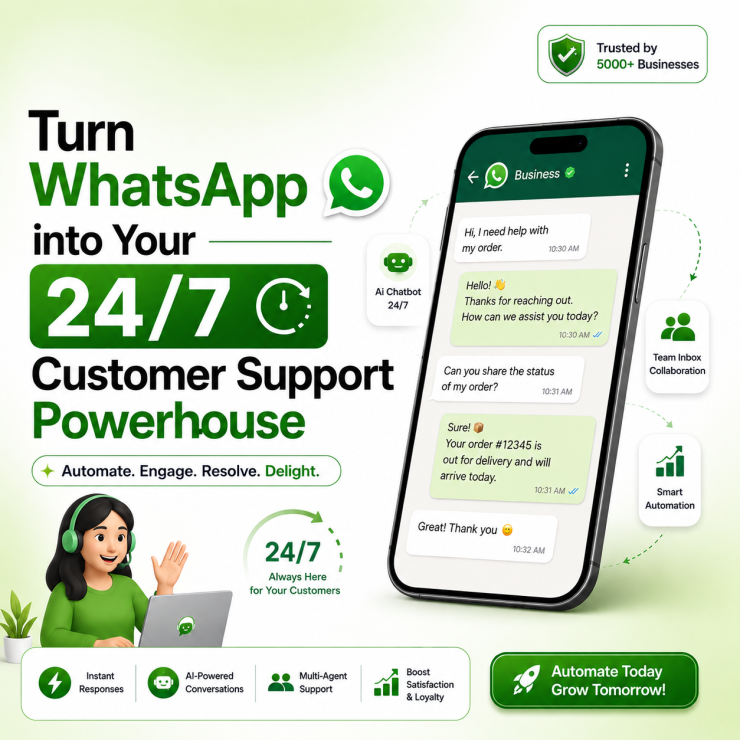
Customer service expectations have changed dramatically over the last few years. Customers no longer want to wait hours for email responses or stay on hold during support calls. They expect quick, convenient, and personalized communication through channels they already use daily. This shift is one of the main reasons businesses are increasingly adopting WhatsApp for customer service.
With billions of active users globally, WhatsApp has evolved far beyond personal messaging. It is now a critical customer communication channel for businesses looking to improve support responsiveness, reduce operational friction, and deliver a more conversational customer experience.
However, using WhatsApp effectively for support requires more than simply replying from a mobile phone. As customer conversations scale, businesses need automation, team collaboration, CRM integration, workflow management, and structured communication systems.
This is where platforms like Picky Assist help businesses operationalize WhatsApp customer support through automation, centralized communication management, and scalable customer engagement workflows.
Why Are Businesses Using WhatsApp for Customer Service?
Traditional support channels often create delays, fragmented communication, and inconsistent customer experiences. WhatsApp changes this by enabling businesses to communicate with customers in a faster and more familiar environment. Businesses are increasingly using WhatsApp because it allows them to:
- Respond to customer inquiries quickly
- Centralize communication workflows
- Reduce missed messages
- Improve customer engagement
- Automate repetitive support tasks
- Share rich media instantly
- Maintain conversational continuity
- Support customers on mobile-first channels
Unlike traditional ticketing systems that often feel transactional, WhatsApp creates a more natural communication experience. For many businesses, this directly impacts customer satisfaction and operational efficiency.
What Makes WhatsApp Effective for Customer Support?
Real-Time Communication
Customers prefer immediate responses, especially when they need support related to payments, appointments, deliveries, onboarding, or technical issues. WhatsApp allows businesses to respond in real time while maintaining conversational context.
Familiar User Experience
Customers already know how to use WhatsApp.
This reduces friction because users do not need to:
- Download additional apps
- Learn new systems
- Navigate complex support portals
The communication experience feels simple and accessible.
Multimedia Support
Customer support often requires more than text responses.
Businesses can share:
- Images
- PDFs
- Videos
- Voice notes
- Product guides
- Screenshots
- Payment confirmations
- Location details
This improves issue resolution speed significantly.
Better Customer Engagement
Compared to traditional email communication, messaging platforms often see stronger engagement and faster response rates. Businesses can maintain ongoing conversations rather than isolated support interactions.
WhatsApp Business App vs WhatsApp API for Customer Service
Many businesses initially start with the WhatsApp Business App. While suitable for small operations, it becomes limiting as support volume grows.
WhatsApp Business App
The app works well for:
- Small teams
- Low message volumes
- Basic customer communication
However, limitations include:
- Single-device constraints
- Limited automation
- Minimal reporting
- No advanced workflow management
- Restricted team collaboration
WhatsApp Business API
The WhatsApp Business API is designed for scalable business communication.
It supports:
- Multi-agent access
- CRM integration
- Chatbot automation
- Workflow automation
- Shared team inboxes
- Advanced analytics
- Broadcast messaging
- Scalable customer support operations
Businesses handling high inquiry volumes typically require API-based infrastructure to manage customer communication efficiently. Picky Assist helps businesses implement these workflows without requiring complex development resources.
How Picky Assist Helps Businesses Manage WhatsApp Customer Support?
Many businesses require more than simple messaging functionality. Picky Assist helps businesses centralize and automate customer communication through:
- Shared team inboxes
- No-code chatbot builder
- CRM workflows
- Broadcast messaging
- Multi-channel communication management
- Lead management automation
- Conversational workflow automation
- Integration capabilities
Shared Team Inbox
As support teams grow, businesses need multiple agents to handle conversations simultaneously. A shared inbox allows:
- Team collaboration
- Conversation assignment
- Internal notes
- Department-based routing
- Response tracking
Without this structure, customer communication becomes difficult to manage at scale.
Chatbot Automation
Not every inquiry requires human intervention. However an AI chatbot can help here! Businesses can automate repetitive queries such as:
- Order status requests
- Appointment confirmations
- FAQ responses
- Lead qualification
- Basic troubleshooting
- Payment reminders
Automation helps reduce response delays while allowing support teams to focus on complex conversations. Picky Assist includes no-code chatbot workflow capabilities that help businesses automate customer engagement without extensive technical setup.
CRM Integration
Support conversations become significantly more valuable when integrated with customer data. CRM synchronization allows businesses to:
- Track customer history
- Monitor lead stages
- View past interactions
- Personalize responses
- Improve support continuity
This creates a more connected customer experience.
Workflow Automation
Businesses increasingly use WhatsApp as part of broader operational workflows. Examples include:
- Ticket escalation
- Automated reminders
- Follow-up sequences
- Customer onboarding
- Feedback collection
- Internal notifications
Automation reduces manual workload while improving consistency.
Industries Benefiting From WhatsApp for Customer Service
Healthcare
Healthcare providers use WhatsApp for:
- Appointment reminders
- Patient inquiries
- Follow-up communication
- Report sharing
- Support coordination
Education
Educational institutions often manage:
- Admission inquiries
- Student communication
- Fee reminders
- Class updates
- Parent engagement
WhatsApp simplifies communication across these workflows.
Real Estate
Real estate businesses use WhatsApp to:
- Qualify leads
- Schedule site visits
- Share property documents
- Provide project updates
- Coordinate follow-ups
eCommerce
Online businesses use WhatsApp for:
- Order confirmations
- Delivery updates
- Cart recovery
- Customer support
- Return management
Financial Services
Banks, lenders, and fintech companies increasingly use WhatsApp for:
- Customer onboarding
- Payment reminders
- Document collection
- Service updates
- Customer assistance
Common Challenges in WhatsApp Customer Support
While WhatsApp offers major advantages, businesses often face operational challenges without the right infrastructure.
High Conversation Volume
As inquiries increase, manual handling becomes inefficient. Businesses need:
- Automation
- Conversation routing
- Queue management
- Team collaboration tools
Fragmented Communication
Using personal devices or disconnected systems creates operational risk. Important customer conversations can easily become:
- Missed
- Duplicated
- Delayed
- Difficult to track
Centralized management becomes essential.
Lack of Workflow Visibility
Without structured systems, managers struggle to monitor:
- Response times
- Agent productivity
- Customer satisfaction
- Resolution efficiency
This limits scalability.
Best Practices for Using WhatsApp for Customer Service
Respond Quickly
Speed matters significantly in messaging-based support.
Businesses should aim to:
- Acknowledge inquiries immediately
- Use automation for first responses
- Route conversations efficiently
Even automated acknowledgments improve customer perception.
Personalize Conversations
Customers expect conversational communication, not robotic messaging. Businesses should:
- Use customer names
- Reference previous interactions
- Maintain contextual continuity
This creates a stronger customer experience.
Avoid Over-Automation
Automation should improve support, not replace human connection entirely. Businesses should carefully balance:
- AI automation
- Human escalation
- Personalized assistance
Customers still expect human support for complex issues.
Organize Support Workflows
Structured workflows improve scalability. Businesses should define:
- Support categories
- Escalation paths
- Response ownership
- SLA management
- Follow-up procedures
WhatsApp for Customer Service and Customer Experience Strategy
Customer support is no longer viewed as a standalone operational department. It directly impacts:
- Brand perception
- Customer retention
- Revenue growth
- Customer loyalty
- Sales conversion
- Operational efficiency
Businesses increasingly view messaging platforms as part of broader customer experience strategies rather than isolated support channels. WhatsApp supports this shift because communication feels:
- Immediate
- Conversational
- Accessible
- Mobile-friendly
- Personalized
For many businesses, this creates measurable improvements in customer engagement quality.
Is WhatsApp Customer Support Suitable for Small Businesses?
Yes. Small businesses often benefit significantly because WhatsApp reduces communication barriers while enabling faster customer interaction. Even with limited teams, businesses can:
- Automate common inquiries
- Organize conversations
- Improve responsiveness
- Centralize customer communication
As the business grows, API-based infrastructure and automation tools can scale accordingly.
Conclusion
WhatsApp for customer service is no longer simply an optional communication channel. For many businesses, it has become a central part of customer engagement strategy.
However, effective implementation requires more than basic messaging access. Businesses need structured workflows, automation capabilities, team collaboration systems, CRM integration, and scalable communication management.
Platforms like Picky Assist help businesses operationalize WhatsApp customer support through centralized communication infrastructure designed for modern customer engagement requirements.
As customer expectations continue shifting toward faster and more conversational support experiences, businesses that invest in scalable messaging workflows will be better positioned to improve responsiveness, operational efficiency, and long-term customer relationships.
FAQs on WhatsApp for Customer Service
1. Why do businesses use WhatsApp for customer service?
Businesses use WhatsApp because it enables fast, conversational, and convenient customer communication while improving response efficiency and customer engagement.
2. Is WhatsApp suitable for customer support teams?
Yes. WhatsApp works well for customer support teams, especially when combined with shared inboxes, automation workflows, and CRM integration capabilities.
3. What is the difference between WhatsApp Business App and WhatsApp API?
The WhatsApp Business App is suitable for small-scale communication, while the API supports advanced automation, multi-agent access, workflow management, and scalable support operations.
4. Can WhatsApp customer support be automated?
Yes. Businesses can automate FAQs, appointment reminders, lead qualification, order updates, and customer workflows using chatbot and automation systems.
5. How does WhatsApp improve customer experience?
WhatsApp improves customer experience by enabling faster responses, personalized conversations, mobile-friendly communication, and easier customer engagement.
6. Can WhatsApp integrate with CRM systems?
Yes. WhatsApp API platforms often support CRM integration, allowing businesses to synchronize customer conversations, lead information, and support workflows.
7. Is WhatsApp customer service secure for businesses?
Official WhatsApp Business API solutions provide structured business communication environments with better operational control and compliance support compared to informal messaging methods.
8. How can Picky Assist help businesses manage WhatsApp customer support?
Picky Assist helps businesses centralize customer communication through automation tools, chatbot workflows, shared team inboxes, CRM integrations, and conversational workflow management.
Add comment