
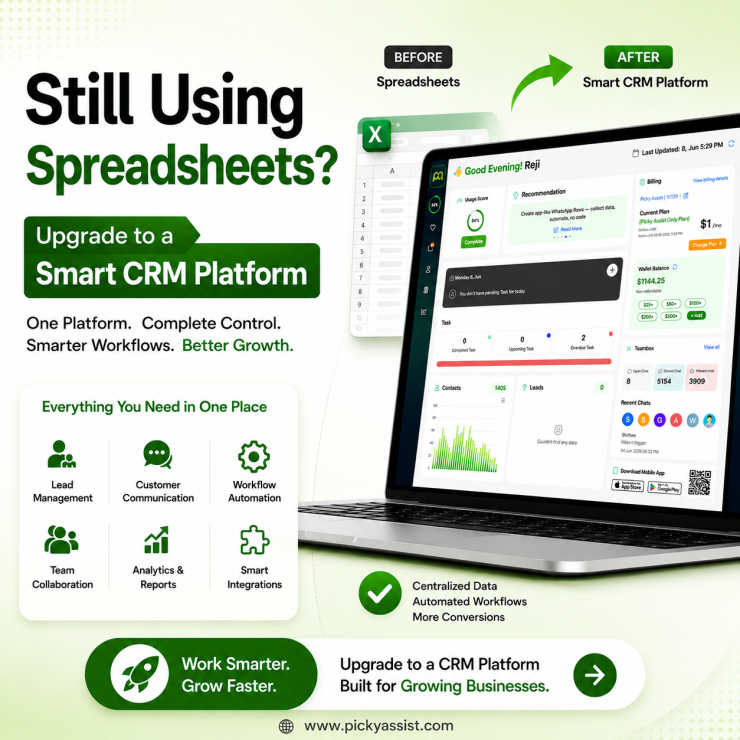
Businesses still rely on disconnected tools, spreadsheets, messaging apps, and manual processes to manage daily operations. As customer expectations rise and competition intensifies, these fragmented systems create inefficiencies that slow growth and reduce productivity. This is why many organizations are investing in a business management platform.
A modern business management platform helps businesses centralize customer data, automate workflows, improve team collaboration, and create structured processes that scale efficiently. Instead of switching between multiple applications, teams can work from a unified environment designed to streamline operations and customer engagement.
In this guide, we’ll explore what a business management platform is, why businesses need one, the features that matter most, how automation is transforming business operations, and how Picky Assist helps organizations manage customer interactions and workflows more effectively.
What is a Business Management Platform?
A business management platform is a centralized system that helps organizations manage core business processes, customer interactions, communication workflows, and operational activities from a single environment.
Rather than using separate tools for lead management, customer communication, team collaboration, and workflow automation, businesses can bring these functions together into one connected system.
Depending on business requirements, a platform may support:
- Customer relationship management
- Lead tracking
- Communication management
- Workflow automation
- Team collaboration
- Customer support processes
- Reporting and analytics
- Customer engagement campaigns
The goal is to improve efficiency, visibility, and consistency across business operations.
Why Do Businesses Outgrow Disconnected Systems?
Many companies begin with simple tools. A spreadsheet tracks leads. WhatsApp handles customer communication. Emails manage follow-ups. Different teams use separate software for specific tasks. Initially, this may seem manageable. However, as customer volumes increase, operational challenges emerge. Common issues include:
- Lost customer information
- Delayed responses
- Missed follow-ups
- Duplicate records
- Limited visibility into customer journeys
- Poor collaboration between teams
- Inefficient manual processes
Over time, these inefficiencies can directly impact customer experience and revenue opportunities. A business management solution addresses these challenges by creating a structured operational framework.
Components of an Effective Business Management Platform
Not all platforms are designed the same way. The most effective solutions combine operational management with customer engagement capabilities.
Centralized Customer Data
Customer information should not be scattered across multiple systems.
A centralized database helps teams access:
- Contact details
- Communication history
- Lead status
- Customer interactions
- Team notes
- Activity records
This creates a complete view of every customer relationship.
Lead Management
Every enquiry represents a potential opportunity. A platform should help businesses:
- Capture leads automatically
- Organize opportunities
- Track lead progress
- Assign ownership
- Monitor conversions
Structured lead management improves visibility throughout the sales process.
Communication Management
Customer communication increasingly happens across multiple channels. Businesses need a system that supports:
- Website enquiries
- Social media interactions
Managing conversations centrally improves consistency and responsiveness.
Workflow Automation
Many daily business activities are repetitive. Automation helps reduce manual effort by handling tasks such as:
- Lead assignment
- Follow-up reminders
- Appointment scheduling
- Customer onboarding
- Status updates
Automation allows teams to focus on higher-value activities.
How Business Management Software Improves Operational Efficiency?
Operational efficiency is often the primary reason organizations invest in business software. Without structured processes, teams spend excessive time on administrative work. Examples include:
- Manually updating records
- Tracking conversations across channels
- Assigning leads
- Sending reminders
- Coordinating customer follow-ups
Business management software helps standardize these processes. As a result, organizations can improve productivity without increasing complexity.
The Growing Role of AI Automation in Business Management
Artificial intelligence is reshaping how businesses operate. Instead of simply automating repetitive tasks, AI automation introduces intelligence into workflows. For example, AI can help businesses:
- Respond to customer enquiries instantly
- Categorize incoming requests
- Qualify leads automatically
- Trigger workflow actions
- Route conversations appropriately
This enables faster responses and more efficient customer engagement. Importantly, AI should support operational efficiency while maintaining meaningful customer experiences.
AI CRM Automation and Customer Lifecycle Management
Customer relationship management becomes significantly more powerful when automation is integrated into the process. AI CRM automation helps businesses:
- Capture customer information automatically
- Track customer interactions
- Segment audiences
- Trigger personalized communication
- Support lead nurturing workflows
Instead of relying solely on manual actions, businesses can create automated customer journeys that adapt to customer behavior. This improves consistency while reducing administrative workload.
Why is Customer Communication Central to Modern Business Management?
Customer communication is no longer a standalone function. It has become a core operational process. Every customer interaction generates valuable information. Businesses that effectively manage these interactions gain better visibility into customer needs, preferences, and opportunities. A modern management platform should therefore connect communication channels with operational workflows. This allows businesses to:
- Respond faster
- Track engagement
- Improve customer service
- Support sales activities
- Maintain complete interaction histories
Communication becomes part of the business management strategy rather than an isolated activity.
How Conversational AI Automation Supports Business Operations?
Businesses increasingly rely on messaging channels for customer engagement. Customers prefer channels that are fast, familiar, and convenient. Conversational AI automation enables organizations to automate interactions while maintaining a natural communication experience. Examples include:
- Answering frequently asked questions
- Capturing lead information
- Scheduling appointments
- Providing service updates
- Collecting customer feedback
By automating routine conversations, businesses can improve responsiveness without increasing staffing requirements.
What Small Businesses Should Look for in a Management Platform?
Small businesses often face unique operational challenges. Resources are limited, teams wear multiple hats, and customer engagement remains critical. When evaluating a platform, businesses should prioritize:
Ease of Use
The platform should be easy to implement and manage.
Automation Capabilities
Workflow automation helps reduce repetitive tasks.
Communication Integration
Customer conversations should connect directly to business processes.
Scalability
The solution should support future growth.
Customer Visibility
Teams should have access to a complete customer history. For many growing organizations, these factors are more important than having the longest feature list.
Why Client Management Matters for Growing Businesses?
Managing customer relationships effectively becomes increasingly difficult as businesses grow.
Many organizations begin searching for client management software for small businesses when they realize manual tracking methods are no longer sustainable.
A structured customer management system helps businesses:
- Maintain accurate records
- Improve follow-up consistency
- Track customer interactions
- Reduce missed opportunities
- Deliver better customer experiences
Strong client management practices often contribute directly to improved retention and revenue growth.
How Picky Assist Functions as a Modern Business Management Solution?
Picky Assist helps businesses centralize customer engagement, communication workflows, and relationship management processes. Rather than operating across disconnected systems, organizations can manage customer interactions through a unified platform. Key capabilities include:
Centralized CRM
Manage customer information, interactions, and lead records from an All-in-One CRM platform
WhatsApp Automation
Automate customer communication and engagement workflows through WhatsApp.
No-Code Chatbot Builder
Create automated conversational experiences without extensive technical resources just with no-code chatbot or flow builder.
Workflow Automation
Automate repetitive operational tasks and customer engagement processes.
Customer Segmentation
Organize customers into meaningful groups for targeted communication.
Broadcast Campaigns
Deliver personalized communication to selected customer segments with automated broadcaster.
Team Collaboration
Provide shared visibility into customer interactions and engagement activities. These capabilities help businesses streamline customer-facing operations while maintaining greater control over customer journeys.
Evaluating the Best CRM Platforms and Management Systems
When comparing solutions, businesses should focus on business outcomes rather than feature counts. Important evaluation criteria include:
Customer Communication Support
Can the platform manage customer conversations effectively?
Workflow Automation
Does it automate repetitive processes?
CRM Functionality
Can it organize and manage customer relationships?
Integration Capabilities
Does it connect with existing systems?
Reporting and Analytics
Can teams measure performance and identify opportunities?
User Adoption
Will employees actually use the platform consistently? The best CRM platforms and management systems are those that align with operational goals and customer engagement strategies.
Conclusion
A business management platform helps organizations move beyond fragmented tools and manual processes by centralizing customer engagement, workflow automation, and operational visibility.
Instead of managing customer relationships, communication channels, and internal processes separately, businesses can create a more connected and scalable operational framework.
As automation and customer engagement become increasingly important to growth, businesses need solutions that support both efficiency and customer experience.
Picky Assist helps organizations achieve this by combining CRM functionality, WhatsApp automation, workflow automation, customer engagement tools, and conversational experiences within a centralized platform designed for modern business operations.
FAQs on Business Management Platform
1. What is a business management platform?
A business management platform is a centralized system that helps businesses manage customer relationships, communication workflows, operational processes, and team activities from a single environment.
2. How is a business management platform different from a CRM?
A CRM focuses primarily on managing customer relationships and sales activities. A business management platform typically includes CRM functionality while also supporting automation, communication management, collaboration, and operational workflows.
3. Why do businesses need a business management solution?
Businesses use these platforms to improve efficiency, reduce manual work, centralize customer information, automate workflows, and create better customer experiences.
4. How does AI automation improve business management?
AI automation helps businesses automate customer interactions, lead qualification, workflow execution, and communication processes, allowing teams to work more efficiently.
5. What industries benefit from business management software?
Industries such as travel, education, healthcare, real estate, financial services, ecommerce, and professional services often benefit from centralized operational management and customer engagement capabilities.
6. What features should businesses look for in a management platform?
Important features include CRM functionality, workflow automation, communication management, reporting, customer segmentation, team collaboration, and scalability.
7. Is a business management platform suitable for small businesses?
Yes. Small businesses often benefit significantly because these platforms help reduce manual work, improve organization, and support growth without requiring large teams.
8. How does Picky Assist help businesses manage customer engagement?
Picky Assist helps businesses centralize customer interactions, automate communication through WhatsApp, manage leads, build chatbot workflows, automate customer journeys, and improve operational efficiency.



Add comment