
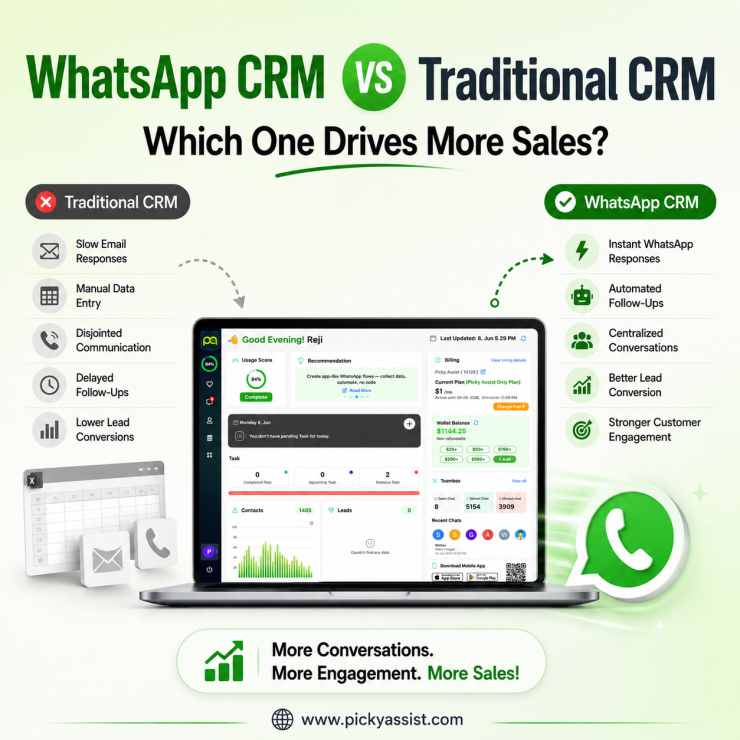
Customer relationships have changed dramatically. Earlier, businesses depended on phone calls, emails, spreadsheets, and disconnected systems to manage conversations. Today, customers expect faster responses, personalized interactions, and support through the channels they already use every day. For many businesses, that channel is WhatsApp. This shift has created a major discussion around WhatsApp CRM vs Traditional CRM.
While traditional CRM systems helped companies organize customer data, manage sales pipelines, and track interactions, modern businesses now need solutions that connect customer conversations directly with business workflows.
A traditional CRM may store customer information effectively, but it often requires teams to switch between multiple tools to communicate, follow up, and close deals. A WhatsApp-focused approach combines customer relationship management with real-time messaging, automation, and conversational workflows.
The right choice depends on how a business interacts with customers, manages leads, and builds long-term relationships. This guide explains the difference between these two approaches, their strengths, limitations, and how businesses can choose the right solution for their growth.
What is a Traditional CRM?
A traditional CRM (Customer Relationship Management) system is designed to help businesses organize customer information and manage sales, marketing, and support activities.
It usually provides features such as:
- Contact management
- Sales pipeline tracking
- Customer history
- Task management
- Reports and analytics
- Team collaboration
Traditional CRMs became essential because businesses needed a structured way to move away from scattered customer records and manual tracking.
For example, a sales team can use a CRM to record:
- Customer name and details
- Previous purchases
- Sales stage
- Follow-up dates
- Communication notes
This creates visibility across teams and helps businesses make better decisions.
However, many traditional systems were built around email, forms, and manual updates. As customer communication moved toward instant messaging, businesses started looking for more connected solutions.
What is a WhatsApp CRM?
A WhatsApp CRM combines CRM capabilities with WhatsApp-based customer communication. Instead of treating messaging as a separate activity, it connects conversations, customer data, automation, and sales processes in one environment. A modern CRM for WhatsApp business helps companies manage customer conversations while maintaining complete customer context. With this approach, businesses can:
- Capture leads from WhatsApp
- Automate responses
- Assign conversations to team members
- Track customer journeys
- Follow up automatically
- Maintain conversation history
A WhatsApp CRM tool becomes especially useful for businesses where customer interactions happen frequently through chat. Industries such as real estate, education, healthcare, travel, retail, automotive, and service businesses often rely heavily on messaging-based communication.
WhatsApp CRM vs Traditional CRM: Know the Key Differences
Understanding the difference between these two systems helps businesses choose technology that matches customer expectations.
| Feature | Traditional CRM | WhatsApp CRM |
|---|---|---|
| Primary communication | Email, calls, forms | WhatsApp conversations |
| Customer engagement | Often manual | Real-time and conversational |
| Lead capture | Forms and imports | Direct chat-based capture |
| Follow-ups | Task-based reminders | Automated conversational follow-ups |
| Team collaboration | CRM dashboard | Shared inbox + CRM workflow |
| Customer experience | Process-driven | Conversation-driven |
A traditional CRM focuses mainly on managing customer records. A WhatsApp-based CRM focuses on managing customer relationships through active conversations.
Customer Communication: The Biggest Difference
Communication is where the gap becomes most visible. Traditional CRM systems usually store communication history after an interaction happens. Teams may need to open another application, send an email, or make a call. A CRM with WhatsApp allows businesses to manage conversations where customers are already active.
For example:
A customer enquires about a property on WhatsApp. With a traditional setup:
- The enquiry may be manually added into the CRM
- A salesperson receives a task
- Follow-up happens later
With an integrated approach:
- The enquiry enters the system immediately
- Customer details can be captured
- Automated responses can answer common questions
- The sales team can continue the conversation with full context
This reduces delays and improves customer experience.
Automation Capabilities: Manual Processes vs Smart Workflows
Automation has become a major factor when comparing CRM platforms. Traditional CRMs often automate internal activities such as:
- Assigning tasks
- Updating sales stages
- Generating reports
A WhatsApp-focused CRM extends automation into customer conversations.
Businesses can create workflows for:
- New enquiry responses
- Appointment reminders
- Order updates
- Lead qualification
- Customer follow-ups
A WhatsApp CRM software solution helps businesses create structured customer journeys instead of relying only on manual replies.
For example, when someone asks about a service, an automated flow can collect requirements, identify intent, and route the conversation to the right team member.
Sales Team Productivity: Which CRM Supports Faster Conversions?
Sales teams today need more than customer records. They need speed, visibility, and context. A traditional CRM gives salespeople information about customers. A connected messaging CRM helps salespeople act on that information instantly.
A CRM WhatsApp integration can help sales teams:
- View customer history
- Respond faster
- Avoid duplicate conversations
- Track lead status
- Collaborate internally
This is especially valuable for businesses handling hundreds or thousands of customer conversations. When customers expect immediate answers, slow follow-ups can directly impact conversion rates.
Customer Experience and Personalization
Customers rarely think about which software a business uses. They care about:
- How quickly they receive a response
- Whether the business remembers their needs
- Whether communication feels personalized
Traditional CRM systems help store customer information, but businesses still need a communication layer.
A CRM with WhatsApp integration connects customer profiles with real conversations.
This enables businesses to deliver experiences such as:
- Personalized product recommendations
- Relevant follow-ups
- Context-aware support
- Faster issue resolution
Instead of asking customers to repeat information, teams can continue conversations with better understanding.
Managing Multiple Customer Conversations
One challenge businesses face is handling large volumes of messages. A normal WhatsApp Business account may become difficult to manage when multiple employees handle customer queries. A WhatsApp-focused system provides a structured approach by offering:
- Shared team access
- Conversation assignment
- Customer categorization
- Activity tracking
This transforms WhatsApp from a simple messaging channel into a business communication platform.
A WhatsApp business platform approach helps organizations manage conversations at scale while maintaining control over customer interactions.
Why Are Businesses Moving Toward WhatsApp-Based CRM Solutions?
Customer behavior is driving this change. People increasingly prefer messaging because it is:
- Quick
- Familiar
- Convenient
- Easy to access
Businesses that adapt their customer engagement strategy around these preferences can improve response times and build stronger relationships. A WhatsApp business CRM approach connects customer expectations with business operations. It helps companies move from reactive communication to proactive engagement.
Instead of waiting for customers to follow up, businesses can create structured journeys that guide customers from inquiry to purchase.
Where Traditional CRM Still Works Well?
Traditional CRM systems remain valuable for many business processes.
They are useful for:
- Complex sales pipelines
- Enterprise account management
- Forecasting
- Reporting
- Internal operations
The goal is not to replace every traditional CRM function.
Instead, businesses should evaluate whether their CRM supports the communication channels customers actually use. A hybrid approach can work well when companies need advanced CRM management along with messaging-based engagement.
Choosing the Right CRM Approach for Your Business?
When comparing solutions, consider these questions:
Where do most customer conversations happen?
If customers mainly communicate through WhatsApp, integrating that channel into your CRM can improve efficiency.
How much manual follow-up does your team handle?
If employees spend hours replying to repetitive questions, automation can reduce workload.
Do you have visibility into customer conversations?
A centralized system helps teams understand customer journeys.
Can your CRM support future growth?
The right platform should support increasing conversations, teams, and workflows.
For many growing businesses, choosing the best WhatsApp CRM means finding a platform that combines automation, CRM management, and customer communication without unnecessary complexity.
How Picky Assist Helps Businesses Build WhatsApp-Centered Customer Relationships?
Picky Assist helps businesses manage customer communication, automation, and CRM processes through connected workflows. Instead of handling conversations separately, businesses can organize customer interactions, automate responses, and support sales teams from one ecosystem.
With Picky Assist, businesses can:
- Manage customer conversations
- Build chatbot workflows
- Automate follow-ups
- Organize customer data
- Connect communication channels
- Improve team coordination
For companies searching for the best CRM with WhatsApp integration, the focus should be on creating smoother customer experiences while improving operational efficiency.
The right technology does not just store customer data. It helps businesses use that data to create meaningful interactions.
Conclusion
The comparison between WhatsApp CRM vs Traditional CRM comes down to how businesses want to engage with customers.
Traditional CRM systems provide strong customer management foundations, helping companies organize information and track business activities.
However, customer expectations have changed. Conversations now happen instantly, and businesses need tools that combine customer data with real-time engagement.
A WhatsApp-based CRM approach helps companies respond faster, automate repetitive tasks, and create personalized customer journeys.
For businesses where WhatsApp is a major communication channel, adopting a connected CRM strategy can improve productivity, customer satisfaction, and sales performance. Picky Assist helps businesses bring conversations, automation, and customer management together so teams can build stronger relationships at scale.
FAQs on WhatsApp CRM vs Traditional CRM
1. What is the difference between WhatsApp CRM and traditional CRM?
A traditional CRM mainly focuses on storing customer information, tracking sales activities, and managing internal workflows. A WhatsApp CRM connects customer conversations directly with CRM processes, allowing businesses to manage chats, automate responses, track leads, and maintain customer history in one place. A WhatsApp-focused approach helps businesses engage customers through the channel they already use while keeping customer data organized.
2. Is WhatsApp CRM better than traditional CRM for modern businesses?
It depends on how a business communicates with customers. Traditional CRM works well for managing customer records, sales pipelines, and reporting. However, businesses that receive frequent customer enquiries through WhatsApp can benefit from a CRM system that combines messaging, automation, and customer management.
3. Can WhatsApp CRM automate customer follow-ups?
Yes. A WhatsApp CRM can automate follow-ups based on customer actions, lead stages, or scheduled workflows. Businesses can create automated responses for enquiries, reminders, product updates, appointment confirmations, and sales conversations while allowing teams to step in when needed.
4. What features should businesses look for in a WhatsApp CRM?
A reliable WhatsApp CRM should include:
- Shared team inbox
- Customer conversation history
- Lead management
- Chatbot automation
- Workflow builder
- Analytics and reporting
- CRM integrations
These features help businesses manage conversations at scale.
5. Can WhatsApp CRM improve sales conversions?
Yes. By helping sales teams respond faster, track customer interactions, and automate repetitive tasks, WhatsApp CRM can improve lead management and customer engagement. Businesses can identify interested prospects and continue conversations with better context.
6. Does Picky Assist work as a WhatsApp CRM solution?
Yes. Picky Assist helps businesses manage WhatsApp conversations through automation workflows, chatbot creation, customer management features, and team collaboration tools. It helps businesses organize customer communication instead of handling every conversation manually.
7. Can WhatsApp CRM replace a traditional CRM?
Not always. Traditional CRM systems still provide value for advanced reporting, forecasting, and internal processes. However, businesses can combine CRM capabilities with WhatsApp communication to create a more connected customer experience.
8. Why are businesses moving toward WhatsApp-based CRM solutions?
Customers increasingly prefer instant messaging for communication. WhatsApp-based CRM solutions help businesses respond faster, personalize conversations, automate workflows, and manage customer relationships through a familiar communication channel.
Add comment