
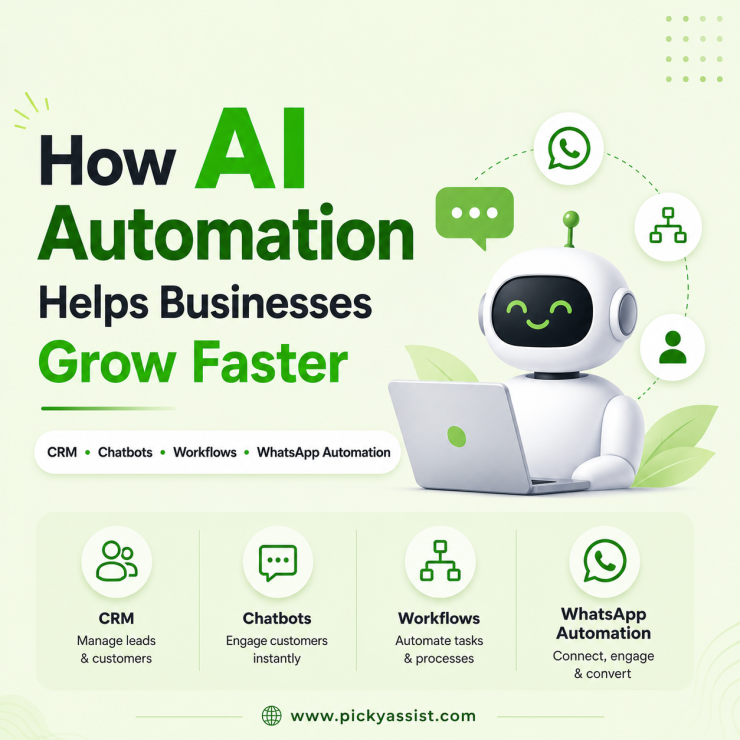
Traditional automation has helped reduce manual work, but it often relies on predefined rules and rigid workflows. Modern businesses require something more adaptive, automation that can understand customer intent, support decision-making, and streamline complex processes. This is where AI automation is creating a significant shift.
By combining artificial intelligence with workflow automation, businesses can automate customer interactions, improve lead management, streamline operations, and create more efficient customer journeys. Instead of simply completing repetitive tasks, AI-powered systems can help organizations engage customers intelligently and respond to business events in real time.
In this guide, we’ll explore what AI automation is, how it works, key business applications, practical implementation strategies, and how platforms like Picky Assist help businesses automate customer engagement through conversational channels and workflow-driven processes.
What is AI Automation?
AI automation refers to the use of artificial intelligence technologies to automate business activities that traditionally require human intervention. Unlike standard automation, which follows fixed instructions, AI-powered systems can analyze information, identify patterns, understand intent, and make contextual decisions within predefined business rules.
For example, instead of simply sending an automated message after a form submission, an AI-powered workflow can:
- Understand customer intent
- Qualify leads automatically
- Route enquiries to the appropriate team
- Trigger personalized follow-ups
- Recommend next actions
The result is a more intelligent and efficient approach to business operations.
Why is AI Automation Becoming a Business Priority?
Customer expectations have changed dramatically. Consumers now expect:
- Instant responses
- Personalized communication
- Consistent service experiences
- Availability across multiple channels
Meanwhile, businesses often struggle with:
- High enquiry volumes
- Manual follow-up processes
- Disconnected customer data
- Operational inefficiencies
- Limited visibility into customer journeys
Automation helps bridge these gaps by creating scalable processes that improve both operational efficiency and customer experience. Organizations can handle more interactions, maintain consistency, and reduce administrative workload without compromising service quality.
How AI Automation Differs from Traditional Automation?
Many businesses already use automation tools.
Examples include:
- Email autoresponders
- Scheduled reminders
- Rule-based workflow triggers
These systems are valuable but limited. Traditional automation follows predefined paths. AI automation introduces intelligence into those workflows. Consider a customer enquiry through WhatsApp. Traditional automation may simply send a canned response. An AI-driven system can:
- Interpret the question
- Identify customer intent
- Collect relevant information
- Guide the conversation
- Trigger appropriate business processes
This makes interactions more dynamic and relevant.
Benefits of AI Automation
Faster Customer Response Times
Speed often influences customer engagement and conversion opportunities. AI-powered systems can respond instantly to customer enquiries, regardless of business hours. This helps businesses maintain responsiveness while reducing delays.
Reduced Manual Work
Many operational activities consume valuable employee time. Examples include:
- Lead assignment
- Follow-up scheduling
- Customer data collection
- FAQ handling
- Appointment coordination
Automation reduces repetitive workloads and improves productivity.
Improved Customer Experience
Customers prefer timely and relevant interactions. AI-enabled systems help deliver consistent communication while maintaining context across customer journeys.
Better Lead Management
Leads can be captured, qualified, organized, and nurtured automatically. This reduces lead leakage and improves sales process visibility.
Increased Scalability
As businesses grow, customer interactions increase. AI allows organizations to scale engagement without proportionally increasing operational costs.
Connecting Processes Across the Customer Journey
Modern customer journeys involve multiple touchpoints. A customer may:
- Visit a website.
- Submit an enquiry.
- Continue the conversation on WhatsApp.
- Request additional information.
- Schedule a consultation.
- Receive follow-up communication.
Managing these interactions manually can become difficult. AI workflow automation helps businesses connect these touchpoints through automated processes. Actions can be triggered based on customer behavior, engagement levels, or business rules. This creates a more organized and efficient customer experience.
How AI Process Automation Improves Business Operations?
Businesses often associate automation with customer service, but operational efficiency is equally important. Automation helps streamline repetitive business functions. Examples include:
Lead Routing
Automatically assign enquiries to the right team members.
Customer Segmentation
Categorize contacts based on interests, engagement, or behavior.
Appointment Scheduling
Automate confirmations, reminders, and follow-up communication.
Workflow Management
Coordinate actions across multiple departments and business processes.
Data Collection
Capture customer information through automated interactions. These capabilities help reduce operational bottlenecks and improve consistency.
The Rise of AI Marketing Automation
Marketing teams increasingly rely on automation to engage audiences at scale. However, traditional marketing automation often focuses primarily on email campaigns. AI marketing expands these capabilities. Businesses can:
- Deliver personalized messaging
- Trigger campaigns based on customer behavior
- Segment audiences dynamically
- Automate customer journeys
- Improve engagement timing
When customer data and communication channels are connected, marketing becomes more relevant and efficient.
Conversational AI Automation and the Shift Toward Messaging Channels
Customer communication has evolved. Many consumers now prefer messaging channels over traditional communication methods. Platforms such as WhatsApp provide faster, more convenient interactions. Conversational automation helps businesses manage these interactions efficiently. Instead of requiring customers to navigate forms or wait for responses, businesses can automate conversations that:
- Answer questions
- Capture lead information
- Schedule appointments
- Share updates
- Guide customers through processes
AI CRM Automation: Turning Customer Data into Action
Customer data becomes significantly more valuable when connected to automation. AI CRM automation helps businesses move beyond record keeping and create actionable customer journeys.
For example: When a customer submits an enquiry. The system can automatically:
- Create a CRM record
- Capture interaction history
- Assign ownership
- Trigger follow-up workflows
- Segment the customer
- Schedule future communication
Everything becomes centralized and trackable. This helps businesses improve visibility while maintaining stronger customer relationships.
Why Small Businesses are Adopting AI-Powered CRM Solutions?
Many small businesses previously assumed automation was only for large enterprises. That is no longer the case. Modern platforms make automation accessible without requiring extensive technical expertise.
Organizations searching for client management software for small businesses often discover that automation significantly improves operational efficiency.
How can Automation help Smaller Teams Achieve more with Existing Resources?
Evaluating AI Automation Platforms
Not all automation solutions are designed for the same purpose. Businesses should evaluate platforms based on operational requirements. Important considerations include:
Communication Channels
Does the platform support WhatsApp and other customer communication channels?
CRM Integration
Can customer interactions be connected to customer records?
Workflow Flexibility
Can workflows be customized to fit business processes?
Reporting and Analytics
Can teams measure performance and optimize engagement?
Ease of Use
Can non-technical teams build and manage automation? The most effective solutions balance functionality with usability.
How Picky Assist Supports AI Automation
Picky Assist helps businesses automate customer engagement, lead management, and communication workflows through a centralized platform. The solution combines CRM capabilities, conversational automation, workflow automation, and customer communication tools. Key capabilities include:
WhatsApp Automation
Automate customer conversations, follow-ups, notifications, and engagement workflows.
AI-Powered Chatbot Workflows
Create automated customer journeys using a no-code chatbot builder.
CRM-Based Customer Management
Organize leads, customer records, and interaction history within a centralized environment.
Customer Segmentation
Group contacts based on business requirements and engagement patterns.
Broadcast Campaign Management
Deliver targeted communication to specific customer segments.
Workflow Automation
Automate repetitive operational processes across the customer lifecycle. By combining communication channels with automation and CRM functionality, Picky Assist helps businesses create scalable customer engagement systems.
Conclusion
AI automation has evolved from a productivity tool into a core business capability. Organizations can now automate customer interactions, streamline workflows, improve lead management, and create more personalized customer experiences without adding operational complexity.
As customer expectations continue to rise, businesses need solutions that connect communication, customer data, and workflow automation into a unified system.
Picky Assist supports this transformation by helping organizations automate customer engagement through CRM-driven workflows, WhatsApp automation, chatbot experiences, and customer journey automation.
For businesses seeking greater efficiency, stronger customer relationships, and scalable growth, AI-powered automation is becoming an essential part of modern operations.
FAQs on AI Automation
1. What is AI automation?
AI automation uses artificial intelligence to automate business tasks and workflows that typically require human involvement, helping organizations improve efficiency, responsiveness, and scalability.
2. How is AI automation different from traditional automation?
Traditional automation follows predefined rules. AI automation can analyze information, understand customer intent, and make context-based decisions within automated workflows.
3. What are the primary benefits of AI automation?
Benefits include faster response times, reduced manual work, improved customer experiences, better lead management, greater scalability, and enhanced operational efficiency.
4. What is AI workflow automation?
AI workflow automation connects business processes and customer interactions through intelligent workflows that automatically trigger actions based on predefined conditions and customer behavior.
5. How does AI CRM automation help businesses?
AI CRM automation combines customer relationship management with intelligent workflows to automate lead capture, customer segmentation, follow-ups, communication, and customer journey management.
6. What is conversational AI automation?
Conversational AI automation enables businesses to automate customer interactions through messaging channels such as WhatsApp using intelligent conversational workflows.
7. Can small businesses benefit from AI automation?
Yes. Small businesses often use automation to reduce administrative work, improve customer management, increase productivity, and scale operations more efficiently.
8. How does Picky Assist support AI automation?
Picky Assist helps businesses automate customer engagement through WhatsApp automation, CRM management, chatbot workflows, customer segmentation, broadcast campaigns, and workflow automation tools.

Add comment