
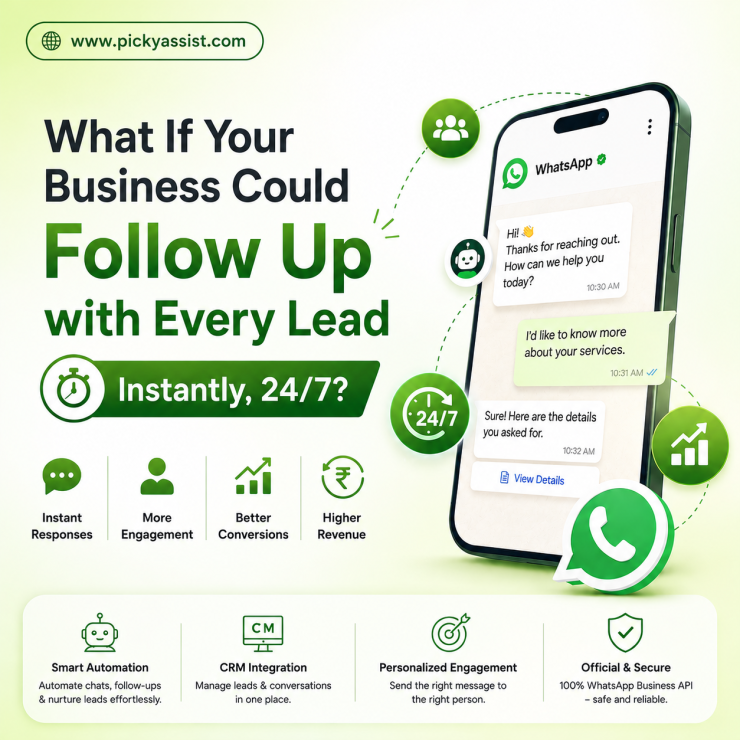
Today Email inboxes are crowded, social media algorithms continue to evolve, and traditional SMS campaigns often struggle to capture attention. Meanwhile, WhatsApp has become one of the most frequently used communication channels for both personal and business interactions. As customer expectations shift toward instant, conversational engagement, businesses are increasingly looking for a reliable WhatsApp marketing platform in India to manage customer communication, automate engagement, and improve conversion rates.
However, choosing the right platform involves more than simply sending messages. Businesses need tools that support customer acquisition, lead nurturing, CRM integration, automation, analytics, and team collaboration while complying with WhatsApp’s official policies.
This guide explores what a WhatsApp marketing platform is, why Indian businesses are investing in it, the features that matter most, and how solutions like Picky Assist help organizations build scalable customer engagement systems.
Why has WhatsApp Become a Critical Business Channel in India?
India has one of the world’s largest WhatsApp user bases. Customers already use the platform daily to communicate with family, friends, service providers, and businesses. This creates a significant opportunity.
Instead of asking customers to download another app or monitor email inboxes, businesses can communicate through a channel customers already trust and actively use. For businesses, this means:
- Faster customer responses
- Higher engagement rates
- More personalized communication
- Improved customer experience
- Better lead nurturing opportunities
As a result, WhatsApp marketing in India has become a strategic communication channel rather than simply a messaging tool.
What is a WhatsApp Marketing Platform?
A WhatsApp marketing platform helps businesses manage customer communication, automate workflows, organize contacts, and execute messaging campaigns using WhatsApp.
Unlike the standard WhatsApp Business App, a business-focused platform offers advanced capabilities such as:
- Customer database management
- CRM integration
- Campaign automation
- Team collaboration
- Chatbot workflows
- Lead tracking
- Analytics and reporting
The goal is not merely sending messages. It is creating structured customer journeys that support sales, marketing, and customer service objectives.
How Businesses Use WhatsApp Marketing Today?
Modern businesses use WhatsApp across multiple stages of the customer lifecycle.
Lead Generation
Businesses collect leads through:
- Website forms
- Landing pages
- Social media campaigns
- Facebook Lead Ads
- Referral programs
The lead can then be automatically engaged through WhatsApp.
Customer Nurturing
Not every prospect is ready to purchase immediately. Businesses use automated follow-ups to educate prospects, answer questions, and maintain engagement until customers are ready to make a decision.
Customer Support
Customers increasingly expect quick support responses.
WhatsApp provides a convenient communication channel for resolving queries, sharing updates, and improving customer satisfaction.
Retention and Re-engagement
Existing customers can receive reminders, updates, renewal notifications, and personalized offers through structured messaging workflows.
What Features Should a WhatsApp Marketing Platform in India Include?
Not all platforms offer the same capabilities. Businesses should evaluate solutions based on operational requirements rather than messaging volume alone.
CRM Integration
Customer conversations become significantly more valuable when connected to CRM data.
Teams can view:
- Customer history
- Previous interactions
- Lead status
- Sales activities
This creates a more complete customer view.
Marketing Automation
Automation helps businesses scale communication without increasing manual effort. For example:
- Welcome messages
- Lead nurturing sequences
- Appointment reminders
- Follow-up campaigns
Effective WhatsApp marketing depends heavily on automation capabilities.
Chatbot Workflows
Chatbots can handle common customer interactions while collecting information and qualifying leads.
Businesses can automate:
- FAQs
- Lead capture
- Appointment requests
- Product enquiries
Team Collaboration
As businesses grow, multiple departments often need access to customer conversations. Shared inboxes and collaboration tools improve visibility and accountability.
Campaign Management
The platform should support structured campaign execution while maintaining compliance with WhatsApp policies. This is particularly important when running a large-scale WhatsApp campaign strategy.
WhatsApp Business Marketing vs Traditional Digital Marketing
Traditional digital marketing often relies on one-way communication. Businesses publish content or advertisements and hope customers respond. In contrast, WhatsApp business marketing creates direct, two-way conversations. Customers can:
- Ask questions
- Request information
- Confirm appointments
- Complete purchases
- Receive support
This conversational approach often creates stronger customer relationships. Moreover, WhatsApp advertising efforts can become significantly more effective when advertisements direct prospects into automated WhatsApp journeys instead of generic landing pages.
Common Use Cases Across Industries
Real Estate
Real estate businesses use WhatsApp to:
- Qualify enquiries
- Share property details
- Schedule site visits
- Follow up with prospects
Education
Educational institutions use the platform to:
- Manage admissions enquiries
- Share course information
- Send reminders
- Engage prospective students
Healthcare
Healthcare providers leverage WhatsApp for:
- Appointment booking
- Patient communication
- Follow-up reminders
- Service updates
Travel and Tourism
Travel companies often use automated messaging to:
- Respond to enquiries
- Share itineraries
- Send payment reminders
- Manage customer journeys
Ecommerce
Online retailers use WhatsApp to:
- Recover abandoned carts
- Confirm orders
- Provide shipping updates
- Promote relevant products
How to Evaluate a Bulk WhatsApp Service Provider?
Businesses often compare vendors primarily based on messaging costs. However, selecting a bulk WhatsApp service provider should involve broader evaluation criteria. Consider:
Official WhatsApp Integration
The provider should support official WhatsApp Business Platform access.
CRM Capabilities
A platform that combines communication with customer management often delivers greater long-term value.
Workflow Automation
Automation reduces operational workload and improves consistency.
Analytics
Performance visibility helps optimize future campaigns.
Scalability
The platform should support business growth without requiring multiple disconnected tools.
Is a WhatsApp Marketing Agency the Right Choice?
Some organizations consider hiring a WhatsApp marketing agency to manage campaigns. An agency may help with strategy, content creation, and campaign execution. However, businesses that own their communication infrastructure often gain greater visibility into customer data and campaign performance. A dedicated platform gives organizations more control over:
- Customer relationships
- Lead management
- Automation workflows
- Long-term engagement strategies
Many businesses combine internal platforms with external expertise when needed.
How Picky Assist Supports WhatsApp Marketing at Scale?
Picky Assist helps businesses move beyond simple messaging by creating a structured communication ecosystem around WhatsApp.
Centralized Customer Management
Customer conversations, contact data, and engagement history can be managed through a unified CRM environment. This reduces fragmentation and improves visibility.
Automated Customer Journeys
Businesses can create automated workflows for:
- Lead qualification
- Follow-up sequences
- Customer onboarding
- Appointment reminders
- Engagement campaigns
Broadcast Campaign Management
Organizations can manage targeted messaging initiatives rather than relying solely on manual outreach. This supports scalable communication while maintaining relevance.
AI-Powered Chatbot Workflows
Chatbots can help businesses:
- Capture leads
- Answer common questions
- Route enquiries
- Collect customer information
Team Collaboration Through Teambox
Multiple users can manage customer conversations within a centralized environment, improving accountability and operational efficiency.
What Makes the Best WhatsApp Bulk Message Sender Effective?
Businesses frequently search for the best WhatsApp bulk message sender. However, effectiveness depends on more than delivery capability. The best solutions help businesses:
- Segment audiences intelligently
- Personalize communication
- Track interactions
- Automate follow-ups
- Manage customer relationships
In practice, successful messaging strategies depend on customer relevance rather than message volume. The most effective platforms combine broadcasting, automation, CRM functionality, and engagement tracking into a unified system.
Conclusion
Choosing the right WhatsApp marketing platform in India is no longer simply a marketing decision. It is a customer experience, sales enablement, and operational efficiency decision.
Businesses need more than message-sending capabilities. They require a platform that connects customer conversations, CRM data, automation workflows, team collaboration, and campaign management into a unified ecosystem.
Picky Assist helps organizations achieve this by combining WhatsApp engagement, CRM functionality, chatbot automation, broadcasting, and workflow management within a single platform.
For businesses looking to create scalable, measurable, and customer-centric communication strategies, investing in the right platform can significantly improve how leads are captured, nurtured, converted, and retained.
FAQs on WhatsApp marketing platform in India
1. What is a WhatsApp marketing platform in India?
A WhatsApp marketing platform enables businesses to manage customer communication, automate workflows, run campaigns, integrate CRM systems, and engage customers through WhatsApp at scale.
2. How is WhatsApp marketing different from email marketing?
WhatsApp provides real-time, conversational engagement, whereas email typically operates as a one-way communication channel with longer response cycles.
3. Can small businesses use WhatsApp marketing platforms?
Yes. Small businesses can use these platforms to automate customer communication, manage leads, improve response times, and scale engagement without large teams.
4. What should I look for when selecting a WhatsApp marketing solution?
Look for CRM integration, automation capabilities, chatbot support, analytics, campaign management features, and official WhatsApp Business Platform compatibility.
5. Is bulk WhatsApp messaging effective for customer engagement?
It can be effective when combined with audience segmentation, personalization, automation, and relevant messaging rather than indiscriminate mass communication.
6. How do WhatsApp chatbots support marketing efforts?
Chatbots can capture leads, qualify prospects, answer common questions, route conversations, and automate customer journeys, improving efficiency and response times.
7. Can WhatsApp marketing help increase lead conversions?
Yes. Timely communication, automated follow-ups, and personalized engagement can help businesses maintain customer interest and improve conversion opportunities.
8. How does Picky Assist support WhatsApp marketing?
Picky Assist provides CRM integration, chatbot automation, customer journey workflows, broadcast management, team collaboration tools, and centralized customer communication management through WhatsApp.
Add comment