
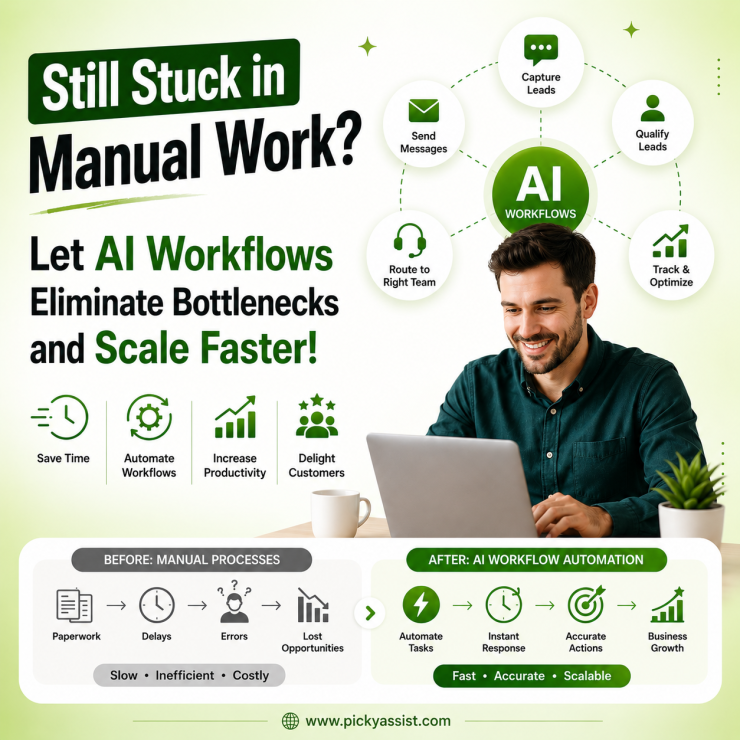
Every growing business eventually encounters the same challenge: operational complexity. As customer enquiries increase, marketing campaigns multiply, and teams adopt more software tools, workflows become fragmented. Employees spend significant time on repetitive tasks, follow-ups get delayed, data becomes scattered, and decision-making slows down. This is where AI workflow automation is changing the way modern organizations operate.
Rather than simply automating isolated tasks, AI-powered workflows can coordinate processes across departments, trigger actions automatically, route information to the right teams, and maintain consistent customer experiences at scale. From lead management and customer support to marketing, sales, and internal operations, businesses are increasingly turning to intelligent automation to improve efficiency while reducing manual effort.
In this guide, we’ll explore what AI workflow automation is, how it works, its practical business applications, and how platforms like Picky Assist help organizations automate customer-facing and operational processes without increasing complexity.
What is AI Workflow Automation?
AI workflow automation refers to the use of artificial intelligence to automate business processes that traditionally require human intervention, decision-making, or repetitive execution. Unlike traditional automation that follows fixed rules, AI can analyze inputs, understand intent, classify information, make recommendations, and trigger appropriate actions based on context.
A workflow may involve multiple steps such as:
- Capturing customer enquiries
- Qualifying leads
- Routing conversations
- Sending notifications
- Updating CRM records
- Assigning tasks
- Triggering follow-up communications
Instead of employees manually performing each step, the workflow executes automatically according to predefined business logic enhanced by AI capabilities. The result is a faster, more scalable operation with fewer bottlenecks.
Why Are Businesses Investing in AI Workflow Automation?
Organizations are under increasing pressure to do more with existing resources. Customers expect immediate responses. Sales teams need faster lead qualification. Marketing departments require personalized engagement. Support teams must handle growing enquiry volumes.
Manual processes often become the limiting factor. Businesses adopt AI workflow automation because it helps them:
Reduce Repetitive Work
Employees spend less time copying data, updating spreadsheets, assigning tasks, and sending routine communications.
Improve Response Speed
Automated workflows can respond instantly, regardless of business hours.
Increase Operational Consistency
Processes are executed the same way every time, reducing human error.
Scale Without Proportionally Increasing Headcount
Workflows can handle significantly higher volumes without requiring additional staff for every growth stage.
Create Better Customer Experiences
Customers receive faster responses, more relevant information, and smoother interactions across channels.
How AI Workflow Automation Differs from Traditional Automation?
Many businesses already use automation tools. However, not all automation is intelligent.
Traditional Automation
Traditional systems operate based on fixed rules.
For example:
- If a form is submitted, send an email.
- If a payment is received, generate an invoice.
- If a ticket is created, notify an agent.
These actions work well but lack contextual understanding.
AI-Powered Workflow Automation
AI-enabled workflows can:
- Understand customer intent
- Categorize enquiries
- Prioritize conversations
- Recommend next actions
- Route requests intelligently
- Trigger personalized communications
This creates more adaptive and efficient business processes.
Components of an Effective AI Workflow
Successful workflow automation typically includes several interconnected elements.
Data Collection
Workflows begin with data from channels such as:
Intelligent Processing
AI evaluates incoming information and determines the appropriate action.
Examples include:
- Lead qualification
- Sentiment analysis
- Intent recognition
- Customer segmentation
Automated Actions
Based on the analysis, workflows trigger actions automatically. Examples include:
- Assigning leads
- Updating CRM records
- Sending reminders
- Creating support tickets
- Scheduling follow-ups
Continuous Optimization
Businesses can monitor workflow performance and refine processes over time.
Practical AI Workflow Automation Use Cases
Customer Enquiry Management
Many businesses struggle with high volumes of customer enquiries arriving across multiple channels. Instead of manually reviewing each message, automated workflows can:
- Capture enquiries instantly
- Categorize requests
- Provide immediate responses
- Route complex cases to human agents
This reduces response times while improving customer satisfaction.
Lead Qualification and Sales Routing
Not every lead is equally valuable. AI workflow automation can:
- Collect qualification information
- Score leads based on predefined criteria
- Route opportunities to sales teams
- Trigger nurturing sequences
Sales representatives spend less time filtering leads and more time closing deals.
Appointment Scheduling
Businesses that rely on consultations, demos, or service appointments can automate scheduling workflows. The system can:
- Capture booking requests
- Confirm availability
- Send reminders
- Follow up after appointments
This reduces administrative workload and missed appointments.
Customer Support Operations
Support teams often spend significant time handling repetitive questions. Automated workflows can:
- Resolve common enquiries instantly
- Provide self-service options
- Escalate unresolved issues
- Update support records automatically
Internal Team Collaboration
Automation isn’t limited to customer interactions. Workflows can also:
- Assign tasks
- Notify departments
- Track approvals
- Manage internal requests
This improves coordination across teams.
The Role of AI Marketing Automation in Customer Engagement
Marketing teams increasingly rely on automation to deliver personalized experiences at scale. While workflow automation focuses on process execution, AI marketing automation focuses on customer engagement and campaign optimization. For example, businesses can:
- Segment audiences automatically
- Trigger personalized messages
- Send behavioral follow-ups
- Nurture leads across channels
When combined with workflow automation, marketing becomes more responsive and data-driven. Rather than manually tracking customer journeys, organizations can create automated engagement paths that adapt to customer actions and interests.
How AI Process Automation Improves Operational Efficiency?
Many operational challenges stem from disconnected systems and manual handoffs. AI process automation helps organizations create structured workflows that connect people, data, and actions. Examples include:
Sales Operations
- Lead capture
- Qualification
- CRM updates
- Opportunity assignment
Customer Service
- Ticket categorization
- Escalation management
- Status updates
Administrative Processes
- Approvals
- Notifications
- Documentation workflows
By reducing manual intervention, organizations improve speed, visibility, and accountability.
Challenges Businesses Face Without Workflow Automation
Businesses that continue relying on manual processes often experience:
Missed Leads
Delayed responses can result in lost sales opportunities.
Inconsistent Customer Experiences
Different team members may follow different processes.
Data Silos
Information becomes scattered across spreadsheets and communication channels.
Limited Scalability
Growth becomes difficult when every process requires manual effort.
Lack of Visibility
Managers struggle to track performance across customer journeys and internal operations. These issues often become more pronounced as businesses expand.
How Picky Assist Supports AI Workflow Automation?
Picky Assist helps businesses automate customer interactions, lead management, team collaboration, and communication workflows through a centralized platform.
Instead of managing multiple disconnected tools, organizations can create structured workflows that connect communication channels, CRM data, automation rules, and customer engagement processes.
Automated Lead Capture
Businesses can automatically collect enquiries from:
- Website forms
- Social media channels
- Other connected sources
Lead information can be organized within a centralized CRM for better visibility and follow-up management.
AI-Powered Chatbot Workflows
Organizations can build chatbot-driven workflows that:
- Respond instantly
- Qualify leads
- Capture customer information
- Route conversations appropriately
This helps reduce manual handling while improving response consistency.
Workflow-Based Customer Communication
Businesses can automate:
- Follow-ups
- Reminders
- Status updates
- Customer notifications
These workflows help maintain engagement without requiring continuous manual intervention.
CRM-Centric Automation
Because communication and CRM data remain connected, teams gain a clearer view of customer interactions throughout the lifecycle. This improves operational coordination and customer experience management.
AI Workflow Automation Best Practices
To maximize results, businesses should follow several key principles.
Start With High-Impact Processes
Focus first on workflows that consume significant time or create bottlenecks.
Define Clear Objectives
Identify measurable outcomes such as:
- Faster response times
- Improved lead conversion
- Reduced manual workload
Maintain Human Oversight
Not every interaction should be fully automated. Complex situations often require human judgment and personalized support.
Monitor Performance Regularly
Review workflow effectiveness and refine processes continuously.
Integrate Systems Strategically
Automation delivers the greatest value when CRM, communication channels, and operational systems work together.
Conclusion
AI workflow automation is no longer a future concept reserved for large enterprises. It has become a practical business capability that helps organizations improve efficiency, reduce manual work, and deliver better customer experiences.
By connecting communication channels, CRM systems, customer interactions, and operational processes, businesses can create workflows that operate consistently and scale effectively.
For organizations looking to streamline customer engagement, automate lead management, improve team productivity, and centralize workflow execution, platforms like Picky Assist provide a practical foundation for building intelligent, automated business processes without unnecessary complexity.
FAQs on AI Workflow Automation
1. What is AI workflow automation?
AI workflow automation uses artificial intelligence to automate business processes, manage repetitive tasks, route information, and execute actions based on contextual understanding rather than simple rule-based triggers.
2. How does AI workflow automation benefit businesses?
It helps reduce manual work, improve response times, increase operational consistency, enhance customer experiences, and support business growth without requiring proportional increases in staffing.
3. What is the difference between workflow automation and AI workflow automation?
Traditional workflow automation follows predefined rules, while AI-enabled workflows can analyze information, understand intent, classify requests, and make contextual decisions before triggering actions.
4. Which business processes can be automated using AI?
Common examples include lead management, customer support, appointment scheduling, enquiry handling, follow-up communications, CRM updates, marketing campaigns, and internal approval processes.
5. How does AI marketing automation relate to workflow automation?
AI marketing automation focuses on customer engagement, audience segmentation, campaign optimization, and personalized communication, while workflow automation manages broader business process execution across departments.
6. What industries can benefit from AI workflow automation?
Industries including healthcare, education, real estate, travel, financial services, ecommerce, professional services, and manufacturing can benefit from workflow automation initiatives.
7. Can small businesses use AI workflow automation?
Yes. Modern platforms make automation accessible to businesses of all sizes, allowing smaller organizations to improve efficiency, customer service, and operational scalability without significant technical resources.
8. How does Picky Assist help with AI workflow automation?
Picky Assist enables businesses to automate customer interactions, lead qualification, CRM updates, communication workflows, chatbot conversations, and follow-up processes through a centralized automation ecosystem.
Add comment